
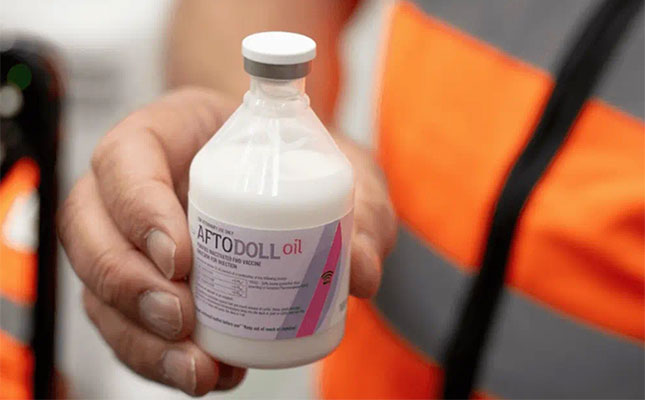
In the Western Cape, a consignment of 100 000 doses of the Aftodoll foot-and-mouth disease (FMD) vaccine arrived at Cape Town International Airport on 10 March, after the Shoprite Group used its company aircraft to urgently transport the vaccines from Gauteng to the province.
The rapid airlift significantly shortened delivery times and ensured vaccination teams could continue their work without interruption.
The Milk Producers’ Organisation (MPO) Western Cape assisted with coordinating logistics, while Dairy Management Consulting and the Western Cape government supported the operation.
The oil-based, inactivated trivalent vaccine is produced by Turkish biotechnology company Dollvet and protects livestock against the SAT1, SAT2, and SAT3 FMD strains. It can be administered to cattle, sheep, goats, and other susceptible animals.
The shipment forms part of a larger national procurement programme that has already delivered approximately 1,5 million vaccine doses to South Africa, with a further six million expected later this month.
Western Cape vaccination campaign expands
The arrival of the latest shipment has allowed vaccination efforts in the Western Cape to continue.
Following a provincial Joint Operations Centre meeting on 9 March, authorities reported that close to 50 000 animals had already been vaccinated in the province as part of the FMD containment strategy.
The campaign is being supported by 29 private veterinarians working alongside state veterinary services, with 276 vaccination sites established across affected areas.
In total, the Western Cape has received 162 120 vaccine doses so far, according to a statement from the provincial government on 11 March. The newly delivered doses will be distributed to vaccination teams operating in the West Coast, Cape Winelands, and Garden Route districts, with deployment coordinated through a provincial ‘war room’, the statement said.
Aftodoll contains an oil adjuvant that boosts immune response. These vaccines are administered in 2ml doses in cattle and should ideally be repeated every six months. While a single dose reduces disease severity and viral shedding, a booster is required to maximise immunity. Oil-based formulations generally provide a longer-lasting immune response than water-based vaccines.
George is a focus area
Despite progress with vaccinations across the province, several areas are still under close surveillance.
The George region remains the main hotspot, as six farms have confirmed cases of FMD, and five more are awaiting laboratory results. Veterinary teams have visited more than 100 farms in the area as part of surveillance and containment efforts.
On the West Coast, FMD has been confirmed on a farm in Kalbaskraal, while neighbouring farms are being investigated for suspected cases. A quarantine zone has been established around the affected farms, and livestock within the area have already been vaccinated. Authorities have also established checkpoints on surrounding roads to control animal movement.
Vaccinations have also taken place in parts of Cape Town, where cattle were vaccinated and goats in the Philippi area given the vaccine after being housed with infected animals.
In the Cape Winelands, vaccination has been completed in Stellenbosch, with teams currently working in the Klapmuts area.
Encouragingly, no confirmed or suspected cases have been reported in the Overberg or Central Karoo districts, where veterinary teams are focusing on awareness campaigns and preparedness training.
Western Cape activates coordinated response
The Western Cape government has implemented a 21‑point response plan to contain the outbreak and limit further spread of the disease.
Measures include strict livestock movement control with continuous border monitoring, strengthened surveillance and traceability systems, and rapid-response veterinary teams operating in affected areas.
Authorities have also erected warning signs along major highways linking the province with neighbouring regions, while additional checkpoints have been established to strengthen movement control.
In a statement released on 11 March, Western Cape Premier Alan Winde and Minister of Agriculture, Economic Development and Tourism Dr Ivan Meyer said the provincial government has mobilised extensive resources to manage the outbreak.
“All of this progress is made possible through collaboration,” Winde said, thanking agricultural stakeholders, including the MPO, the Red Meat Producers’ Organisation (RPO), Milk South Africa, Agri Western Cape, and Shoprite for supporting the response effort.
“We will continue to intensify the response plan to protect this critical sector of our economy. In everything we do, we aim to protect growth, livelihoods and jobs.”
Winde added that he remains in contact with national Minister of Agriculture John Steenhuisen regarding the implementation of a livestock movement permitting system to strengthen containment measures.
In a joint FMD update released on 9 March, Agri Western Cape and the RPO Western Cape urged farmers to remain vigilant, emphasising the importance of carefully managing livestock movement and reporting any suspected cases immediately.
Private sector logistics support vaccinations in other provinces
Industry collaboration is also helping to speed up vaccine distribution in other provinces affected by FMD.
In the Eastern Cape, 152 000 doses of the Dollvet vaccine were released from Onderstepoort Biological Products (OBP) for continued vaccination efforts. Of these, 50 000 have been allocated to dairy farmers.
The vaccines are being transported to veterinary wholesaler VetServ in Gqeberha, where they will be distributed to private veterinarians to support vaccination programmes. The delivery was made possible with the support of Murray Versfeld Managing director of Waikato South Africa of dairy solutions company Waikato South Africa, which sponsored the courier costs required to transport the vaccines from OBP to the Eastern Cape.
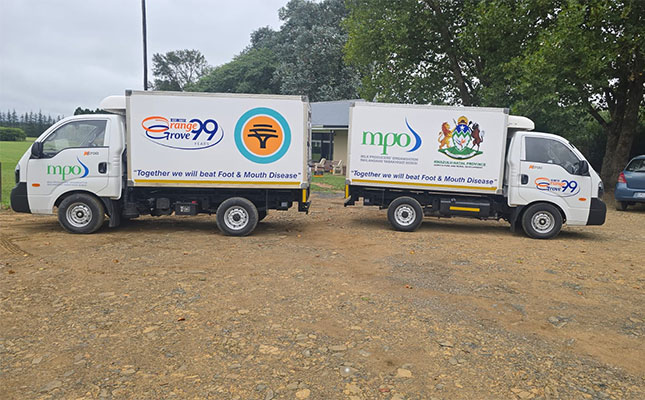
Meanwhile, in KwaZulu-Natal, a truck from Orange Grove Dairy transported 140 boxes of FMD vaccine from OBP, carrying approximately 560 000 doses for the province. Of these, 160 000 have been secured for the dairy industry, with vaccinations prioritised in the districts of uMgungundlovu, Amajuba, and uMzinyathi.