
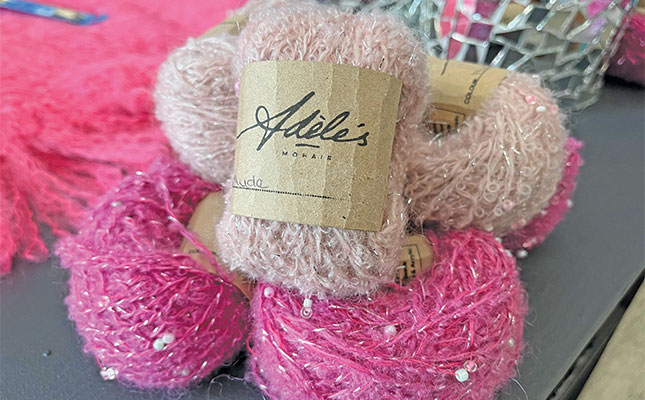
On a stretch of fynbos-rich farmland tucked between East London and Gqeberha, a workshop hums with colour. The air carries the scent of dye pots, the low chatter of rural women at work, and the gentle rustle of brushed mohair drifting in the breeze.
This is Adele’s Mohair: a craft-driven enterprise grounded in South Africa’s proud mohair heritage and in the belief that handmade work still has a vital place in modern life.
Cutten says she founded the business in 1983, and the business has since grown from a solitary experiment with a spinning wheel into a rural craft economy supporting families, developing artisanal skills and celebrating the beauty of South Africa’s ‘noble fibre’.
While the enterprise now sells designer yarns across the country and abroad, its foundation remains unchanged: fibre, colour, creativity, and community woven into a story shaped over four decades.
Cutten’s journey began far from the Eastern Cape coastline. Soon after graduating, she travelled through Scotland and Wales. There she visited woollen mills, watched traditional weaving, and observed the centuries-old production of tweed.
But one encounter shaped her future. On the Isle of Harris, she met an elderly croft dweller, a woman of modest means who, astonishingly, was the now late Queen Elizabeth’s official tweed weaver. This woman collected wool caught on fences, washed and carded it herself, spun it on a wheel older than she was, dyed it with natural pigments, and produced fabrics of remarkable depth and character.
“That old woman sparked my imagination. She never made anything ordinary. Everything she touched had intention and value,” she says.
So when Cutten returned to South Africa, she bought a spinning wheel, set up a makeshift workspace and began teaching herself how to spin and dye.
Her early efforts, she jokes, “belly-flopped, nosedived, resurfaced and swam a little”, but each misstep clarified her vision: a South African studio blending artistry, local fibre, and original design.
A landscape that inspires
Her workshop sits on a 50ha coastal farm just 3km from the Indian Ocean. It is a landscape shape-shifting with seasons, bright fynbos blooms, salt- laced breezes, and sunsets that wash the fields in gold.
“Our land is still in its natural state. It’s a privilege to walk my five dogs every evening and clear my head from the day’s work,” says Cutten.
The farm operates with quiet communal intention. Staff and residents grow organic vegetables, propagate indigenous plants, recycle kitchen waste, and share produce. The bees, birds, butterflies and natural vegetation form part of the workshop’s broader ethic: production that respects its environment.
The workspace itself was once a cluster of old agricultural sheds. Today, it is a vibrant open-air studio where skeins of freshly dyed mohair hang between trees and women sit at long wooden tables sorting fibres, threading beads, spinning and crocheting.
Why mohair matters
South Africa produces half of the world’s mohair, and the Eastern Cape is the heart of the global industry. For Cutten, working with mohair is both a creative choice and a contribution to a local agricultural heritage.
“It’s a truly South African fibre. It takes colour beautifully. It’s shiny, soft, and has a texture that’s different from wool. I was drawn to it because it allowed me to do something unique,” she says.
Proximity to Gqeberha, home to the international mohair auctions and processing mills, made sourcing the fibre straightforward. While she does not buy from individual farms due to the small scale of her own production, she sources from the Responsible Mohair Standard-compliant lots auctioned in the city.
From the beginning, Cutten focused on originality.
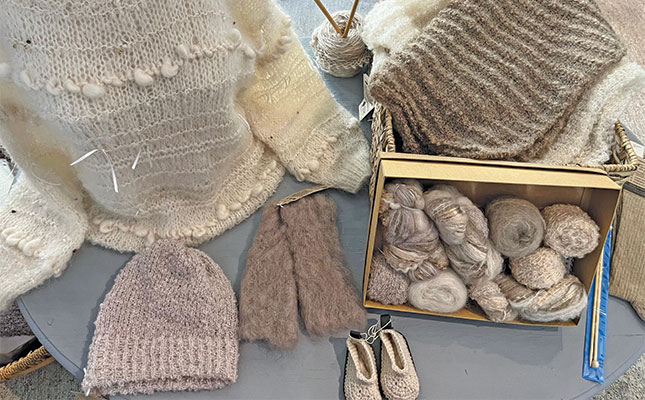
“It started with a simple question: what can I make that a machine can’t?” she says.
This philosophy led to distinctive yarns combining mohair with ribbons, feathers, lace, linen, bamboo, and upcycled materials. One of her most celebrated innovations is bead yarn.
“Beads are part of South African identity. I felt strongly that they belonged in our yarns. It took time to perfect it, but we did.”
Experimentation once filled her kitchen with pots bubbling with onion skins, beetroot pulp and geranium leaves as she tested natural dyes. Her children teased her for smelling like a ‘wicked witch’. Eventually she shifted to EU-approved dyes for environmental consistency and broader colour range.
The workshop team, led by long-serving employee and master dyer Liz Dyakala, now handles an extensive palette developed through years of refinement. Under shaded outdoor work stations, younger women learn the craft from older hands: boiling, blending, dipping and drying fibres in a system where colour is both science and instinct.
“Our workshop feels like a toy store. It’s bursting with creativity and possibility,” she says.
Women at the centre
Cutten has always been rooted in rural women’s labour, skill and resilience. Many of the women employed over the years arrived with little formal education, but with strong hands, strong character and a hunger to learn.
“All the women who work for me are local. Some still live on surrounding farms, others take taxis in every day. Their skill levels vary, and we train them step by step,” she says.
Tasks, such as sorting, spinning, crocheting, dyeing or finishing, are assigned according to ability, and employees are free to develop new competencies over time. Cutten’s manager, for example, is a young woman who first joined Cutten during the holidays when she was still a schoolgirl. Several staff members have also been with the business for more than 20 or 30 years.
Among them is Mavis Bhula, whose daughter now also works in the workshop, and Jeanette Pase, who used her income to educate her child.
“My team is mainly Xhosa women: strong, united, and always standing up. My journey has been learning to respect their culture while building a business that works for everyone,” she says.
Upcycling at the heart of production
Although known for luxurious hand- dyed mohair yarns, Cutten operates with a conscientious production ethos. “Nothing goes to waste,” Cutten explains.
When blankets and scarves are brushed to create softness, loose fibres gather on the brushes. These fibres, called ‘fluff’ are saved, re-spun, and transformed into new yarns.
Dye-lot ends, fibre scraps and offcuts are also reworked into thick-and-thin yarns, textured blends and limited-run batches.
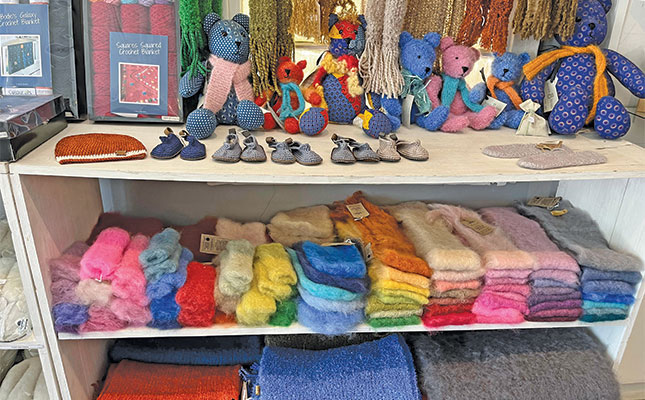
“Every yarn we make has an element of upcycling. There is huge scope to do even more design work with these leftovers,” she says.
This circularity avoids wastage and creates additional employment, as the recycling and re-spinning processes require manual labour.
The Graaff-Reinet connection
In addition to the coastal workshop, Adele’s Mohair runs a small shop in Graaff-Reinet, the historic centre of the global mohair trade. The store opened in November 2020, during a difficult period for South African tourism.
“It’s doing okay. Not at the level we had at the V&A Waterfront before COVID-19, but it still serves a purpose,” she says.
The Karoo shop helps visitors understand the relationship between the region’s farms and the final fibre products, a connection not always obvious to tourists. Farmers support the shop with purchases of practical items like socks, while international visitors often gravitate toward luxury yarns and scarves.
Online shopping
The physical farm shop remains the heart of the business, as selling online is more complicated.
“We have over a hundred colours and many products. Keeping an online store fully updated is difficult,” Cutten says.
A digital revamp is underway, but for now the workshop thrives on direct customer interactions. Fibre enthusiasts arrive to feel textures, compare colourways and browse the racks of skeins drying outdoors.
Trade shows remain one of Cutten’s favourite platforms.
“I meet so many people there. I go to the Yarn Festival in Cape Town, the Winter Festival in Middelburg, and some international shows. That’s where long-term relationships are built,” she says.
Cutten does not worry about competition. “There are very few people doing what I’m doing. If someone copies me, it motivates me to create something new.”
Quality, however, is non- negotiable. “You always strive to make it better. A designer friend once told me that good design is simple. With our limited equipment, we’ve kept things simple but sharp,” she says.
Her products are not cheap, nor do they try to compete with factory-made yarns. Instead, they cater to a niche market that values authenticity, craftsmanship and the story behind each item.
“When someone buys from us, they take home something created from the heart of a very special, talented person,” she says.
Endless possibility
Despite challenges, from political unrest in the 1990s to COVID-19 and economic slowdowns, Adele’s Mohair continues to innovate.
“There is so much scope for design. I just don’t have enough hours in the day. Mohair has endless potential. If the quality is good, people will always respond to it,” she says.
Although industry bodies like Mohair South Africa focus largely on the commercial sector, Cutten is content carving her own path.
“You have to get on with your life and do what you do,” she says.
For her, that means creating beauty from fibre, nurturing rural skills, respecting the land and producing work that machines cannot replicate.
A living craft between land and sea
Back in the workshop, freshly dyed yarns sway gently as coastal winds sweep through.
Women laugh as they work, dogs doze in the shade, and visitors wander between shelves of yarn, touching each skein in search of colour that speaks to them.
This is the world Cutten has spun: one rooted in South African heritage, enriched by rural women’s hands, and animated by the textures of a noble fibre.
“When you buy handmade, you’re buying something created from the heart of a very special and talented person. That’s the soul of our workshop,” she says.
For more information email Adele Cutten at [email protected].