So, you love oysters and have been toying with the idea of starting your own oyster farm. How difficult can it be?
Well, according to Kevin Ruck, the owner of Blue Sapphire Pearls, it is not that difficult at all: “As a matter of fact, it has many similarities with on land production. So, if you can produce vegetables, you can probably produce oysters, although it has its own set of unique challenges,” he grins.
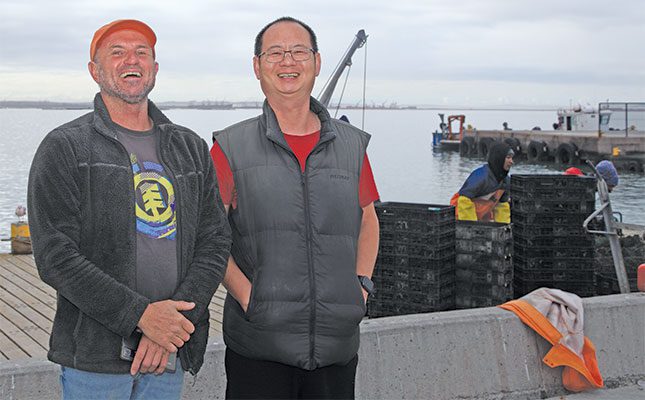
Studying marine biology, as Ruck did, would provide some valuable insights, but it is not a prerequisite for success.
“You do not need to be a marine biologist to make it work, you just need to stick to the basics of production, and navigate quite a few administrative and financial hurdles,” Ruck adds.
Seed stock
Pacific oysters (Crassostrea gigas) are the main species used, internationally and in South Africa, to produce culinary oysters. Introduced to this country decades ago, they are now considered naturalised.
South Africa’s indigenous species are wild harvested, but enabling commercial production would require extensive research and development into the spawning and hatching of these species.
Pacific oysters are also different from the species used to produce pearls (Pinctada maxima). The production of pearl oysters is forbidden in South Africa, because these are invasive, whereas Pacific oysters are not.
Production starts off with juvenile oysters (spat or seed), grown large enough at a hatchery to ‘plant out’. There are three of these hatcheries in South Africa, situated in an estuary in Hamburg in the Eastern Cape, Paternoster in the Western Cape, and Kleinzee in the Northern Cape.
“The hatchery needs to be in a place where the water is calm, as you need to fetch and wash the babies much more frequently than the farmed oysters, which are cleaned and placed into larger baskets to accommodate their growth on a monthly basis,” he says.
Production basics
Ruck prefers to use seed measuring 14mm to 20mm, as this presents lower production risks and is less labour intensive.
“The smaller the oysters are, the more cleaning and attention they require,” he says.
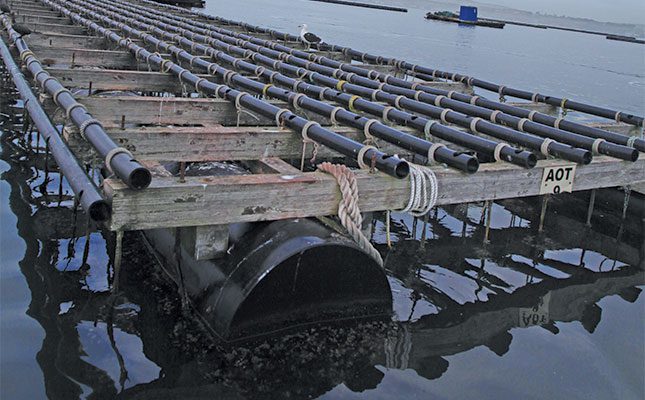
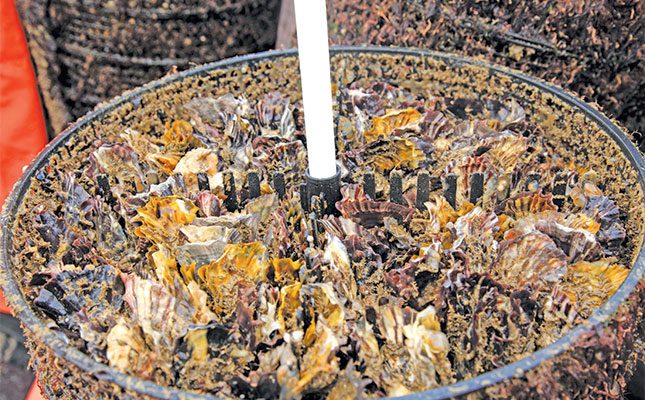
He has been experimenting with different growing bags, baskets and nets, in which the oysters are placed and then suspended in the sea water from floating long lines.
While impressed with baskets, especially for use with small oysters, the lantern nets have proved to be more cost-effective.
“Starting production from scratch would require an investment of a couple of million rands. The baskets alone, are made up of different layers, which altogether cost in the region of R1 300 per basket to make.
“Over and above that, you still need floaters, lines, boats, motors, tanks, and cleaning facilities and must still budget for breakages, repairs, and maintenance,” he says.
He has managed these costs by growing his business organically, as the demand for his products grew on the market and he had money available to do so.
Sustainability
A bonus with oyster production is that they do not require any chemicals or additives to grow, but live off phytoplankton, which they filter from the water.
What’s more, they help clean the ocean. Ruck explains that they are being reintroduced and used to stabilise and improve some areas that have been impacted by pollution and degradation. (Read more about this at shorturl.at/E3E5k.)
“A single oyster can filter 200ℓ of water per day. Oysters used for this purpose, nevertheless, may not be suited for human consumption,” he points out.
In future, oysters’ ability to sequestrate carbon and nitrogen could also allow farmers to earn carbon credits for merely producing oysters, which would greatly improve the financial viability of oyster farming in South Africa.
It takes about eight to 10 months for the oysters to reach market size.
Ruck says that oysters grow slower over the winter months, when the water is cooler and less plankton is available, but they taste better in winter.
“This is a pity, because most South Africans eat oysters in summer.”
Production area
The industry, nevertheless, faces various challenges. Firstly, oysters need to be produced in a natural sheltered bay, rendering only Saldanha Bay in the Western Cape, where Ruck farms, and Gqeberha in the Eastern Cape, suited for production.
Oysters were also produced in Knysna at one stage, but production there has stopped.
There is not enough plankton to justify production, and urbanisation has made the water too polluted to produce oysters for the culinary market.
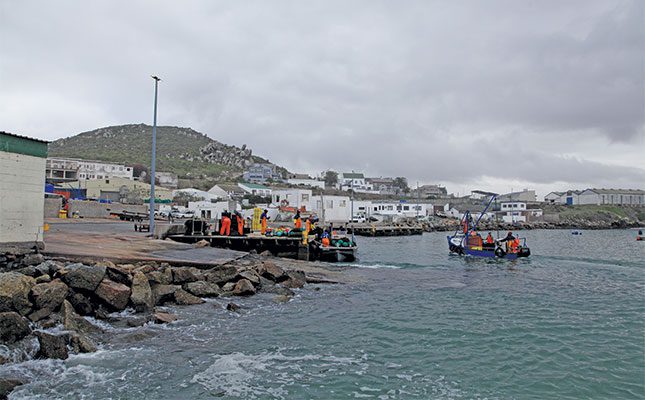
Along with this, prospective farmers must apply for production permits from the Transnet National Ports Authority. Ruck applied for a permit to produce oysters at Small Bay in Saldanha back in 2006 and received approval two years later.
Permits are issued for areas of up to 5ha blocks, with Small Bay now having reached its full 160ha production capacity. Rent amounts to R7 300 per 5ha plot.
“The farmers feel this is excessive given that the costs in all other aquaculture regions around the world are significantly lower.
Market demand
The market for oysters is also limited. Ruck estimates that South Africa produces about eight million oysters per year, amounting to about 600t of oysters. Of this, about six million oysters are produced in Saldanha Bay.
Simultaneously, the local market is only able to absorb around 10 million oysters, which is restricting industry growth.
Gabriel Lee, owner of Salmar Trading, points out that exporting oysters should theoretically help to balance supply and demand.
While Ruck only supplies the local market, Lee has diversified to also export oysters to Asian countries, such as China, Hong Kong and Chinese Taipei. He would have liked to also export to the EU, but so far South Africa has been unable to meet the audit requirements that would go with this.
“Compliance costs are very high when you want to export oysters. Currently, it does not make economic sense because the poor international economy has negatively impacted sales in the East. Supplying the EU might help, but the EU already has strong local producers with whom it would be difficult to compete.”
This was also a problem encountered when government, with good intention, declared an Aquaculture Development Zone (ADZ) in 2018, to stimulate mussel and oyster production, and a caged salmon initiative in the area.
“Aquaculture can be a huge contributor to transformation and is an important generator of job opportunities, in areas like Saldanha, were there are limited job opportunities. I, for instance, employ 19 people and my business has a turnover of less than R10 million. About 55% of our expenses go towards wages,” says Ruck.
For the ADZ, government and the industry invested over R19 million in the establishment of a mussel processing plant and empowerment of small-scale farmers in the region, with currently hardly any of the farmers left.
“There are a number of reasons why the project failed, but I think the biggest is that the community did not give its blessing to the project due to misguided environmental concerns. The result was that the project beneficiaries did not receive commercially viable units.”
“We also need to develop the overseas market or grow the local market to substantially increase local production,” he says.
Lee adds that the development of overseas markets was particularly challenging as it required a lot of government-to-government work and negotiations, before producers could get involved. Having only a handful of producers also meant that they had less clout than big producer organisations.
Potential for growth
Lee thinks that there is potential for growth on the local market, as many South Africans, especially inland, are unfamiliar with oysters, and do not always know how to eat them.
Ruck says that having oyster tanks at restaurants could help with this, but stricter quality control was also necessary to ensure the best possible eating experience with this luxury item.
“Oysters are very much like wine, with the production environment having a huge influence on the quality and the taste of the oyster. Along with this, the cold chain and storage of oysters needs to be managed.
“Nothing beats a fresh oyster from Saldanha. It’s a complete package of wholesome goodness and excellent taste,” he says.
For more information email Kevin Ruck at [email protected].