
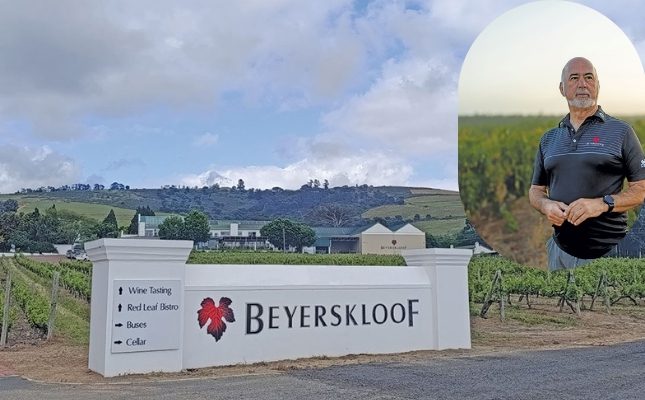
Few people embody their brand quite like Beyers Truter, the charismatic owner of Beyerskloof near Stellenbosch in the Western Cape.
When he speaks, he has a way of making you feel as if you’re the only person in the room – and you can’t help thinking how lucky his winery, and the South African wine industry, are to have such a strong leader and passionate storyteller at the helm.
And to think he was almost lost to the wine industry. After completing military service, Truter wanted to study medicine so he could make a difference in people’s lives. When he wasn’t accepted, he enrolled for a BSc degree with the hope of qualifying for medicine later.
But acceptance required an 80% average, and by his second year, he decided that he “no longer felt like chasing 80% anymore”.
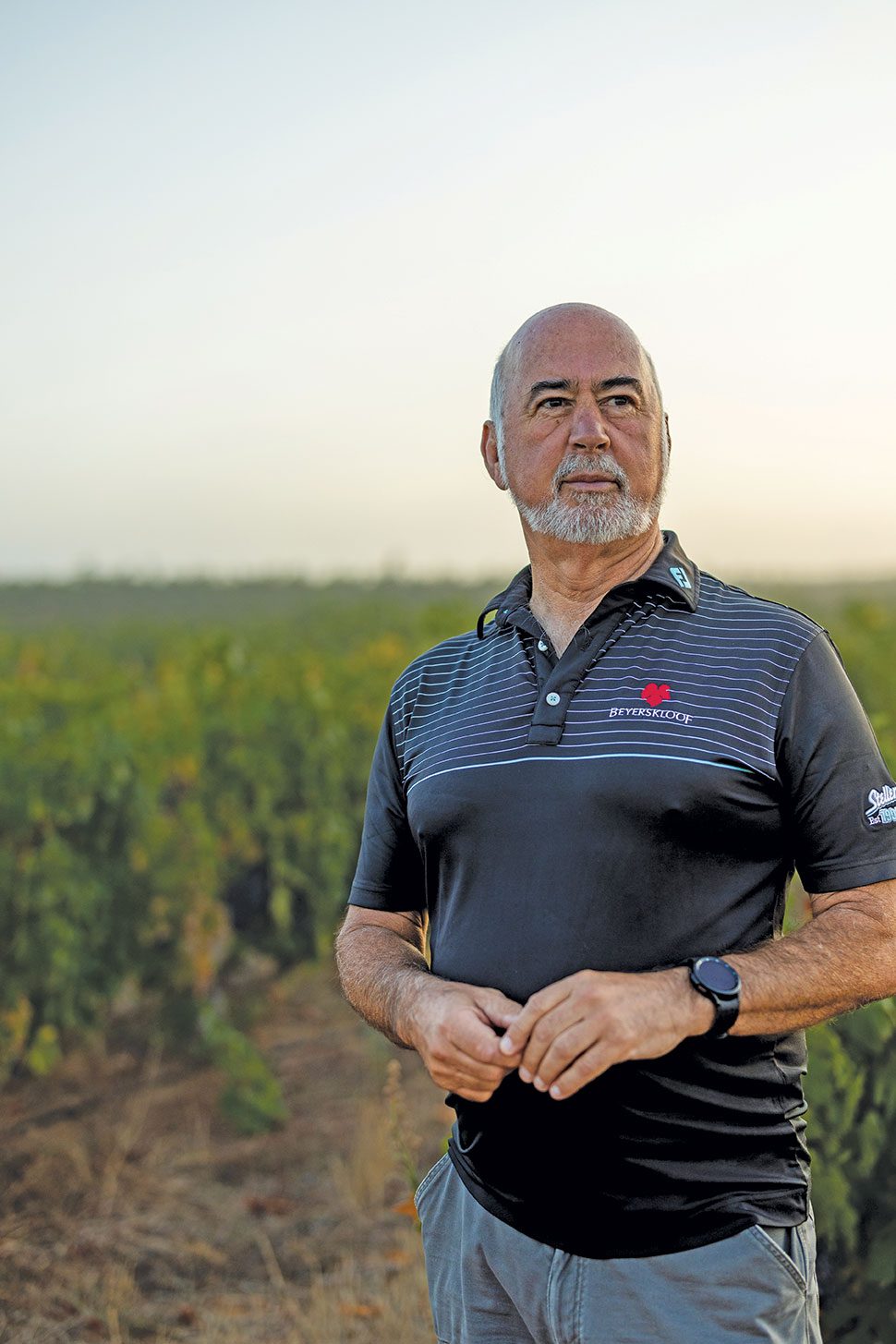
He had always loved red wine and even started his own small collection during his high school days at Jan van Riebeeck in Cape Town. So, he switched to a BSc in Agriculture, specialising in viticulture, oenology and chemistry.
“In those days, we had to do mainstream chemistry. It was difficult and resulted in me taking five instead of four years to finish the degree,” he recalls with a laugh.
During his student years, Truter threw himself into campus life, serving as secretary of the Pieke house committee and running their rugby club.
“I loved my varsity days and learned a lot of valuable skills and lessons through these involvements, especially about administration and giving back,” he says.
Today, Truter uses his success as a wine estate owner to create jobs and improve lives. His farm employs around 70 full-time workers, a number that nearly doubles during harvest season, which runs from pruning in September through to the Cabernet Sauvignon harvest at the end of March.
But Truter’s influence extends far beyond Beyerskloof. He has left an indelible mark on the wider winemaking community, where he is regarded as a legend – primarily for his role in promoting Pinotage and Cape Blends, red wines that typically feature at least 30% Pinotage combined with other grapes such as Cabernet Sauvignon, Merlot and Shiraz.
The journey of Pinotage
Pinotage was developed in 1925 by Prof Abraham Izak Perold, who crossed Pinot Noir and Cinsault. Its early reputation was mixed. Truter notes that the first experimental Pinotage wine was made in 1941 at Elsenburg College, with Bellevue becoming the first estate to win the South African Wine Show with a Pinotage in 1959, followed by Kanonkop in 1961.
The variety, however, suffered a major setback in 1976, when a British wine critic complained that Pinotage “smelled like rusty nails and nail varnish”.
“I was still studying, so I don’t know exactly what the complaint was,” Truter says. “It might be that the British had it in for the South African wine industry, or perhaps something went wrong with some of the exported batches.”
In response to the negative publicity, many farmers uprooted their Pinotage vineyards, while others started making lighter wines or blending Pinotage with other cultivars to win back favour abroad.
Still, a handful of producers – including Kanonkop, Bellevue, Delheim, Spier, Simonsig and Meerendal – remained steadfast in their belief in the grape.
A turning point came in 1991, when Truter won the Robert Mondavi trophy at the International Wine & Spirit Competition with a Pinotage of Kanonkop.
“It was a first for Pinotage, and a second for a South African wine,” he says.
“The publicity was huge. People called me the best winemaker in the world, but it was just the best wine in the world,” he quips.
The potential of Pinotage was reaffirmed in 1993, when international sommeliers and chefs visited South Africa and tasted a wide range of local wines at Kanonkop. “They ended up calling Pinotage ‘red gold’ and the ‘trump card’ of South Africa,” Truter recalls.
Encouraged by this renewed enthusiasm, he launched the Pinotage Association from his office at Kanonkop.
“There were no smartphones or email then. Every invitation had to be faxed or phoned through,” he laughs. “To my surprise, 120 people showed up for the launch meeting. The large turnout was probably due to the wine industry facing a difficult time and farmers being uncertain over the future of Pinotage.”
A united front
Among the early champions was Duimpie Bayly, whom Truter describes as “one of the great icons of the South African wine industry”. Bayly served on the Pinotage Association board from its inception until his passing in 2021.
“Some of the best advice Duimpie gave us was not to respond or pay attention to criticism,” says Truter, “but to stay the course by focusing on producing top-quality wines.”
That steady, forward-looking mindset continues to guide the association’s work today. Its vision is to continuously improve the quality and reputation of Pinotage by supporting winemakers through research, knowledge transfer and collaboration – not only with other producers, viticulturists and cellar teams, but also with farmworkers.
Truter explains that the association invests in both farmer trials in vineyards and cellars as well as scientific research at university level.
“The vision is to create a knowledge base that helps to prevent mistakes and accelerate progress, especially for young winemakers and viticulturists. Each year we invest funds in scientific research, and we always have a university professor serving on our board,” he notes.
Research that had completely changed production practices, for instance, revealed that exposing berries to sunlight early in the season, immediately after berry set, reduced sun damage compared with later exposure. The berries exposed to sunlight also developed more intense flavour profiles than those that were not.
Currently, a strong drive is the evaluation of different Pinotage clones in terms of their resilience, adaptability and disease resistance, as well as their flavour and aroma profiles.
“Currently there are about eight clones commercially available, but researchers have identified a few promising ones from various wine estates. In the EU, some farmers are planting a mix of clones in the same vineyard to add depth to their wines,” he says.
Raising awareness and marketing
The association’s third pillar is promotion, by raising the profile of Pinotage through, amongst others, wine shows, tastings and master classes both locally and abroad.
The results speak for themselves. Over the years, the association has helped lift the overall quality and reputation of Pinotage. “Today, Pinotage is an internationally recognised wine that can compete with any other cultivar,” says Truter proudly.
The improvement in quality has also been mirrored by stronger prices. “Many top Pinotage and Cape Blend wines now retail at around R500 per bottle, with several having crossed the R1 000 mark and even fetching R2 000,” he says.
Also, Pinotage is currently the second-highest paying red variety in South Africa, just after red blends, both in bottle and bulk.
“Research by Dr Jonathan Steyn at the University of Cape Town found that having Old Vines, Stellenbosch or Pinotage on your label could add roughly R390 in value per bottle – proof that Pinotage has truly come of age,” says Truter.
Add a good story to that wine, and, as he puts it, “you’ve hit the jackpot”.
One of his most beloved creations carries exactly such a story. Truter named his top-selling Pinotage after his late dog, Diesel, a loyal Boerboel/Great Dane cross. “Diesel was part of the family, and I wanted to make a wine that echoed his strength, warmth and personality,” he explains.
Only about 12 000 bottles of Diesel Pinotage are produced each year, selling for around R1 200 per bottle, and they are typically sold out within four months of release.
Production and innovation
While there’s been growing pressure from the UK and EU for producers to make wines with lower alcohol levels, Truter says that’s easier said than done with Pinotage.
“The grape only develops its full flavour from about 13% alcohol upwards. Anything below that, and you lose the essence of what makes Pinotage special,” he explains.
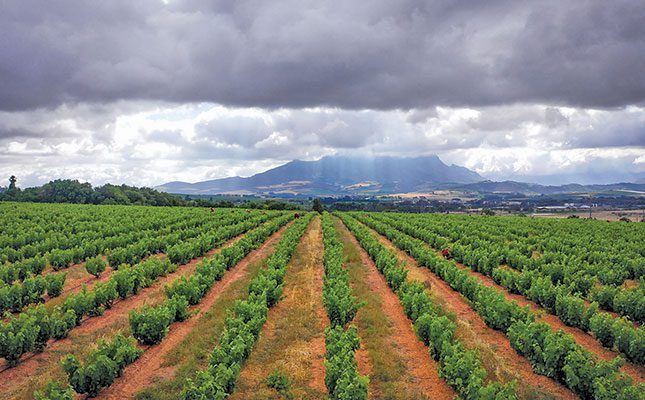
Still, Truter is never one to shy away from experimentation. Last season, he picked Pinotage at 25 degrees Balling and Chenin Blanc at 24 degrees Balling, then pressed and fermented the two together, after which he started to age them in barrels. Truter is excited about the results.
“It is totally different from our white Pinotage Chenin Blanc wine, which is a blend of these two varieties. With the experiment, the Chenin Blanc is surprisingly prominent so far, but we will see the full outcome once the ageing process is finished after 13 to 15 months in the barrel. I hope the experiment allows us to put another variety in the Cape Blend,” he says.
In the coming season, he plans to harvest a small batch of Pinotage early, at around 11% to 12% alcohol, and then ferment it on the skins of riper grapes harvested later at higher sugar levels.
“So far, my attempts to make a lower-alcohol Pinotage haven’t quite worked,” he admits with a grin. “But who knows? Maybe this next trial will open new doors for us.”
Lessons from a lifetime in wine
There are many lessons to learn from Truter’s journey. The first is his unwavering work ethic. Even after buying Beyerskloof, he continued to work as a winemaker at Kanonkop until his own business was firmly established.
The second is his belief in collaboration over competition. “It’s better to share knowledge and lift the whole industry than to isolate yourself,” he says. “Not only because technology and practices evolve so fast, but because it builds a network of friends who’ll look out for you when you need it.”
He emphasises the importance of adapting general advice to local conditions: “You need to be in tune with what is happening in your vineyards and how each season’s climate affects your vines. For instance, Pinotage grapes must be harvested when ripe. Picking too early will hurt quality, while waiting just two days too long can push alcohol levels up dramatically.”
Additionally, he urges producers to draw on expert guidance when establishing vineyards.
“Even something as simple as row orientation can have a huge impact on the final wine,” he explains. “Pinotage planted north-south gets more sun exposure, resulting in riper, prune and blackberry-like flavours, while east–west plantings produce lower alcohol wines with softer redberry favours.”
Finally, he emphasises the importance of matching the right varieties and rootstocks with the right soils, and treating these according to their potential. His top-quality grapes, for instance, are treated much more intensively than those used to produce entry level wines, which sell for about R100 a bottle.
“We will go into the vineyards and remove bunches at veraison (when the grapes change colour) until only one is left per shoot to force all the flavour into that bunch. The average yield of these vineyards is around 4t/ha to 5t/ha, where it is up to 8t/ha to 10t/ha in the vineyards that produce our entry level wines.”
For Truter, Pinotage is more than a grape – it’s a legacy. “It’s part of our South African identity,” he says. “If you respect it, it will reward you.”
Nearly three decades after founding the Pinotage Association, he remains as energetic and curious as ever, still experimenting, still sharing knowledge, and still telling the story of a grape that once divided opinion but now unites a nation of winemakers.
“At the end of the day,” he adds with a smile, “if you can make great wine and good friends along the way, you’ve done something right.”
Email [email protected].