
When he first started carving out his career as an auctioneer, Johan van der Nest was viewed by many as arrogant, a fly-by-night, a scamster, and even a clown.
This was because he did not back down to the then ‘co-operative system’ that dominated the auction industry at the time, and were set in their ways.
He would not conform to the highly regulated style of auctioneering practised in South Africa in the changeover to a free market economy during the 1990s. His swagger and rolling ‘chant’ were frowned upon as inappropriate and ‘too American’.
He was determined and resilient, though, and believed in the change that was needed and the opportunity that was there for the taking.
Today, Van der Nest is not only renowned as one of the best auctioneers in South Africa, but he has also played an instrumental role in the development of beef production in the country through tailoring the improvement of genetics for decades.
Defining moment
Van der Nest began his career in the livestock industry as a loading master and marketing agent with Vleissentraal. From there he left for the US, where he attended the Missouri Auction School in Kansas City. He also spent time working in the auction industry in the US.
“After graduating there I got a job in America with the Minot livestock auction company in North Dakota. This is where my career really started. I then worked with Auction Effertz in the stud stock industry before returning to South Africa.”
Van der Nest returned to South Africa around the early 1990s in a time of turmoil, change and opportunity. At that stage, the South African auction landscape was very different to the US free-trade system due to the constraints of regulatory councils such as the meat and wool boards.
In addition, he had picked up a ‘swagger’ and sense of showmanship that went against the grain of the way in which auctions were managed in South Africa.
He applied for several auctioneering jobs, but was not welcomed into the existing co-operative and corporate-based auction houses.
“I think they thought I was too outrageous, too windgat (arrogant). I was considered a fly-by-night and a scamster at that time.”
He managed to find work at Vleissentraal, as well as doing a stint at PC Verster Auctioneers for about a year. However, Van der Nest believed that change was needed in the way the industry was operating and also saw opportunity amid the chaos at the time.
It was at that stage that he decided to start operating as a freelance, ‘free trade’ auctioneer in line with the experience he’d built up working in the US. Shortly thereafter he was accepted by the livestock marketing company Roderick and Martin, which he describes as the pioneering company of auctions in South Africa.
Despite the perception of him at the time, it was not only Van der Nest that recognised that change was needed; some local producers shared his beliefs.
“There were a lot of progressive farmers and operators in the industry with a lot of foresight [at the time],” he says.
Fast talking
To be a good auctioneer, one needs a natural talent and the right personality, coupled with knowledge of the product that is being auctioned, expertise, integrity and intuition.
“The best auctioneers in the world are born with a natural talent, like an athlete. You need to have the right type of personality to work with people,” says Van der Nest.
He says an auctioneer also has to be quick on his or her feet, with an ability to multitask. This includes reading the crowd, evaluating the
animals, relaying information from the catalogue, keeping track of spotters, counting the calls from the floor, and keeping the momentum going.
“You need to be quick enough in that split-second moment to say something that will stop you from losing the crowd. What distinguishes a good auctioneer is his or her ability to read the room,” he explains.
He emphasises that an auctioneer requires the ‘X-factor’ to work with people while trading, as well as a passion for the industry. Added to this is a level of wit and intelligence.
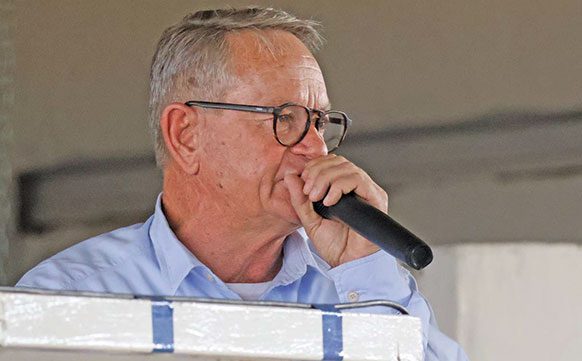
One of the big misconceptions, he says, is that people think auctioneering is all about talking fast.
“You don’t need to be the fastest talker. Clarity is more important. It is about finding a rhythm.”
Van der Nest remembers how, when he returned from the US, the chant style of auctioneering that he had adopted had been entirely different from the norm in South Africa.
“In South Africa they were calling shots, like ‘Ay there’s a sixty, seventy, sixty, seventy, seventy. I was the first to come with this American rolling chant, and initially people discriminated against me, saying I was acting like I thought I was an American. But it caught on over time.”
When it comes to his journey, passion and knowledge were key factors in his career development. He combined elements of the South African and American ways to create his own unique flair.
“To be honest, it was the knowledge I had about genetics, together with the auctioneering, that cracked the way open for me.”
He warns that it is a tough industry to get into, heavily reliant on connections. He says only the exceptional few will get to the top and make a living out of this.
“If you know you don’t have all that it takes to become a top auctioneer, rather try another career,” he stresses.
365 days a year
As an auctioneer, one needs to have vast knowledge of all aspects related to the industry.
“An auctioneer needs to know the product and its value inside-out. You need to be acquainted with all market segments and role players,” says Van der Nest.
When it comes to preparation for a sale, he conducts full genotypic and phenotypic (genetic and visual) evaluation of all animals he will be selling.
“I usually inspect the cattle that I sell the afternoon before the sale.”
He says he is fortunate to have passion and a natural ability for appraising livestock, which translates into innate knowledge of various breeds and bloodlines.
“It is a love that I have [for the livestock] and it comes naturally,” he says.
In addition to becoming familiar with the animals going on sale, his process also includes marketing and reaching out to potential clients and canvassing buyers ahead of the sale.
“I think this contributes quite a bit to my success. I interact with potential buyers before the sale, trying to find out who is looking for what, and I always try to find them what they want.”
He says he is part of the industry 365 days a year, and not just on the day of the auction.
A cattleman by example
Van der Nest’s involvement in the industry has extended to all aspects over the years, ranging from order buying of cattle and transport, to regulatory level engagement for the registration of new breeds in the country, such as the Droughtmaster.
“I have been fortunate enough to have been involved in importing and exporting genetics of many different breeds into and out of South Africa.
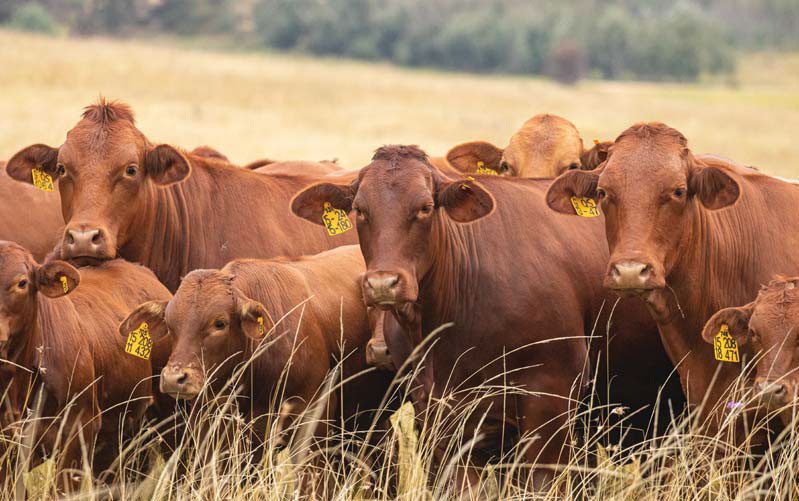
“With my love for genetics, being the architect of breeding cattle is something that gives me great satisfaction.”
Some of the highlights of his career over the years include the export of Brahman and Bonsmara genetics to Australia, and the importing of Boran genetics from both Kenya and Zambia, as well as live Boran imports from Eswatini (formerly Swaziland).
He says he is proud to stand back today and realise that some of the best genetics in several different breeds were produced from herds where he was involved as an owner, co-owner or partner.
“I was involved in huge embryo programmes and we were fortunate to be highly successful in producing some of the best bloodlines and animals in certain breeds.
Standing back, realising that this is a talent that was given to you, makes you feel really humble when you realise the success of what’s been achieved.”
He has also exported genetics of numerous breeds to other beef-producing countries in Africa.
“The market into Africa is open; there are buyers from all over Africa buying up good genetics from South Africa, then it shipping out of the country,” adds Van der Nest.
Droughtmaster
He also introduced the Droughtmaster breed into South Africa in the 1990s.
“I brought it in because I realised the livestock industry was looking for the ideal animal – a functional, efficient, environmentally adapted breed of cattle derived from Bos indicus (Brahman) genetics.”
He explains that the Bonsmara breed at that stage was one of the most successful stories in the bovine industry and had already provided producers with most of these criteria. However, it was derived from Sanga, or Afrikaner, genetics, and his vision was to fill the need for a similar Indicus composite breed.
“I came across the Droughtmaster breed in Australia and I realised they could play a pivotal role in the [South African beef] industry.”
He says he had realised that the big variation in the existing composite Indicus-derived breeds could be combined by introducing a breed like the Droughtmaster with its strong prepotency and desirable traits to develop a red Indicus composite, which would suit the Southern African environment and all requirements of the beef industry.
Van der Nest is thrilled at the success of the breed so far, saying it is the fastest growing breed in the country. The first animals were introduced in the 1990s, but it took a lot of effort to finally get it registered as a breed. He says the registrar only recognised the Droughtmaster as a breed in South Africa in December 2023.
Since then, it has grown to boast a registered cow herd of more than 15 000 animals.
“The Droughmaster is exceeding my own, and industry expectations by far,” he says.
Auctions as a platform for trading genetics
Van der Nest says breeders have been improving genetics for decades by making sound mating decisions. This has made the industry more competitive.
“Buyers are more selective, and especially in the stud stock industry, we have made huge strides in improving the genetics in the country.”
He says the bottom line for breeding cattle is to produce beef. He describes the commercial cow herd of the world as the factory for beef production.
“I am a farmer and a breeder in addition to being an auctioneer, and over the years we have been breeding cattle to adapt to the natural environment and make a profit there.”
The selection of cattle is approached by evaluating the performance data, pedigree and estimated breeding values of an animal on paper. This is combined with the visual appraisal of animals, and then coupled to achieve the desired outcome of such a breeding programme.
He says the industry has changed for the better over the years because producers have selected more for genetics, creating more functional, efficient cattle that fit the requirements for the industry better than in the past.
He says producers have made great strides in preparing and presenting their animals for auctions. They use all forms of advertising, including social media and online platforms, to promote and market their animals.
Online platforms make a great contribution to the actual auction these days. A potential buyer can bid on cattle from anywhere around the globe, removing challenges that previously existed, such as biosecurity and health factors.
In his opinion, the only challenge that exists for a prospective buyer is to get the animals evaluated by a professional selector.
Van der Nest says we have ‘immaculate’ cattle genetics in South Africa. “It (genetic development) is progressive, it’s evolving and it is just going to get better and better.”
Responsibility to clients
Whether you are talking about a buyer or a seller, Van der Nest is adamant that it is never the client who makes a mistake. It is the role of the auctioneer to fulfil the needs and expectations of both parties, responsibly, and with integrity.
He says people skills are crucial. “You need to have the personality to engage with people in all different ways, to treat them as if they are the most important, and convince them that you want to satisfy their needs. You have to be professional and treat all your clients accordingly.”
Knowledge of the product and of the industry as a whole is critical, coupled with intuition.
“You have to be able to read the crowd and try to keep everybody’s attention. It is difficult to describe; it is something that comes naturally.”
He says when he is standing up on the rostrum, he knows that he has been employed by somebody who has entrusted him with their entire investment.
When conducting an auction, Van der Nest says it’s important to realise that the seller has placed their complete trust in you.
He says one must realise that an auction is the ‘harvest day’ for many livestock breeders.
“It is crucial for an auctioneer to realise that you are a partner of the consigner on whose behalf you are acting. The responsibility of the success for the execution of an auction rests solely upon the auctioneer on the day,” he says.
Mantra in life and work
“Think, criticise, but find a workable solution.”
This is the philosophy on which Van der Nest has built his life and his career, and it still rings true today.
“You can throw any challenge at us [producers in the industry]; it might be COVID-19 or foot-and-mouth disease, but we always come up with a workable solution.”
Van der Nest says this is what has helped him get to where he is today, because no challenge is too big once you think about it, dissect it and find a solution.
He says it has not always been an easy journey, with challenges and opposition from many established industry role players. He had to stay true to his vision and often needed a thick skin.
“I think I just happened to be the right guy at the right time, and I knew the industry had to change,” he says.
Today, as he is on the crest of his career at the age of 65, Van der Nest says it has been a journey of blessings, success and gratefulness.
“My appreciation goes back to the people: support of people in the industry, farmers, breeders, agents, and auctioneering companies.
“My life has been a blessed one and I am pleased to have contributed and to be a part of this great industry.”
He is upbeat about the future of the beef industry and agriculture as a whole.
“South Africa has some of the best farmers, best breeders and best auctioneers in the world. We have learnt through ingenuity and experience.
“The future belongs to those who want to conquer,” concludes Van der Nest, with a glint in his eyes.