
For years, South Africa was a net importer of soya bean oilcake. Investment in local pressing facilities and infrastructure has changed this, enabling the country to start exporting the oilseed.
The local soya bean industry has seen remarkable growth and productivity, reflecting farmers’ shift to crops that improve rotations and long-term soil health. Wider availability of improved cultivars, new technologies, and adapted field practices have boosted yields, profitability, and sustainability. Farmers have expanded plantings and achieved record yields.
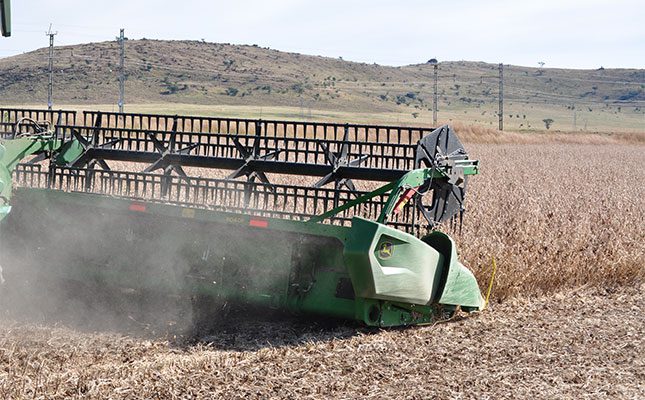
The impact was clear in this year’s Grain SA Grow for Gold National Yield Competition, where soya bean entrants achieved exceptional yields across both irrigation and dryland regions. Three yield records were broken, including one surpassing the previous record by more than 1t/ha.
Not long ago, yields of 7t/ha seemed unattainable, yet today the productivity benchmark keeps rising, with a dryland entry reaching 7,12t/ha in one category.
Soya bean yields increased in the 2024/25 season, from 1,61t/ha the previous year to 2,39t/ha. Although the national average remains below competition levels, Andrew Bennett, CEO of the South African Cultivar and Technology Agency, told Farmer’s Weekly that adoption of new varieties and technologies (Intacta) is increasing, and he expects the average yield of 2,5t/ha to continue rising.
These trends indicate that the industry has cemented its role as a key contributor to South Africa’s agriculture and agro-processing sectors, while also enhancing its competitiveness in the global oilseed market,” Bennett added.
According to Corné Louw, head of applied economics and member services at Grain SA, these achievements are a testament to producers’ determination and adaptability, as well as a celebration of the science behind cultivar development.
Steady growth expected for 2025/26 season
The Crop Estimate Committee’s (CEC) ninth production estimate expects 1,18 million hectares to be planted to soya bean in the 2025/26 season, 28 200ha more than in 2024/25.
“Although it seems marginal, this increase reflects consistent growth, driven by higher profitability and strong demand from regional processors,” Louw said.
Juan-Pierre Kotzé, manager of research and projects at the South African Cereals and Oilseeds Trade Association, said the marketing season began with some uncertainty around crop sizes, particularly for soya beans and maize.
“The first CEC production estimate, published on 27 February 2025, put soya bean production at 2,33 million tons, while the latest estimate forecasts 2,75 million tons, which is an 18% increase,” Kotzé noted.
He added that this represents roughly 900 000t, or 49%, more than the previous season, which was severely affected by drought. Compared with the record 2023/24 crop of 2,77 million tons, this season’s crop is expected to be only 17 000t smaller.
Possibility of another record crop
Looking ahead to 2026, Kotzé noted that although intentions to plant show only a 2% year-on-year increase, it marks the seventh consecutive year of growth, with a 27% rise in hectares over the past five years.
“With improved cultivars and more efficient planting, South Africa could see another record soya bean crop—potentially reaching three million tons if average yields hit 2,55t/ha,” he explained.
He added that in the 2023/24 season, exports totalled nearly 600 000 t, of which 560 000 t were deep-sea shipments.
“In the current season, cross-border exports of whole soya beans amounted to 110 325 t between March and September 2025,” Kotzé said.
Kotzé added that the latest National Agricultural Marketing Council (NAMC) supply and demand publication estimates project exports of 300 000 t, leaving South Africa with an ending stock of 405 000t, compared with 320 000t after the record 2023/24 crop.
- According to Louw, total available supply for the season was revised to an estimated 2,9 million tons. By week 30 of the 2025/26 marketing season, commercial producers had delivered around 2,7 million tons, which was 822 037t more than at the same point in 2024/25.
“Total exports of whole kernels for the coming season are estimated at 300 000t, driven by higher local milling demand. Total demand for the production of oil and oilcake is estimated at 1,97 million tons,” he said.
Regarding expectations for the next season, Marguerite Pienaar, agricultural economist at Grain SA, said much will depend on rainfall and current plantings. With a La Niña pattern developing and wider adoption of new varieties and technologies, yields are expected to be strong.
“We could see average soya bean yields exceed 2,5t/ha for the first time. Coupled with high planting intentions, supply may surpass demand, which could put pressure on prices,” she said.
Bennett added that, given potential price pressure, it will be essential for farmers to manage input costs carefully.
He added that with increased supply, more soya beans will be available for crushing, giving farmers additional options beyond selling raw beans.
Upcoming challenges
Looking ahead, Bennett warned that a significant rise in harvest volumes could strain domestic storage and transport, making efficient crop movement essential.
Louw noted that the SAFEX soya bean price is currently about R400/t above the US export parity and in line with Brazil’s.
“The export parity for March 2026 at Durban currently stands at R7 433/t,” he said.
Based on this, Bennett said there could be three likely ‘price bands’ for farm-gate soya bean prices:
- Low-yield scenario: weak export demand and strong supply could push prices to between R5 500 and R6 500/t, leaving farmers with tight margins.
- Base or mid-scenario: average yields, expected domestic supply, and moderate demand could result in R6 500 to R7 500/t, providing acceptable to good margins.
- Upside scenario: average to high yields, strong global demand, or an export surge, and a strong local currency could lift prices to between R7 500 and R8 500/t, giving farmers good margins.
According to Agbiz’s SA Agri-market Viewpoint released on 8 December, the 2025/26 oilseeds marketing year began at the start of March 2025. “In the first 39 weeks, soya bean producer deliveries totalled 2,69 million tons, accounting for 97% of the expected harvest of 2,77 million tons,” the viewpoint stated.
Kotzé added that whole soya bean exports to Eswatini began around September 2024, following the opening of a crushing plant. Since then, an average of 2 500 t has been exported monthly, although exports of soya bean meal have decreased.
He also explained that exports of whole soya beans to Zimbabwe were relatively low between March and June 2025, not exceeding 6 000 t per month and totalling 19 747 t for the first four months.
Since July 2025, exports to Zimbabwe have risen notably. According to the South African Grain Information Service, some 69 556t were exported between July and September 2025, exceeding 20 000t per month.
Kotzé noted, however, that reports indicate the local crushing industry in Zimbabwe has reduced soya bean meal imports to protect domestic production, which has in turn boosted whole soya bean imports.
According to the NAMC, despite the positive developments in the local soya bean industry, several critical obstacles could limit its growth potential.
In commentary by Thandeka Ntshangase, grain specialist at the NAMC, she highlights the following challenges confronting the industry:
- Unpredictable rainfall patterns
- Fluctuating temperatures
- Frequent seasonal droughts
- Tight profit margins
- Rising input costs for improved seed varieties, fertilisers, fuel, and irrigation
“Making matters worse are the structural barriers related to logistics and market access, especially due to inefficiencies in road and rail transportation, inadequate rural infrastructure maintenance, and inefficiencies at ports like Durban,” she noted in the report.
Kotzé said the key question is whether South African port facilities can handle soya bean exports. A strong soya bean crop would likely coincide with a good maize crop, raising the possibility of another strong maize export season as well.
On a positive note, the expanding feed and poultry industries will continue to support demand for soya bean meal, boosting the crop’s contribution to national food security.
According to Louw, the industry’s success goes beyond high production levels, reflecting efforts to improve processing efficiency, reduce reliance on imports, and promote self-sufficiency in the oilseed value chain, while also supporting the livestock sector.
Email Andrew Bennett at [email protected], Corné Louw at [email protected], Juan-Pierre Kotzé at [email protected], and Wandile Sihlobo at [email protected]. Visit sagis.org.za.