
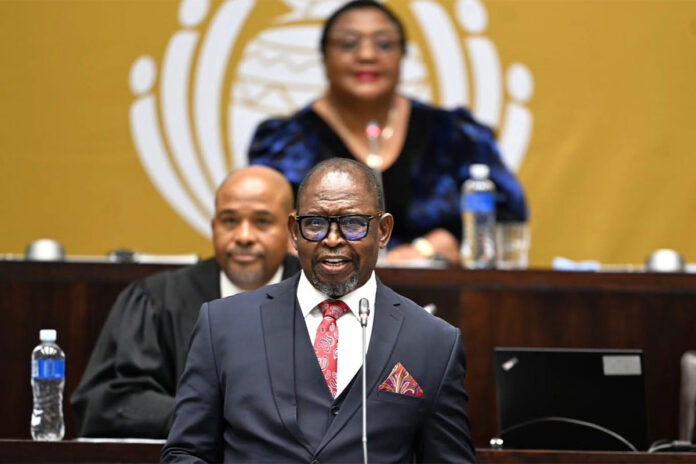
South African agricultural organisations have welcomed key measures in Finance Minister Enoch Godongwana’s 2026 Medium-Term Budget Policy Statement (MTBPS), including temporary fuel levy relief, additional funding for agricultural extension officers, and infrastructure investment.
However, they stress that effective implementation and accountability will be essential to addressing rising costs and climate risks.
Tabled in Parliament on 21 October, the MTBPS revised South Africa’s projected economic growth for 2026 down from 1,6% to 1,2%, owing to global uncertainty, including the Middle East conflict and its impact on oil supplies, energy, and food prices.
“A prolonged conflict in the Middle East, alongside El Niño and its likely impact on producer costs and output, could further weaken domestic growth,” Godongwana said in his speech.
The outlook raises concerns for the 2026/27 agricultural production season, with potential drought conditions threatening crops, livestock, and grazing.
In a press release, Agbiz described the budget as balanced, addressing several priorities for agriculture and agribusiness.
TLU SA called for greater accountability to ensure public spending delivers results, while AgriSA welcomed the fuel relief and allocations for infrastructure rehabilitation and foot-and-mouth disease (FMD) vaccine procurement, emphasising the need for sustained investment.
In his official commentary, Frank Blackmore, lead economist at KPMG South Africa, welcomed the increased R10 billion contingency reserve and additional funding for agricultural extension officers, saying these measures could help farmers manage climate risks and reduce the threat of a food crisis.
Fuel relief offers some breathing room
One of the most immediate measures for agriculture is the reduction in the general fuel levy relief.
From 4 November to 1 December 2026, the levy will be reduced by R3/ℓ for diesel and R1,50/ℓ for petrol. The reductions will then be scaled back to R1,50/ℓ for diesel and R1/ℓ for petrol until 5 January 2027.
For farmers, the relief comes as the production season gets under way and fuel is needed to run tractors other machinery, and to transport inputs and agricultural products.
According to Agbiz CEO Theo Boshoff, the impact extends beyond the farm gate, as agricultural businesses depend heavily on road transport to move food and other products across the country.
“About 80% of South African agricultural products are transported by road,” he said.
Lower fuel costs could, therefore, ease pressure across the agricultural value chain, from producers and processors to distributors and retailers.
“It’s an important intervention to ease pressure on agricultural production costs and food prices,” AgriSA CEO Johann Kotze said in a statement.
He added that the timing was particularly important as farmers prepared for the summer grain planting and summer fruit production seasons.
“Against this backdrop, the fuel relief is particularly welcome. Diesel is a major input across agricultural operations and the entire food system. The intervention will provide much-needed relief at a time when farmers are making critical production and investment decisions,” Kotze said.
However, the relief is temporary, while many of the costs facing farmers are ongoing.
While, TLU SA welcomed the intervention, particularly the diesel price reduction, the organisation warned that they relief could not make up for years of deteriorating infrastructure, inefficient logistics, and rising operating costs.
General Manager Bennie van Zyl said commercial farmers were largely price-takers, meaning they generally have limited influence over the prices they received for their products. Therefore, they could not simply pass every increase in fuel, transport, and other production costs on to consumers.
“For years, we’ve been asking what actually happens to taxpayers’ money. [Minister Godongwana] has now acknowledged that substantial infrastructure funding has been spent without delivering the intended results. The question is why this was allowed to continue and what consequences there will be for those responsible,” he said in a statement.
EL Niño raises concerns for the coming season
Godongwana announced that government’s contingency reserve had been increased to R10 billion to respond to potential risks, including the effects of El Niño.
However, the reserve is not a dedicated allocation to agriculture alone, and support for affected farmers will depend on how the risks are assessed and the available resources allocated.
In his commentary, Blackmore described the increase as positive, proactive step because it made funding available before the full effects of a potential drought were felt.
“If it turns out that the El Niño phenomenon is not as bad as [we] previously thought it may be in its impact on the agriculture sector, this funding can always be reallocated to other sources,” he said.
Agis chief economist Wandile Sihlobo also welcomed the increased reserve, warning that that El Niño-related drought could make the 2026/27 season difficult for the sector.
“The Department of Agriculture, among others, will need to closely assess the impact of El Niño in the sector in 2027 and tap into these resources to help the most affected farmers in the sector,” he told the media.
According to Kotze, the effects of drought could extend beyond lower crop yields. Farmers could face higher costs for feed, irrigation, and other inputs, while livestock producers could struggle with declining grazing and water availability.
He said the anticipated climate risks, combined with high input costs, made dedicated investment in climate resilience and El Niño preparedness increasingly important.
“The challenge will be to identify vulnerable regions and producers early enough for assistance to make a meaningful difference,” he said.

Extension services could support new farmers
The MTBPS also provides an additional R1,5 billion over three years for the hiring of agricultural extension officers.
Extension officers provide technical advice, help farmers improve production practices, and assist them in addressing operational challenges. Their support can be particularly valuable to emerging farmers who may lack access to private agricultural advisers, financial resources, or established farming networks.
“As South Africa releases more state land and refocuses on the implementation of the Agriculture and Agro-processing Master Plan, we also need to increase the capacity to assist the new-entrant farmers,” Sihlobo said.
Blackmore said additional funding for extension services could help address skills shortages and provide crucial support to farming communities.
“I think both of these steps [fuel levy relief and hiring extension officers] are good at focusing on alleviating pressures in the agriculture sector and ensuring that we don’t get into a food crisis in South Africa as a result of either weather conditions or the lack of skills in this case,” he said.
Van Zyl also acknowledged the extension funding but said its value should be measured by the practical support delivered to producers, rather than the amount announced.
He said Godongwana’s speech did not include a specific new allocation for critical concerns such as FMD control or rural safety.
Kotze, however, highlighted the R183 million carried forward for FMD vaccine procurement in the Adjusted Estimates of National Expenditure.
While welcoming the allocation, Kotze warned that FMD remained a major threat to livestock production and export markets. He said a sustained, properly funded vaccination and biosecurity programme was needed, rather than continued reliance on emergency interventions.
The organisations also questioned how effectively additional policing resources would benefit farming communities.
The MTBPS provides R810 million in 2027 to recapitalise the South African Police Service vehicle fleet. TLU SA said the investment would need to be assessed against improvements in operational policing and the protection of rural communities.
Infrastructure spending must deliver results
The organisations emphasised that reliable roads, water, electricity, and facilities for handling and distributing produce are essential to agriculture. Poor rural roads can delay deliveries and damage vehicles, while unreliable water and electricity supplies can disrupt production and increase costs.
In view of these challenges, Agbiz CEO Theo Boshoff welcomed the increased focus on infrastructure and municipal performance.
“Many of our members continue to face constraints in business activity and rising costs because municipalities fail to be effective. We also clearly see such failures with fresh produce markets that need improvement across our country,” he said.
The findings of the Infrastructure Conditional Grant Review – commissioned in October 2025 – announced by Finance Minister Enoch Godongwana during the MTBPS, highlights the scale of public investment in infrastructure.
He said between 2017/18 and 2023/24, national government transferred R887 billion through infrastructure conditional grants to provinces and municipalities.
Despite this substantial investment, projects were often delayed, left incomplete, or failed to deliver their intended benefits.
According to Van Zyl, the findings raise questions about financial management and accountability.
“Government cannot keep referring to economic growth as a priority while the conditions necessary for growth remain inadequate. Entrepreneurs and farmers create economic value when they can operate profitably and with confidence. That confidence cannot be created through budget announcements alone,” he said.
Godongwana said government was reforming the infrastructure grant system to strengthen planning, accountability, and oversight. He also emphasised the need to maintain existing infrastructure rather than focusing only on new projects.
“Every maintenance project deferred today becomes a larger repair bill tomorrow,” he said.
AgriSA also welcomed R242 million in additional funding to rehabilitate flood-damaged agricultural infrastructure and R1,46 billion for the rehabilitation of flood-damaged national and provincial roads.
Kotze said the roads were vital to agricultural logistics and market access.
“However, infrastructure investment needs to extend beyond disaster recovery. Reliable roads, water systems, and logistics networks are essential to lower production costs, attract investment, and expand agricultural exports,” he said.
Growth remains the bigger challenge
Despite signs of improved fiscal stability, Godongwana said the economy was still growing too slowly to create enough jobs and meaningfully reduce poverty.
He said the budget deficit was expected to narrow to 3,9% of GDP in 2026/27, compared with the 4% forecast in February 2026.
He also reported that the debt-to-GDP ratio had stabilised at 78,4% in 2025/26 and was expected to decline over time.
Economic growth is forecast to reach 1,6% in 2027 and 2% by 2029.
Van Zyl said the growth outlook was insufficient to address unemployment, poverty, and the country’s dependence on public finances, adding that sustainable growth required policy certainty, protection of private property rights, functioning infrastructure, and an effective security environment.
For agriculture, temporary fuel relief and additional public spending are among the measures intended to ease immediate pressures, while longer-term growth will depend partly on the conditions in which farms and agribusinesses operate.
Kotze pointed to the sector’s contribution to the economy, saying that agriculture had grown by an average of 3% annually since 2012, compared with 1% for the broader economy.
He said sustaining that performance would require targeted investment in biosecurity, infrastructure, and agricultural finance to unlock further investment, employment, and exports.
“The MTBPS provides welcome short-term relief, but agriculture’s long-term contribution to economic growth, employment, and food security depends on sustained investment in the systems that support production,” Kotze said.
While the budget offers some support through fuel levy relief, agricultural extension funding, and the increased contingency reserve, the organisations all agree that the coming season will test how effectively government responds to climate risks and whether infrastructure funding translates into improvements for producers.
“Every rand spent must contribute towards a functioning country and a growing economy. Agriculture needs reliable infrastructure, safety, and an economic environment in which producers can remain profitable. Ultimately, the success of this budget will be determined not by what was announced today, but by what actually changes on the ground,” Van Zyl said.