

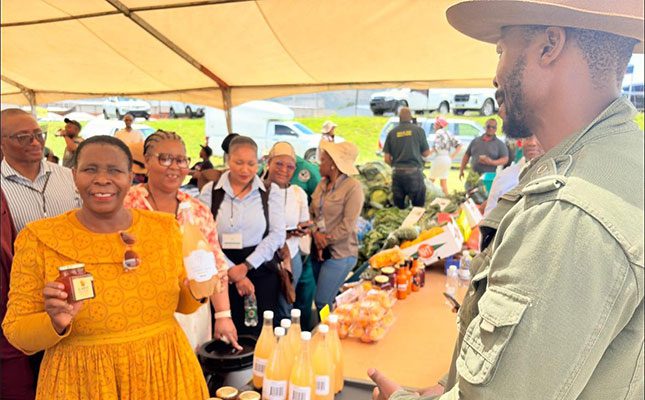
The show, held on 27 November in Komani, marked the third instalment in a provincial effort to revive historic agricultural exhibitions as functional platforms for farmer development and market access.
The initiative began with the Amathole-BCM Agricultural Show on 17 June followed by the OR Tambo District Agricultural Show on 10 September, and has continued to grow by bringing together exhibitors and local municipalities across the Eastern Cape.
Speaking to Farmer’s Weekly on the day, Eastern Cape MEC for Agriculture Nonceba Kontsiwe said the quality of the exhibits stood out immediately. She added that the livestock and crop displays reflected improved production standards, despite many farmers operating in resource-constrained environments.
“It was impressive to see the high quality of livestock, produce, as well as the agro-processing elements in this instalment of the show.
“It was also pleasing to see the high turnout of farmers across municipalities, even those from impoverished areas, coming through to put on classy displays,” she said.
Kontsiwe added that the event reaffirmed the need for a provincial model that places agro-processing at the centre of rural economic development, particularly in the Chris Hani District where untapped potential still exists.
The participation of agencies such as the Eastern Cape Development Corporation (ECDC) and the Eastern Cape Rural Development Agency allowed officials to assess the support needs of smallholder farmers more accurately.
“The presence of these agencies was important for seeing what needs to be done,” she explained.
Reviving a provincial tradition
This year’s agricultural shows form part of the Eastern Cape’s broader campaign to revive once-prominent farmer exhibitions that historically connected producers to buyers, markets, and support programmes.
For many attendees in Komani, it was the first time they had showcased their enterprises outside their municipalities, and Kontsiwe said this exposure is crucial for rural producers often working in isolation.
“Most of our farmers are from rural areas; they are scattered and working in silos. This serves as a bridge for rural farmers to connect to urban farming. It is the only platform where they come together to share ideas, network, and expand their contact base,” she explained.
She added that the provincial Department of Agriculture (the department) has already profiled participating enterprises from all three shows and identified those that require support to transition into the commercial space.
She confirmed that the department will soon announce the first cohort of farmers who will receive infrastructure, capital investment, or machinery to scale their operations.
Bankable opportunities identified
The ECDC used the Komani event to evaluate market-ready enterprises, promote funding instruments, and speak directly with producers.
Rufus Nayo, ECDC Regional Manager for Buffalo City and Amathole districts, said the show displayed clear signs of commercial potential across the Chris Hani and Joe Gqabi districts.
He added that the interactions confirmed that smallholder farmers in these districts are capable of supplying formal value chains if the right investment is unlocked.
“From an ECDC perspective, the show confirmed there are real, bankable opportunities for smallholder farmers in the Chris Hani District, especially where they organise around value chains rather than operating in isolation,” Nayo said.
He explained that many farmers continue to sell raw products despite strong demand for processed goods, highlighting immediate opportunities for small-scale plants in meat and dairy processing, milling, fruit and vegetable drying, and wool washing.
Nayo added that retailers, abattoirs, and processors at the show had shown strong interest in exploring potential partnerships with organised farmer groups. He said this created a favourable environment for developing off-take agreements that offer stable markets rather than once-off sales.
Another need that emerged during engagements was the lack of shared infrastructure for storage, aggregation, and logistics. Nayo said the district would benefit significantly from collection points, cold rooms, storage facilities, and mechanisation support, which would help reduce farmers’ production costs and improve consistency for buyers.
He added that the show also revealed increasing interest from women and youth farmers in technology-enabled production, such as climate-smart irrigation systems and digital platforms for market access, which could create new opportunities for blended-finance support.
Partnerships driving inclusive growth
Nayo said the show’s strong turnout demonstrated the value of cooperation between government, development finance institutions, and the private sector. He emphasised that inclusive agricultural development cannot be driven by a single institution and requires practical, on-the-ground collaboration.
“Today’s strong turnout and active engagement sent a very clear message that no single institution can drive inclusive rural and agricultural development alone,” he said.
Nayo added that government departments provided policy direction, extension support, and coordination; private companies offered investment and market access; and institutions like ECDC played an intermediary role by de-risking projects, structuring finance, and ensuring that partnerships benefit smallholder farmers.
He described the event as a practical example of public-private partnerships shifting from policy documents to real engagement with producers.jjjjj




