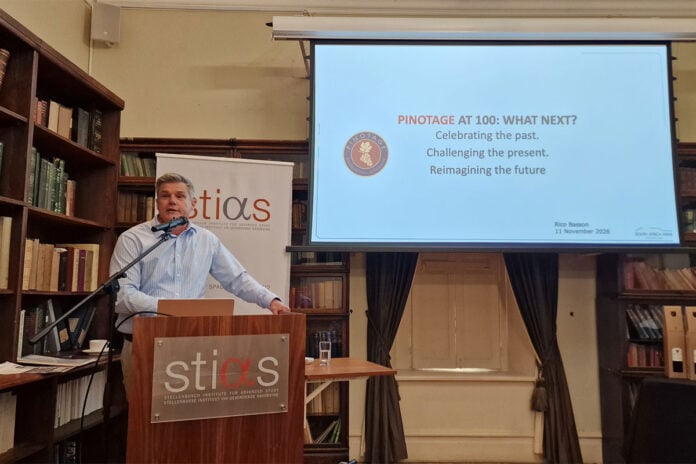
The event, held on 11 November at the Stellenbosch Institute for Advanced Study in the Western Cape, brought together experts in markets, soil science, crop protection, economics, grapevine genetics, and space technology to consider the future of Pinotage and the South African wine industry as a whole.
Unlocking greater value
Rico Basson, CEO of South Africa Wine, said only about 15 million litres of the roughly 62 million litres of Pinotage produced in 2025 were sold as cultivar wine.
A further five million litres went into blends, while about 40 million litres entered broader categories in which Pinotage was not necessarily specified.
Basson described Pinotage as a versatile “workhorse”, but said more of this volume needed to be converted into recognisable value. He also proposed linking the wine to South Africa’s appetite for chicken through food pairings, marinades, and a possible collaboration with a popular fast-food brand.
Speaking to Farmer’s Weekly, De Wet Viljoen, vice-chairperson of the Pinotage Association of South Africa, said the think-tank had been about three years in the planning.
He facilitated the programme and delivered the opening address on behalf of association Chairperson Beyers Truter. Its purpose was to bring influential thinkers together and connect research with practical opportunities for the wine industry.
“The quality is there, but we want more volume sold. More volume sold will mean more money in the pockets of producers,” Viljoen said.
From soil to natural capital
Heinrich Schloms, geographic information systems and soil scientist at Vinpro, said growers should understand each soil’s inherent limitations and match the soil, rootstock, and cultivar before planting.
“You can’t fix something after it’s planted if you chose the wrong soil or the wrong rootstock,” he explained.
Schloms added that poor soil preparation, compaction, over-irrigation, and unnecessary nutrient applications could all undermine vineyard performance.
Dr Ernst de Beer, head of crop protection for perennial crops at Laeveld Agrochem, urged producers to regard beneficial insects and other natural enemies as natural capital.
He explained that monitoring pests without measuring the beneficial organisms already suppressing them could lead to unnecessary interventions that disrupted this natural control.
Economist Theo Vorster advised wine businesses not to assume the rand would continue depreciating at historical rates. Producers should protect their financial and human capital, manage debt-service capacity, and concentrate on factors within their control.
White Pinotage and wine beyond Earth
Prof Melané Vivier presented research conducted at the South African Grape and Wine Research Institute at Stellenbosch University on expanding Pinotage’s genetic diversity.
Only three clones dominate commercial Pinotage plantings, compared with 43 registered clones each for Cabernet Sauvignon and Chardonnay, she pointed out.
Researchers selected 40 promising individuals from an initial trial of 500 vines. One retained Pinotage’s confirmed genetic fingerprint but produced white berries, raising the possibility of new wine styles if the vines performs successfully in further vineyard and winemaking trials.
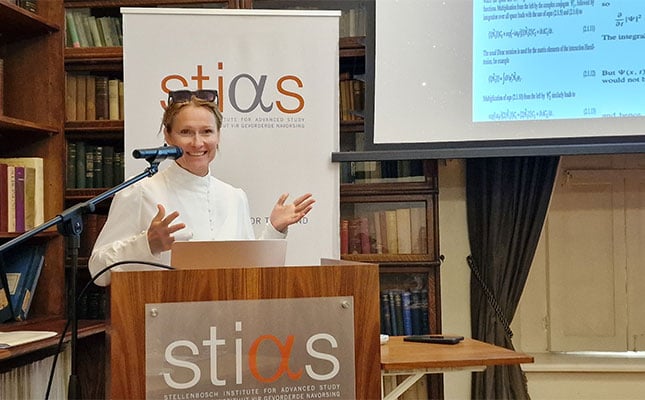
Keynote speaker Dr Adriana Marais, theoretical physicist and founder of Proudly Human, discussed how research for extreme environments could improve resource-efficient agriculture on Earth, while opening more speculative possibilities such as Pinotage accompanying people to a Moon habitat.
“The kind of research we would do to think about people living far beyond Earth is exactly the kind of research we need to do on Earth to maximise production of a certain crop in a certain area,” she said.
More immediately, Basson told Farmer’s Weekly South Africa Wine would launch its domestic consumer campaign in Gauteng in March 2027. Working with four major retailers and supported by wine-focused events, the campaign aims to make wine more accessible and attract new consumers, giving Pinotage a practical route into the wider South African market.