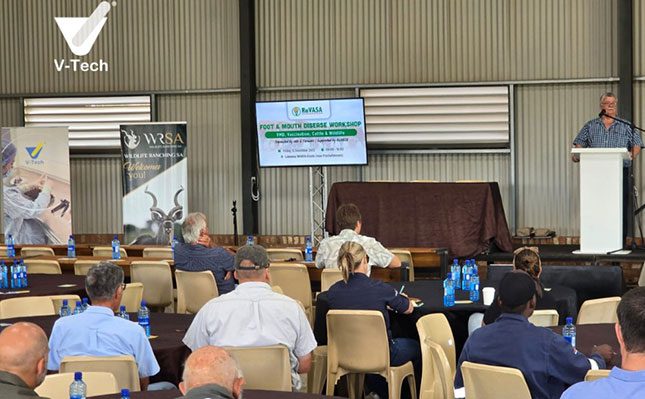
The workshop, hosted by the Ruminant Veterinary Association of South Africa (RuVASA), was held at Lekwena Wildlife Estate.
It was organised in response to concerns raised by farmers and veterinarians dealing with FMD on the ground, particularly in the Parys and Vredefort areas of the Free State.
The programme featured input from leading local and international animal health experts, including Dr Mark Chimes, manager of the animal health and welfare programme at Milk South Africa (Milk SA).
Other speakers included the chief state veterinarian at the National Department of Agriculture, Dr Lin-Mari de Klerk Lorist; Dr Baptiste Dungu, a member of the scientific commission of the World Organisation for Animal Health (WOAH); Dr David Gerber, CEO and chairperson of Dunevax Biotech; and RuVASA CEO Dr Dave Midgley.
Connecting at ground level
Dr Jan Bastiaan (Basjan) Fouché, a private veterinarian from Parys Animal Hospital, said the needs of farmers had become increasingly urgent.
“The pressure on industries to step up and help with solutions has become very, very important.
“From a humble farmer’s day that I planned, this became the very first FMD workshop, which just connects the ground level,” he said.
Fouché explained that by “ground level” he meant everyone working directly with animals.
“State veterinarians, private veterinarians, farmers and industry role players; all aiming to make a difference for the farmer and at the end of the day for the industry,” said Fouché.
Disease spreading fast
Fouché shared his experience of dealing with the outbreak in his area, saying the disease was spreading faster and more widely than expected.
“From the first case that I diagnosed, within three weeks I reported over 40 cases between the Free State province and the North West province within a 20km radius of my town, Parys. And from there, it definitely did not slow down,” he said.
He warned that while FMD was “not necessarily so deadly”, it was “definitely regarded as one of the most economically devastating diseases worldwide”.
Fouché also said under-reporting remained a major problem.
“Under-reporting creates a false impression of control,” he said. “If we don’t report as farmers at ground level, how can we expect the state to control something they believe is not that big of a problem?”
He emphasised that responsibility lay across the entire value chain.
“Each and every sector, each and every role player, each and every link of this chain are responsible, are at fault and do cause failures,” he said.
FMD risks beyond cattle
A major focus of the workshop was the role of other species in spreading the disease.
Fouché warned that FMD was not only a cattle issue.
“Potentially any cloven-hoofed animal can contract and transmit foot-and-mouth disease,” he said, alluding to risks posed by sheep, pigs, buffalo and other wildlife.
“Pigs are amplifier hosts of foot-and-mouth disease and buffalo are maintenance hosts,” he explained.
“That means they can be carriers of this disease without showing symptoms for very long periods of time. The train smash is that there is no vaccine for buffalo.”
Severe impact on dairy farms
Dr Mark Chimes outlined the devastating impact of FMD on the dairy sector.
“FMD is effectively out of control at the moment, and we have run out of vaccine at the worst possible time. Until vaccine supplies arrive, likely only by the end of January, the situation is going to become very difficult,” he said.
Chimes explained that while beef and dairy cattle showed similar symptoms, the impact on dairy farms was far worse.
“The disease looks similar in dairy and beef cattle, but the impact in dairy herds is far worse because milk production collapses almost immediately.”
He said milk production dropped sharply because cows could not eat or walk properly, and severe viral mastitis often developed.
“Cows can’t eat because their mouths are painful, they struggle to walk because of lesions on their feet, and as a result feed intake drops sharply. The virus concentrates in the udder. If that milk is fed to calves, they can develop FMD and many of them die from heart complications. Even after cows recover, their milk production for the rest of that lactation never returns to pre-outbreak levels, and in many cases the damage is permanent.”
According to Chimes, the financial losses were enormous.
“The average farm loses somewhere between R4 000 and R6 000 per cow,” he said, adding that total losses could reach “between R5 million and R10 million per farm” during an outbreak.
Some farms were discarding up to 20 000 litres of milk a day because it could not be processed or sold.
“That is not just wasteful, it is devastating.”
He also highlighted the emotional toll.
“For weeks, farmers and workers are treating animals until late at night and returning before dawn. The physical exhaustion is immense, and the psychological impact is immeasurable,” he said.
Public-private partnerships key to effective control
RuVASA CEO Dr Dave Midgley emphasised that effective disease control relies on strong, functional relationships between government and private veterinarians, rather than top-down instruction.
He stressed the importance of collaboration at ground level in managing outbreaks such as FMD.
He expressed disappointment that outreach from private veterinarians had not always been met with action.
“There was an outreach from government to us as private veterinarians. We were asked how we see this relationship, and then nothing happened,” Midgley said.
He praised younger veterinarians for their energy and willingness to work together.
“The enthusiasm of young colleagues makes me proud. They are the new generation and they must take this forward.”
He also raised concerns about delays in authorising private veterinarians, shortages of critical medicines and laboratory backlogs, but said cooperation remained the only way forward.
Call to all role players
Fouché said trust between neighbours was critical. “Keeping quiet is not going to help the situation.”
He urged all role players to work together. “It is time that we sat together like today, to set aside emotions, business plans and alternative motives. We need to meet in the middle and today is the middle,” he said.
Fouché said he hoped this would be the first of many such workshops. “My motive is sharing knowledge, bringing together people and making sure everyone is equipped for the battle.”
Get trusted farming news from Farmers Weekly in Google Top Stories.
➕ Add Farmers Weekly to Google ✔ Takes 10 seconds · ✔ Remove anytime