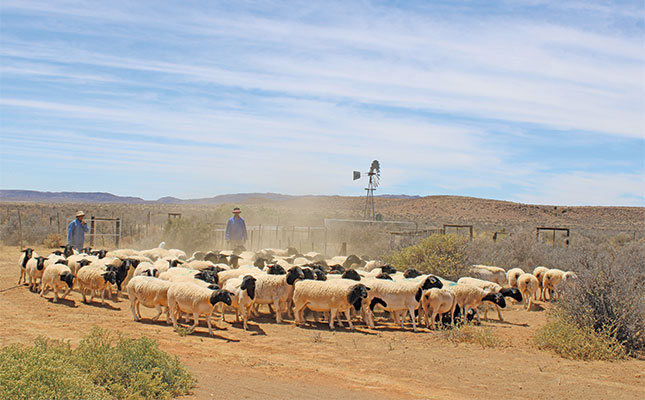

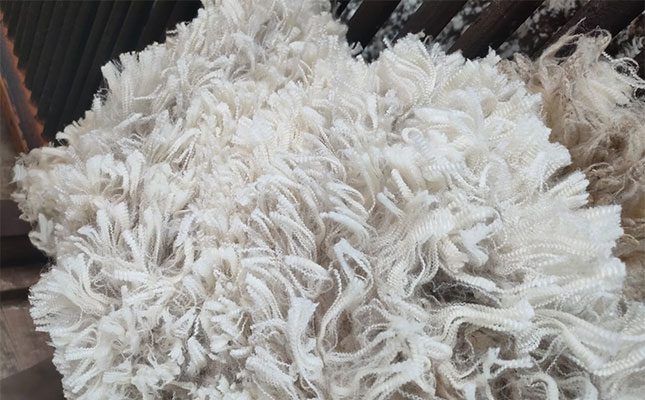
Speaking to Farmer’s Weekly, André Christie-Smith, who farms at the Kleiheuwel Trust in Bredasdorp, said the superfine bale was the result of a long-term breeding and wool-classing strategy that has been intensified over the past two seasons.
“As one of the oldest Merino farms in South Africa, we have a strong genetic base, coupled with the skills and hard work of the ram breeders in our district. We have steadily reduced the flock’s average micron. For the superfine lines, we test each sheep’s wool individually, then group and bale it according to micron,” he explained.
While some fleeces tested as low as 12,6 microns, they were excluded due to concerns over their tensile strength.
“We were aiming to produce a bale under 14 microns, but some of the really fine fleeces were not up to standard. This pushed the average to just above 14 microns. We are still incredibly proud of our achievement,” he said.
Christie-Smith added that the result follows Kleiheuwel’s 2024 success, when it sold a 14,3-micron bale for R300/kg at a BKB auction.
Kleiheuwel runs 1 500 breeding ewes and 2 200 wethers, with nutrition allocated strategically to influence fibre quality.
“The ewes receive much more feed and the best grazing so they can produce more and better lambs. This also makes their wool a little bit stronger, at around 18 microns,” Christie-Smith said.
Wethers graze mainly on marginal land, with year-round supplementation to maintain wool health without fattening.
“This leads to finer wool, at an average of 16,5 microns. But they must be monitored carefully, as too little food or too much stress can weaken the fibre,” he added.
Lambs are shorn at 10 months and again at 20 months. “It is this second shear on our young wethers that produces the finest wool on the farm,” according to Christie-Smith.
Record achieved under extreme weather pressure
The record-breaking superfine bale was produced during a three-year period marked by climate volatility. The farm endured two seasons of severe flooding, followed by a year of exceptionally low rainfall.
“We have only received about 45% of our annual average rainfall. The very dry conditions have the effect of producing finer wool; like us, the sheep don’t enjoy the drought,” he said.
The bale was purchased by Standard Wool, whose Italian clients from luxury textile company Drago were in South Africa for the auction.
“We were honoured to meet Standard Wool’s clients from Italy. They plan to produce a fabric line, and ultimately garments, using the five bales of Kleiheuwel Trust wool they purchased,” Christie-Smith said.
An exceptional bale
Leon du Plessis, BKB manager of wool auctions and technical services, told Farmer’s Weekly that superfine wool of the Kleiheuwel calibre seldom enters the market.
“Wool finer than 14,5 microns is extremely rare, and fibre of this fineness that also meets spinners’ best-style standards [quality of wool to be used in high-end materials] is even more exceptional. Add requirements such as a staple length of 68–80 mm, tensile strength above NKT [Newtons per kilotex] 32, low vegetable matter, and high yield, and the available pool becomes incredibly small.
“This specific lot set a new South African record [price], making it the most expensive wool ever sold locally,” he explained.
According to Du Plessis, medium wools (19–21 microns) performed strongly on auction day due to limited supply, while 18-micron wool “started slower but recovered steadily.” Fine wool lagged, but Du Plessis expects stronger gains ahead.
“This type of superfine bale rarely enters the market. While it attracts strong competition on the day, its limited availability means it won’t materially affect broader market trends,” he explained.