Speaking to Farmer’s Weekly, Dr Asive Luningo from the University of Pretoria’s (UP) Faculty of Veterinary Science said that since many farmers might not recognise the plant, it could lead to significant livestock losses.
Cestrum parqui, commonly known as Chilean cestrum or green poisonberry, grows along the edges of grazing lands and homesteads. Because it remains green when most grasses dry off, hungry animals are more likely to eat it, especially during feed shortages.
The plant has spread widely across the Highveld and continues to move into new districts.
Luningo explained that it forms thick, bushy stands that take over natural veld. Birds eat the attractive berries and spread the seeds, while the plant’s roots send up new shoots even after it is cut down. This allows it to survive drought and disturbance and makes it difficult to control once it is established.
She added that the danger comes from a toxin in the plant called kaurene glycosides, which can cause sudden and severe liver damage. Depending on the time of year, animals may only need to eat a small amount to fall ill.
In many reported cases, cattle died within 48 hours after grazing the plant. Sheep, goats, and horses are also at risk, and in other countries, dogs have become sick after eating the berries.
“Farmers may not suspect poisoning because the plant grows quietly in the background, and animals usually avoid unfamiliar shrubs unless grazing is limited,” she explained.
Signs of poisoning
Farmers should watch for sudden changes in their animals’ behaviour or movement. Early signs include excessive drooling, a slowing or stopping of the rumen, and constipation. Animals may also appear weak or unsteady on their feet, stand with their necks stretched out, show restlessness, or, in some cases, display aggression.
Yellow gums or the whites of the eyes can indicate liver damage, a key sign of Cestrum parqui poisoning. Luningo emphasised the importance of conducting a post-mortem when animals die suddenly. In confirmed cases, the liver is usually swollen, very soft, and tears easily.
“There may also be bleeding on the surfaces of internal organs and a build-up of fluid around the lungs, heart, or in the abdomen,” she added.
How to identify the plant in the veld
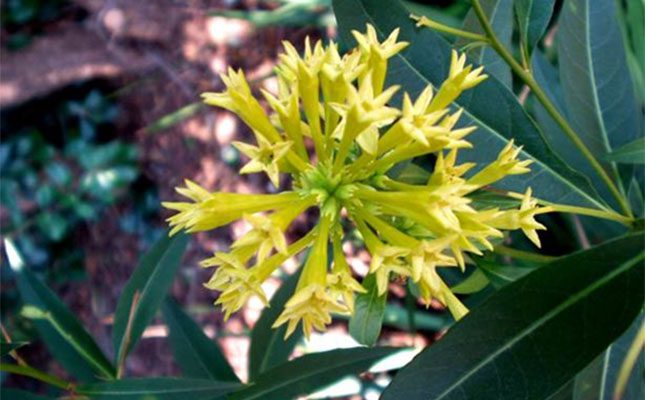
Correct identification is essential so that farmers can remove the plant before animals can get to it. Cestrum parqui is an evergreen shrub that grows between 1m and 3m tall. It has narrow, smooth-edged leaves that are pointed at both ends. When the leaves are crushed, they give off a strong, unpleasant smell.
The flowers appear in clusters and are tubular, with a green-yellow or brownish colour. The berries are shiny, purplish-black, and egg-shaped when ripe. The shrub also has shallow yellow roots.
“This species is different from the more familiar inkberry [C. laevigatum], which grows much taller and is commonly found along the coast. It also differs from orange cestrum [C. aurantiacum], red cestrum [C. elegans], and night-blooming jessamine [C. nocturnum], which have brightly coloured flowers and different berries,” Luningo explained.
The plant flowers in summer, but the risk of poisoning increases during two periods: early spring, when new shoots appear and animals may be tempted by the fresh growth, and winter, when the berries are ripe and highly toxic. Most livestock poisoning cases occur during these seasons.
Reported cases
There are two confirmed cases of Cestrum parqui poisoning in the country: one in the Carletonville area of Gauteng and another in Ventersdorp, North West. Additional suspected cases have been reported across the Highveld but were sometimes recorded as inkberry poisoning, as the two plants look similar. This confusion makes it difficult to track how widely the plant has spread.
At present, no herbicides are registered in South Africa specifically for killing Cestrum parqui. The Agricultural Research Council recommends removing the plant by hand, ensuring all roots are pulled out, as even a small piece left behind will allow the shrub to regrow. For large, tall plants, slash-and-burn may be used where fire regulations permit.
“Herbicides like triclopyr and imazapyr are registered for inkberry only and should not be used for Cestrum parqui. Farmers are encouraged to check their grazing lands regularly, especially near rivers, old kraals, abandoned lands, and homesteads where birds may drop the seeds,” Luningo advised.
Because Cestrum parqui is a listed invasive species under the National Environmental Management: Biodiversity Act (No. 10 of 2004) farmers should report any new sightings or infestations. Assistance is available from the UP’s Section of Pharmacology and Toxicology.
Luningo added that reports can also be made to the Department of Forestry, Fisheries and the Environment, The South African National Biodiversity Institute or local veterinarians, especially in cases where livestock have died.
“The University of Pretoria is currently conducting research to better understand the plant and its toxicity. The ARC Plant Protection Research Institute has published a fact sheet to help farmers identify and manage the species,” Luningo added.
For assistance, farmers may phone the UP Section of Pharmacology and Toxicology on 012 529 8015/8239/8581.