
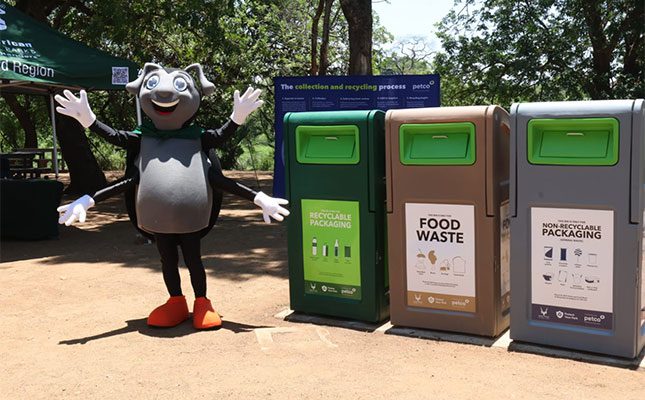
The pilot, a partnership between South African National Parks (SANParks) and producer responsibility organisation Petco, introduced an animal-proof, three-bin waste separation system at the Tshokwane picnic site near Skukuza in Kruger National Park (Kruger Park).
During the recent festive season alone, more than half a ton of recyclable product packaging was recovered at the site, where over 43 000 food and beverage items were sold.
Speaking to Farmer’s Weekly, Dr Danny Govender, SANParks’ general manager for sustainable development and management, said that given that day visitors account for more than 70% of Kruger Park’s gate traffic and typically make use of at least one picnic site, these high-use areas were identified as strategic points to improve waste management.
She added that the system uses clearly labelled, colour-coded bins: green for recyclable packaging, grey for non-recyclable waste, and brown for compostable materials such as food waste.
Govender said separation at source is critical, as the park currently relies on manual sorting at 10 waste sites, a process that often results in contaminated recyclables and lost opportunities to recover compostable material.
“Strong separation-at-source partnerships with organisations like Petco are key to ensuring that valuable resources are circulated back into the economy, rather than being lost to landfills,” she explained.
Food waste is a major opportunity
Govender added that food waste made up a substantial portion of the waste stream at Kruger Park, a challenge shared by many farms.
“If food waste is separated immediately, it doesn’t contaminate recyclables and can be composted more easily. For farms, this makes sense, as composting can be done on-site using windrows and combined with garden waste to enrich soils,” she explained.
Petco CEO Telly Chauke said Kruger Park was one of South Africa’s most important natural assets, making it essential to support sustainable waste solutions in such a pristine environment.
“If the public helps separate waste at source, recyclables remain uncontaminated, have a much higher value for collectors and recyclers, and can be turned into new, useful products,” she said.
Chauke explained that South Africa’s extended producer responsibility framework requires producers to take responsibility for packaging throughout its life cycle.
“That’s why sponsoring separation and recycling infrastructure in high-traffic public spaces like Kruger [Park] is a priority for Petco,” she added.
To ensure the system could withstand wildlife and environmental conditions, Petco worked with Pioneer Plastics to refine a baboon-proof bin design.
Pioneer Plastics sales and marketing director Gary Wiid said in a statement that the 240ℓ wheelie bins are housed in tamper-proof casings, securely mounted on concrete slabs, and manufactured from linear low-density polyethylene plastic for UV resistance, durability, and impact strength.
“They’re designed to withstand persistent scavengers like hyenas and honey badgers,” he added.
Concession partners align with conservation goals
SANParks concession partner Tourvest, which operates Tshokwane, said the initiative aligns closely with its long-standing conservation commitments.
Regional operations manager Henry Daschner said in a statement that recycling and waste management are central to reducing environmental impact and supporting Kruger Park’s long-term sustainability.
“Using data on waste volumes and recovery rates will help influence what we sell, how products are packaged, and how we drive a truly circular economy across our operations,” he said.
Beyond conservation areas, the project offers practical insights for farmers. Govender said monitoring and tracking waste volumes is essential.
“You can’t manage what you don’t measure. Once you understand what waste you’re generating, you can reduce landfill costs, earn rebates on recyclables, and make informed decisions about alternative packaging or inputs,” she explained.
The pilot is set to be rolled out at two additional picnic sites in Kruger Park, Nkuhlu and Afsaal, in the coming months.
Get trusted farming news from Farmers Weekly in Google Top Stories.
➕ Add Farmers Weekly to Google ✔ Takes 10 seconds · ✔ Remove anytime