
During open discussions, auctioneer Johan van der Nest, who also served as moderator, said the event was aimed at encouraging new thinking in the red meat industry.
“When you talk about a revolution in South Africa, you know something is going to happen, and today something big is going to happen,” he said.
The day’s programme got under way with a video presentation by Dr Bobbie van der Westhuizen, CEO of SA Stud Book, emphasising the critical role that genetics, performance data, and accurate record-keeping play in a modern beef production system.
The highlight of the day was a presentation by internationally renowned breeder and consultant Kit Pharo. Pharo, founder of the Pharo Cattle Company in Eastern Colorado, US, shared insights from a seedstock operation focused on low-input, high-profit cattle genetics.
His breeding philosophy prioritises profit per hectare rather than performance per animal, with a strong emphasis on adaptability, fertility, and cow efficiency.
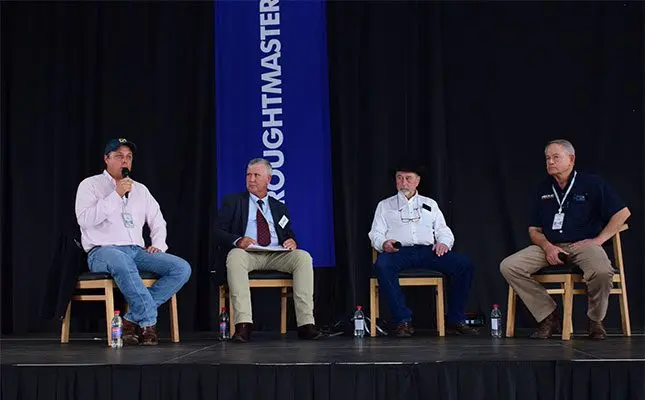
The remainder of the programme comprised an informal panel discussion composed of Pharo; PJ Budler, a globally recognised cattle expert, consultant, and internationally renowned livestock judge based in Texas, US; Richard Haupt, a livestock breeding specialist; and Van der Nest, who served as the moderator.
The discussion was candid, relevant, and strongly farmer-focused, with particular emphasis on practical, on-farm challenges and solutions suited to South African conditions. The session drew strong participation from producers, with robust questions and comments from the floor.
Budler, originally from South Africa, has more than 25 years of experience as a cattle consultant and international livestock judge. He highlighted the growing disconnect between show cattle, genetic evaluations, and commercial production realities.
“There is a [breakdown] between show cattle and the commercial industry. There’s also a separation between selecting purely for numbers such as [expected progeny differences] and [estimated breeding values] and what actually works in a practical production system,” he explained.
He also warned that unless the show industry shifts towards more objective, commercially relevant standards, it risks becoming irrelevant.
“The show ring should be the shop window of the industry, but only if it reflects what the market truly needs,” he added.
Efficiency over extremes
A recurring theme throughout the day was the need to optimise rather than maximise production traits. Discussions around frame size, birth weights, and cow efficiency highlighted the dangers of chasing extremes.
Pharo explained that while smaller-framed cattle can produce more kilograms per hectare, market realities still demand balance.
“I can’t sell a one- or two-frame animal, but I can sell three- to four-frame cattle. The goal is to match efficiency with what the industry wants,” he said.
Responding to concerns about dystocia in smaller-framed cows, Pharo said his experience showed no increased calving difficulty. “I’d rather let the calf grow outside the cow than inside,” he added.
Budler cautioned against breeding for very low birth weights, noting that the US industry made significant mistakes by swinging from one extreme to another. “Profit lives in average. You might not make headlines, but you’ll stay in business,” he said.
Management, nutrition, and environment
Discussions also covered herd management, grazing systems, and nutrition. Pharo described how his herds, ranging from 100 to 800 cows across several US states, are developed primarily on grass and forage, with minimal supplementation.
Van der Nest highlighted South Africa’s phosphate-deficient soils and the importance of mineral supplementation, particularly for improving calving rates and winter nutrition.
Shorter mating seasons were identified as a key management opportunity for South African producers. According to Van der Nest, reducing mating periods would allow for better herd control, selection, and overall efficiency.
The concept of ‘easy-fleshing’ cattle drew strong interest from producers. Budler explained that easy fleshing is an inherited trait linked to early maturity and lower maintenance requirements rather than a result of overfeeding.
“You cannot be profitable without easy-fleshing animals,” he said. “If cows are overmanaged, nutrition masks natural fertility, making it harder to identify the truly productive animals.”
Genetics, adaptation, and profit drivers
Panel discussions emphasised selecting cattle under local conditions and within existing gene pools. Pharo warned that many bulls used globally to produce fertile, high-quality female progeny are too large, arguing that adaptability should take precedence over size.
“Most of the money you make is within your own fences. Find cattle that are profitable for you. The rest of the value chain will look after itself,” he said.
He added that his main profit drivers are selecting the right bulls to produce efficient cows and consistently culling underperforming animals. He keeps most heifers, invests minimally in their development, and allows the environment to identify which animals truly belong in the herd.
Industry alignment and change
Some of the questions from the floor addressed the tension between cow-calf producers and feedlot requirements. Budler challenged the notion that ‘the customer is always right’, arguing that cow-calf producers must first ensure their own profitability.
Van der Nest echoed this sentiment, urging producers to rethink genetics, management, and marketing strategies in response to changing conditions.
“The beef industry will have to change to survive and thrive,” he said.
Closing the event, Budler reminded producers of the need for balance. “There are three things you must keep happy: the veld, the cattle, and the bank manager,” he said.
Pharo concluded with a call for adaptability: “Better is not always different, but different is always better. Those who change fastest when change is needed will always be ahead.”