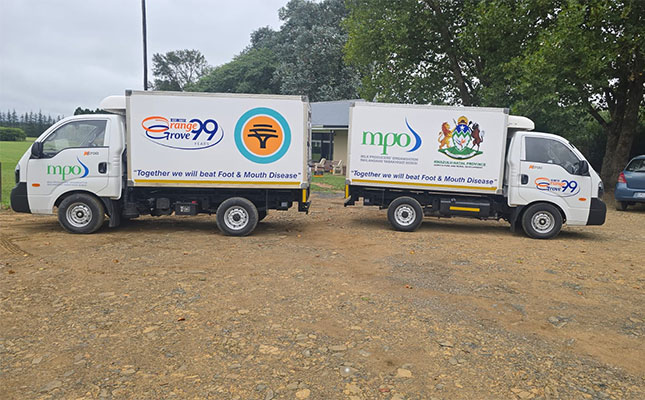
The initiative was coordinated by the Milk Producers’ Organisation (MPO), with financial and logistical support from industry partners including First National Bank (FNB) and Orange Grove Dairy.
In an interview with Farmer’s Weekly, Sandra Berning, chairperson of the MPO in KwaZulu-Natal, said the district had been identified by authorities as a high-risk corridor for the spread of FMD due to factors such as animal movement, shared grazing areas, auctions, and communal livestock interfaces.
“Our aim is to reduce viral circulation quickly by ensuring vaccines reach dairy farms through a controlled, veterinary-led roll-out in a priority district, thereby protecting farmers’ livelihoods and the wider livestock economy,” Berning said.
Vaccines distributed through veterinary practices
The vaccines were sourced through regulated industry procurement channels during the national shortage and produced by the biotechnology company Biogenesis Bago.
Distribution is being coordinated through three veterinary practices serving the district: EG Veterinary Services, Underberg Veterinary Clinic and Two Rivers Veterinary Clinic.
Two refrigerated vehicles donated by Orange Grove Dairy and FNB are being used to transport the vaccines to the clinics while maintaining the required cold chain.
“These vehicles are used to transport vaccines to veterinary clinics while maintaining the cold chain and are also available for use by state veterinarians should they wish to utilise them,” she added.
Private sector backing
Private sector support has been essential in funding vaccine transport and logistics during the shortage. In a separate response to Farmer’s Weekly, Dawie Maree, head of information and marketing at FNB Business Agriculture, said the bank’s involvement was driven by its close relationship with farmers and the agriculture sector.
“We have a sizeable market share in KwaZulu-Natal and in the dairy industry in general. When our clients suffer, we suffer,” Maree said.
At present, the bank’s contribution has focused on funding vehicles transporting vaccines to veterinary clinics, while further support options are being explored.
“The support is financial, to have the vehicles on the road and delivering vaccines. We are in the process of looking at how we can expand on support,” he said.
Biosecurity critical
Improved biosecurity will be essential for the long-term sustainability of the livestock sector, according to Maree.
“Biosecurity might start on the farm, but it is also the responsibility of the whole value chain. These disease outbreaks have shown how vulnerable the sector is and how low the level of biosecurity is in South Africa,” he said.
“Now is the time to start.”
Long-term disease management
Berning said the scale of vaccination required means disease control will be a long-term effort.
“The dairy industry has shown that when vaccine becomes available, we can mobilise immediately,” she said.
“But the reality is that KwaZulu-Natal alone has around 400 000 dairy animals that need urgent vaccination, followed by a six-month booster and annual vaccinations thereafter. This is a long-term disease management effort, and the industry is committed to working with government to protect farmers, jobs, and food security.”
Maree added that collaboration across the agricultural value chain would remain essential in combating the disease.
“Biosecurity is the responsibility of the value chain. Without collaboration among all links in the chain, the fight against FMD will be meaningless. Now is the time to forget about politics and collaborate.”