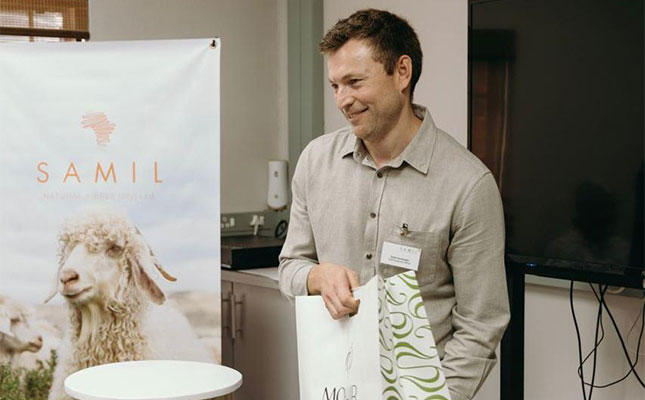
Speaking to Farmer’s Weekly, Evert Vermeulen, CEO of SAMIL Natural Fibres, said the installation of the advanced R21,5 million Schlumberger NSC W235 2,5m carding machine at the company’s Ntabozuko facility will reshape processing efficiency, yield, and competitiveness.
He said South Africa produces 2 600t of mohair annually, 72% of which comes from the Eastern Cape, which equates to 35% to 40% of global production. By processing the fibre locally rather than exporting it raw, the country increases export value and retains the economic benefits.
Vermeulen added that the beneficiation at source enables further downstream manufacturing, including spinning and weaving, strengthening a sustainable, high-quality industry rooted in the province.
“We are focused on improving efficiency and yield so that less fibre is lost in production,” he said.
The new carding machine, which Vermeulen said is regarded as among the best in the world, replaces two older units and features sophisticated drive systems that enable automated, sequential stop-and-start functions. On older systems, halting production often caused significant fibre waste.
The upgraded machine minimises downtime, reduces waste, and boosts productivity. Improved efficiency also lowers production costs.
Social impact and skills development
Samil combing plant manager Keith Green told Farmer’s Weekly that, beyond technology, the investment carries socio-economic implications. More than 60% of qualified artisans and technicians at the plant are women, a notable shift from traditional industry patterns. On any given day, three out of five technicians on site are female.
To sustain this inclusivity, Samil launched four mentorship programmes in February. They are open to existing employees seeking advancement and unemployed individuals who want to enter the textile industry.
The mentorships combine practical training with personal development, and most successful participants are offered employment opportunities at Samil upon completion.
“We focus on people who have a foundation that can be developed to their full potential,” Green added.
Cayly Warner, marketing co-ordinator, said the company also supplies female-owned weavers across South Africa and Eswatini with quality processed fibre, which they would otherwise need to source internationally. Access to locally processed, export-grade fibre strengthens their ability to compete in global markets.
Upliftment and development, Vermeulen said, are central to the company’s long-term strategy.
Eastern Cape MEC for Agriculture Nonceba told Farmer’s Weekly that private agro-processing investments are supported through financial incentives, infrastructure development, and strategic partnerships.
Instruments such as the AgriBEE Fund provide grants to black-owned enterprises acquiring equity in value-adding initiatives. The Eastern Cape Department of Agriculture (the department) also offers technical guidance on equipment procurement, food safety compliance, and market access.
Regulatory bottlenecks, such as small business registration and land-use approvals, are being addressed to encourage rural agro-processing expansion.
Policy alignment is further driven by the Agriculture and Agro-processing Master Plan, which seeks to coordinate public and private interests to transform and grow the sector.
Training centres including Mpofu Agricultural Training Centre and Tsolo Agricultural and Rural Development Institute focus on youth development and animal production skills, ensuring women and young people can access employment opportunities linked to private investment.
The department also collaborates with commodity groups and agribusinesses to integrate smallholder farmers into commercial value chains.
Eastern Cape MEC for Economic Development, Environmental Affairs and Tourism Nonkqubela Pieters mentioned in her speech that framed the investment as a vote of confidence in the Eastern Cape’s industrial future.
The two projects, the R21,5 million NSC Worsted Carding Machine and the R8,2 million NSC Chain Gills GC40 investment, represent nearly R30 million in capital expenditure. At least 18 new jobs are expected across construction and operations, alongside expanded throughput and modernised production systems.