
Steenhuisen emphasised that preventing further spread of the disease would require strict control of livestock movements and improved on-farm biosecurity, alongside vaccination.
He added that the South African Police Service, South African National Defence Force and municipal traffic departments could be called in to help enforce movement controls if FMD is declared a national disaster.
“FMD is not magically spread; it is spread through the movement of infected animals,” he said.
Phased vaccination strategy
Steenhuisen announced that the Ministerial Advisory Task Team on Animal Disease Prevention and Control will take an aggressive, proactive approach to getting the disease under control and regaining the ability to monitor high-risk areas.
“For many years, we have been chasing the disease. What we now need to do is get ahead of it. We want to wage war on FMD,” he explained.
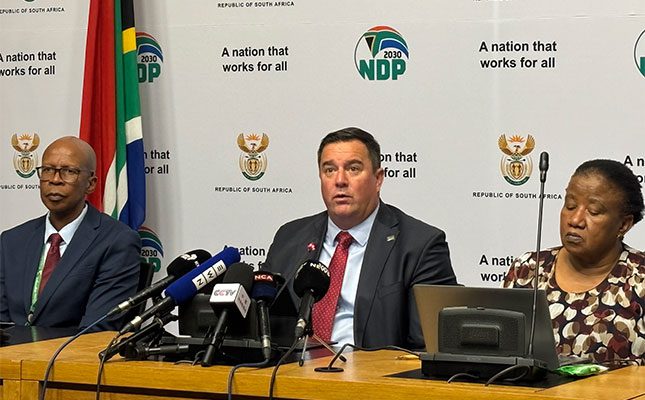
Introducing the upcoming vaccination programme at the briefing was Dr Emily Mogajane, head of the Ministerial Advisory Task Team on Animal Disease Prevention and Control. She explained that the programme will be divided into four phases to be implemented over the next decade.
The first phase will span two years and is aimed at stabilising infection rates through intense vaccination, livestock movement control, enhanced surveillance, and the improvement of the Onderstepoort Biological Products (OBP) laboratory’s capacity to produce effective FMD vaccines in South Africa.
Mogajane added that the task team has set a 12-month operational objective to reduce outbreak incidents by at least 70% and achieve at least 80% vaccination coverage of target cattle populations in the priority districts of KwaZulu-Natal, Gauteng, and parts of North West.
The vaccination rollout will be repeated every three months in these districts, with priority given to all feedlots, at least 90% of commercial herds, and at least 80% of communal herds by the end of 2026.
Following China’s ban on beef products from South Africa in 2025 and the 30% US import tariff on South African agricultural products, the industry has had to adapt to reach new markets. In response, the vaccination programme will also target 100% of herds for export.
“Local producers have already sought out new markets, which has also forced the Department of Agriculture [DoA] to be more proactive in entering new markets for not just beef but all South African produce,” Steenhuisen added.
The second phase will be implemented between years two and four, and the goal is to establish buffer zones that act as barriers between areas of varying FMD risk. Mogajane added that farmers are responsible for these buffer zones and must maintain consistent biosecurity practices.
The third phase will run from years four to seven and will entail the stopping of FMD vaccinations in zones that have been declared free of the disease.
The objective of the fourth and final stage, implemented between years seven and 10, is to regain South Africa’s FMD-free status in accordance with the World Organisation for Animal Health.
How the programme will be enforced
Steenhuisen explained that the distribution and administration of the vaccines will be conducted by state and private veterinarians with support from animal health experts.
He added that although FMD is a state-controlled disease, the government lacks the capacity to run the vaccination programme alone and is using an outbreak heat map with Red Meat Industry Services to improve traceability and case reporting.
In high-risk provinces like the Free State and Mpumalanga, biannual or triannual vaccination campaigns will be introduced. The Eastern Cape, classified as a medium-risk province, will also receive biannual vaccinations.
Despite Limpopo being considered low-risk, the large buffalo populations pose a risk. Therefore, targeted vaccinations for communal areas and feedlots will be implemented, and livestock will need to be vaccinated at least 14 days before being moved to market points.
The Western and Northern Cape are considered ‘protection zones’ and will be monitored but will not receive routine vaccinations.
Due to sector pushback and the rapid spread of FMD over the past 10 months, an initiative is under way to review legislation and draft amendments to the Animal Diseases Act (No. 35 of 1984). According to Mogajane, this will include amendments to the Animal Identification Act (No. 6 of 2002) to enable phased mandatory electronic identification that utilises existing commercial traceability platforms.
In addition, she explained that the hope is that the legislative reviews will lead to the authorisation of the implementation of digital permit systems for livestock movements aligned with the Livestock Identification & Traceability System and vaccination records.
Lastly, Mogajane said emergency funding and procurement for the fast-tracking of vaccine imports and conditional authorisation will be done through the South African Revenue Service and National Treasury to ensure efficient supply as soon as possible.
“As a nation, we were able to do this during [the COVID-19 pandemic], so we believe we can follow this route again to ensure fast-tracking,” she added.
International vaccine supply
Steenhuisen said the Department of Agriculture has administered almost two million FMD vaccines so far, but acknowledged that shortages of certified vaccines have posed a major challenge.
Government has relied largely on vaccines from the Botswana Vaccine Institute (BVI), but Steenhuisen said additional international supplies would be required to support the phased control programme.
Alongside BVI, two international manufacturers, Biogénesis Bagó in Argentina and Dollvet in Türkiye, have confirmed their capacity to supply vaccines.
Steenhuisen said that once imported doses become available, “each dose will be tested and compared to ensure the future use of the most effective versions.”
Biogénesis Bagó produces vaccines targeting the SAT1, SAT2 and SAT3 strains of FMD and is ready to supply an initial one million doses within the next two weeks, pending regulatory approval, with a further five million doses projected by March 2026.
The Dollvet vaccine will be introduced in collaboration with South African company Dunevax Biotech.
In addition, the Onderstepoort Biological Products (OBP) laboratory will collaborate with BVI to produce SAT1, SAT2 and SAT3 vaccines locally. Mogajane said this could result in an annual production capacity of about 12 million doses, with a target of two million doses every two months.
“We are very optimistic about the rollout of this phased programme and remain committed to achieving our operational objectives outlined in this briefing,” Mogajane said.
Steenhuisen said the first phase of the vaccination programme would begin once clearance for imported doses is obtained, adding that vaccines would be distributed fairly across all sectors.
Movement controls and market impact
Responding to questions about balancing movement restrictions with the need for trade, particularly for smaller-scale farmers dependent on livestock markets, Mogajane acknowledged the challenge.
She said the department would engage with auctioneers and abattoirs in areas experiencing persistent outbreaks and, based on risk assessments, may advise temporary market closures.
“We understand the intricate balance, but we require cooperation between the state and industry bodies. Regulation is key,” she said.
Mogajane added that livestock movement would not necessarily stop entirely in affected areas, but permits would be required and animals would need to be declared disease-free before any movement could take place.
Industry scepticism
Speaking to Farmer’s Weekly after the briefing, Jane Holliday, a dairy consultant at Intelact for KwaZulu-Natal and Gauteng, questioned whether the rollout of the programme was realistic.
“There is such a significant risk of unfair vaccine distribution and support by the Department of Agriculture. They are making promises which, once again, they will not keep,” she said.
Holliday also questioned whether the current vaccine supply, along with the expected imports, was being adequately tested, noting that laboratories have limited oversight.
According to Holliday, the state’s plan to monitor livestock movement through the police, military and municipal traffic departments was an over ambitious attempt to solve a massive logistical challenge the department was not equipped to handle.