Given recent years of weather variability linked to El Niño and La Niña climate patterns, combined with lower investment returns and rising production costs, particularly in marginal areas, farmers are likely to remain cautious.
“The 2026 crop intentions highlight an agriculture sector strategically adapting to new realities. Farmers are managing risk by choosing crops that offer stronger market potential and resilience under unpredictable climate conditions.
“Water availability remains a decisive factor, with producers monitoring reservoir levels and soil moisture before finalising planting plans,” Marguerite Pienaar, agricultural economist at Grain SA, told Farmer’s Weekly.
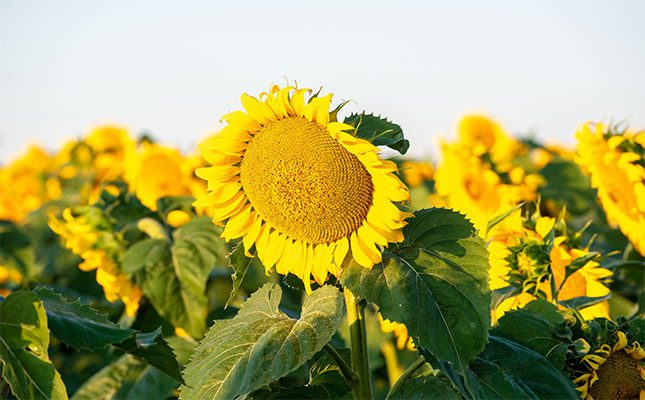
Sunflower prospects for 2025/26 season
Regarding expectations for the next season, she notes that the 2025/26 summer crop season could strengthen South Africa’s position as a leading grain and oilseed producer in the Southern African region if the weather is favourable and global markets stabilise.
Hendrik van Staden, Syngenta Seeds head of field crops for Africa and the Middle East, said sunflower’s ability to produce relatively consistent yields under adverse weather conditions makes it an attractive option, particularly for producers who farm under dryland conditions.
“The crop’s ability to deal with adverse climate conditions makes it a good alternative to other grain crops,” he added.
Van Staden said Syngenta Seeds expects a slight increase in sunflower hectares despite other market and environmental pressures. He highlighted the following factors:
- Growing demand for high-oil sunflowers
- Producers are capitalising on the premium prices for high-oil sunflowers, viewing them as an alternative income source.
He agreed that unpredictable weather patterns could strongly influence planting intentions.
“Soil profiles with sufficient subsurface moisture can create favourable conditions for early planting, whereas late rains or drought may affect maize plantings. In particularly dry areas, sunflowers can be considered an alternative crop,” he explained.
He cautioned that the market remains dynamic: “It is influenced by many external factors, and farmers must continually revisit decisions to adapt promptly to changing circumstances. Choosing the right hybrid is critical not only for sunflower success but also for profitability.”
High-quality hybrid seed not only ensures better and more productive crops but also plays an important role in mitigating risks associated with grain production, such as disease, pests, and climatic diversity, thus enabling farmers to grow food using less land, less water, and fewer inputs.
“We strongly recommend planting a hybrid package to strategically manage disease and drought stress. With [Syngenta Seeds’] new sunflower package, we recommend that farmers stagger their planting dates to manage risks, particularly to manage Sclerotinia,” Van Staden explained.
According to Pienaar, farmers are increasingly diversifying and prioritising sustainability. “Producers are aiming for balance, matching market signals with climate-smart practices, and aligning crop choices with resource constraints,” she said.
Possible decline in sunflower hectarage
Corné Louw, head of applied economics and member services at Grain SA, points out that, according to the Crop Estimate Committee’s (CEC) ninth production estimate released at the end of October 2025, sunflower production will most likely remain unchanged from the previous estimate at 708 300t.
According to Juan-Pierre Kotzé, manager of research and projects at the South African Cereals and Oilseeds Trade Association, the CEC stated that intentions to plant sunflower indicate a decrease of around 25 000ha from the 555 700ha planted in the previous season.
“This is a decrease of 4,43%. These are, however, only intentions to plant, and the actual planting of the sunflower crop will depend on the weather conditions as we move through December,” he explained.
One of the reasons for the decrease can be attributed to Sclerotinia in many areas during the 2024/25 production season, Louw pointed out.
“In spite of this and other challenges, average sunflower yields increased to 1,27t/ha in comparison with the 1,19 t/ha during the previous season. It must be mentioned, however, that during the recent Grain SA Grow for Gold National Yield Competition, yields of 3,5 t/ha and 4,4t/ha were recorded.
“This shows that if sunflower is treated as a primary crop and planted at the optimal time, farmers can receive a good return on investment.”
When considering the different yield scenarios, Louw said the following should be kept in mind:
- Low yield scenario: if an average yield of 1,2t/ha is assumed, total available stock is estimated at 765 000t, total demand at 681 000t, and exports at 200t.
- Base or mid-scenario: if an average yield of 1,3t/ha is assumed, total available stock is estimated at 781 000t, total demand at 696 000t, and exports at 3 000t.
- Upside scenario: if an average yield of 1,5t/ha is assumed, total available stock is estimated at 865 000t and total demand at 767 000t, leaving 3 000t available for exports.
“In all the above-mentioned scenarios, the available stock will support the price, and 60 000t of imports can be expected if the worst-case scenario prevails,” Louw explained.
Supply and demand
He added that, at this stage, total stock is estimated at 789 157 t, as the overall sunflower yield for the 2024/25 season was higher, at 1,27 t/ha.
From week 34 of the 2025/26 marketing season, total commercial sunflower deliveries amounted to 693 140 t, which is 68 121 t more than at the same point last year.
Kotzé said the first deep-sea export vessel carrying 15 000 t of whole sunflower seed was shipped to the Congo in September 2025.
However, he also noted that market reports suggest an import vessel from Argentina is expected to arrive in South Africa later this season.
“This would be the first sunflower seed import vessel to arrive in South Africa since February 2017, when a shipment of 30 000 t was received from Romania.”
According to him, this can be attributed to high local prices for sunflower oil and seed, which make imports more cost-competitive.
“Furthermore, reports indicate that the oil content of Argentinian sunflower seed is higher than that of local seed, adding to the price incentive.”
Kotzé noted that the news of the two vessels came as a surprise to the industry, as deep-sea imports and exports of bulk sunflower seed are uncommon in South Africa, where trade in processed products is the norm.
He added that the start of the season brought some challenges in obtaining import permits for sunflower seed from Botswana.
“Even though imports from Botswana were not large in volume, the trade remains important for some industry stakeholders. However, the issue was resolved in July 2025, and imports of about 1 400 t of sunflower seed have since been received from Botswana,” he said.
Louw indicated that about 220t of sunflower seed is expected to be exported during the season, while imports are projected at around 4 000t.
“Approximately 700 000t of sunflower will be pressed locally for oil and oil cake. The CEC adapted the final stock from 72 857t during the previous season to 77 863t for the current season,” Louw added.
For more information email Marguerite Pienaar at [email protected], Hendrik van Staden at [email protected], Corné Louw at [email protected], and Juan-Pierre Kotzé at [email protected]. Visit sagis.org.za.