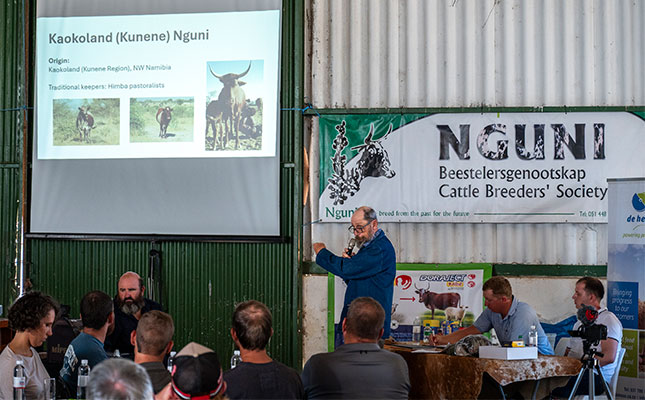
Cedric Stoch, an Nguni farmer with more than 40 years of industry experience, opened the day with a presentation on Nguni ecotypes and the breed’s varying characteristics across South Africa.
“Ecotypes are animals, or groups of animals, that have developed in isolation over a long period of time, over many generations,” he explained.
Breeding in an isolated region leads to noticeable changes in size, shape, and behaviour as the cattle adapt to the environment. This gave rise to the different Nguni types we know today, namely Makhathini, BaPedi, and Venda.
The distinctions between these types are not only physical. Each one has deep cultural and historical roots among its respective ethnic group, which influenced their names and the ways people have shaped them over time.
What influences ecotype variation
Stoch explained that ecotype variation is determined by three factors. The first is geographical isolation: breeding herds in a specific region without extended contact with other herds naturally leads to physical traits that characterise that region’s type.
The second factor, climatic variation, is closely linked to geographic isolation. Differences in heat, humidity, and soil types across the country have led Nguni cattle to develop frames that cope better under harsh climates.
For example, Nguni in high-heat regions such as the Northern Cape and Namibia have developed narrower frames, reducing surface area and helping their bodies handle heat more efficiently. He added that Nguni in these regions typically remain small due to a lack of feed availability and lower overall nutrient intake.
Stoch said the third factor, which he referred to as the artificial or human factor, significantly influenced the breed’s evolution through specific breeding and cultural practices. A prime example is the Venda Nguni, which generally has a darker hide because black Nguni bulls are culturally important in ritual burials.
Hides are commonly used to wrap the deceased, so these animals are more likely to be selected for breeding, resulting in darker hides among Venda herds.
“Looking at these components, we see a type of phenotype. In other words, the animal in front of us is composed of the genotype and the [influence] of these factors: soil, climate – including food availability – temperature, humidity, and finally, the human factor,” he said.
Behaviour and growing conditions
Following presentations by Lochner Eksteen of Exsteen Ngunis near Piketberg, on phenotypical corrections and Josh Stoch, son of Cedric Stoch, on the economic impact of selecting the right bull, Ida Glover, a veterinarian at Octavoscene, shared her field experience with the Nguni breed.
She focused on the behavioural patterns and physical growing conditions of the Nguni.
“I have noticed that Nguni keep their peak condition for a favourable period, and it is often challenging to determine the age of some of the Nguni. Some may be several years old but still look young and very healthy.
“I believe that is one of the many benefits of this breed. They are so well-adapted to our climate that they are an incredibly reliable breed. Many believe they are aggressive and uneasy around people, but I have never found it challenging to interact with them,” Glover said.
Rounding out the presentations was Tiaan Gerber, technical adviser for extensive ruminant and dairy at De Heus, who discussed feed development that balances protein and nutrient intake specific to the Nguni breed.
Speaking to Farmer’s Weekly, he said feedlots are generally less accepting of Nguni, so optimising feed programmes is necessary to give farmers a feasible way to finish and sell their cattle to feedlots rather than sending them to market as calves.
He added that De Heus aims to develop supplemental feed using as many naturally available on-farm materials as possible. Optimising feed development, he said, will lead to better feed conversion rates, slaughtering percentages, and market opportunities for Nguni breeders.