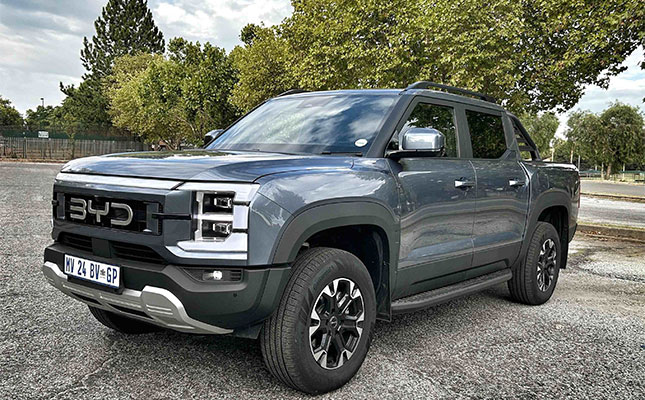
When the Shark’s 29,58kWh lithium iron phosphate battery is charged, the bakkie is every bit as lethal as its aquatic namesake.
By clocking a 0 to 100km/h sprint time of 5,66s last year, it dethroned the Ford Ranger Raptor (6,9s) as Mzansi’s fastest production bakkie.
But the Shark is very dependent on its battery in order to hunt down Raptors with the regularity of a marine predator.
Once the battery starts running low and the bakkie becomes more reliant on its 1,5ℓ petrol engine, it’s not the deadliest of weapons anymore.
Petrol and electricity unite
The bakkie’s petrol mill produces 135kW of power and 260Nm of torque. A front axle-mounted electric motor produces 170kW/310Nm and a rear axle-mounted motor brings another 150kW/340Nm to the party.
BYD rates the combined power at 321kW/640Nm, which already tells you it’s not as straightforward as merely adding the numbers up.
Fully charged, the Shark is so brutal off the line that you’ll never guess the monstrosity weighs 2 710kg. But because the bakkie is a plug-in hybrid electric vehicle (PHEV) and not an EV, it’s pure electric range is only rated around 100km.
Hybird driving
If you can’t make it to a DC charger, which charges the BYD Shark from 20% to 80% in less than 30 minutes, or charge it at home overnight, you can still prolong your fun in hybrid electric vehicle (HEV) mode, providing you manage the energy system.
BYD provides the option of selecting a target percentage of between 25% and 70% of what it calls the battery’s ‘State of Charge (SOC)’.
By activating the SOC, the battery management system does not allow the power level to drop below the selected percentage.
To achieve this, engine power is applied to keep the battery at the desired level.
And except for the engine noise erupting from stomping on the accelerator, the BYD Shark still behaves very much like an EV when operated like this.
It almost feels like the engine is used more as a generator to power the electric system than to contribute to the drive itself. Either way, you are now paying for petrol.
Not so lethal anymore
The third way in which to operate it happens when you have depleted the electric range without activating the SOC. Now the petrol engine powers the bakkie with some electrical assistance, like a self-charging hybrid. In this case, the battery level always stays at around the 20% mark.
But by now the light-footed EV soul is a distant memory, and all you are left with is a heavy, noisy, and underpowered bakkie. It will get you from point A to point B just fine and take you on open road trips without any range anxiety, but this is not the Raptor killer you were sold on.
The verdict
Our conclusion is that the BYD Shark is every bit the predator it is made out to be. It accelerates like a beast and offers comfort in a very plush and technologically advanced cabin. And it’s R959 900 price tag is very competitive in the bakkie game.
To make the most out of it, you will need to be mindful of managing the energy flow.
BYD Shark Premium AWD
Engine: 1,5ℓ petrol + hybrid electric
Transmission: One-speed automatic
Power: 321kW
Torque: 640Nm
Fuel consumption (tested): 9,8ℓ/100km
Licensing mass: 2 710kg
Towing capacity: 2 500kg
Payload: 790kg
Price: R959 900