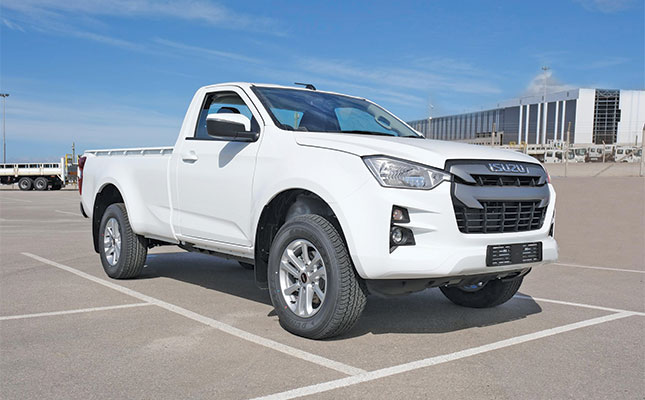
At R590 800, the single cab, two-wheel drive Isuzu D-Max 3.0 DDI LS automatic makes for a compelling package, albeit on the pricey side compared to the newer and slightly better equipped, but also less powerful single turbo Ford Ranger XL priced R574 000.
As a single cab is designed to work, its interior is rather basic. But it came as a welcome departure from the tech-laden, but also sometimes fussy layout of certain double cabs. It is straightforward, and while hard plastics are the order of the day, it feels solid.
The ergonomics are plain to use, from the shortcuts at the base of the infotainment to the physical buttons and dials for the air-conditioning.
Far from being spartan, the bakkie features a height-adjustable steering column, a four-speaker sound system, height-adjustable seats, a multi-function steering wheel, cruise control, 4,2” TFT instrument cluster display, electric windows and 7” infotainment system.
Decent level of spec
Something we found very bizarre was the infotainment system programmed to dim when the headlights are switched off, meaning the lights had to be on the whole time to navigate through the display.
Thrown into the mix further is halogen daytime running lights, 17” alloy wheels, electric mirrors, auto lock/unlock doors, Apple CarPlay and Android Auto, a rear diff-lock, dual front airbags, traction control and hill-descent control.
Seat comfort is acceptable as well as the myriad of storage spaces – including behind the seats – and the grippy leather-wrapped steering wheel itself.
While the LS represents the flagship single cab Isuzu D-Max, it omits a reverse camera, rear parking sensors, leather upholstery, the bigger 9” infotainment system, push-button start and the suite of safety and driver assistance systems found on the double cab LSE and V-Cross variants.
Honest worker
After being put to good use with some odd jobs around Joburg, our Isuzu could finally stretch its legs and put its loadbin to better use during a road trip to Bethlehem to help a family member move house.
Household items tipping the scales at a few hundred kilograms were enough to make a considerable difference in ride quality by almost removing the bouncy feel with nothing in the back. What’s more, the 4JJ3-TCX 3,0ℓ turbodiesel engine that makes 140kW of power and 450Nm of torque hardly broke a sweat.
As much as the trip had shown the D-Max’s working credentials, and comfort for what is still a workhorse, the other point of content was fuel consumption. Fuel economy for the 794km trek came in at just over 8ℓ/100km. Our long-term loan went back after 2 301km, without any interior rattles or creaks.
What’s the verdict?
As much as the practical standpoint of a double cab continues to be undisputed, single cabs are still the bread-and-butter of many bakkie brands. Significantly cheaper than the Toyota Hilux 2.8 GD-6 RB Raider stickered at R646 200, the D-Max remains a solid and dependable choice given not only Isuzu’s reputation for reliability, but simplicity despite being dated in some areas.
Isuzu D-Max 3.0 DDI LS 4×2
Engine:3,0ℓ turbodiesel
Transmission: Six-speed automatic
Power: 140kW
Torque: 450Nm
Fuel consumption (tested): 10,1ℓ/100km
Licensing mass: 1 780kg
Towing capacity: 3 500kg
Payload: 1 205kg
Price: R590 800