
Great Wall Motors (GWM) prides itself on being the longest-serving local Chinese brand. After establishing itself as a proper player in the light commercial vehicle segment with the Steed and P-Series line-ups, it rolled out the P500, one of the biggest double cabs in the business.
Separating the brand’s new throne bearer from its garden variety four-cylinder turbodiesel contemporaries is its hybrid powertrain reserved for the top-of-the-range Ultra Luxury. It is powered by a 2,0ℓ turbo-petrol engine and electric motor with battery pack delivering a total system power output of 255kW, making it the most powerful bakkie in the country after the beastly petrol-driven V6 Ford Ranger Raptor (292kW).
The downside to all this power is the P500’s portly 2 575kg kerb mass, which sees the payload reduced to 735kg.
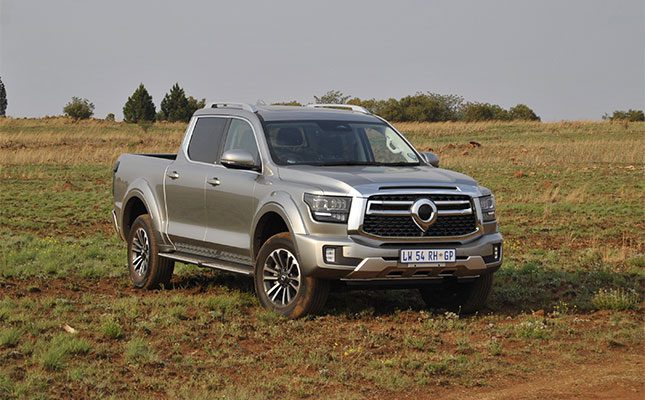
We liked the bakkie’s distinctly American truck-like macho appearance, which does not come across as overly brash. The combination of the oversized grille and P-Series logo, angular LED headlights and profile make for an imposing entrant easily capable of rivalling the Ford Ranger and even the Toyota Hilux GR Sport for kerb appeal.
Raising the bakkie bar
A first for South Africa is its multifunction tailgate that opens in two stages. It opens in split barn-door-type design in addition to being a traditional drop-down bakkie tailgate.
Inside, the P500 is spacious. Its minimalist design looks and feels premium with soft plastics and leather.
A comparatively large 14,6-inch infotainment system with 360° surround-view camera system is only the starting point of a tech-loaded cabin that also includes a 12,3-inch digital instrument cluster.
Bakkie firsts include a panoramic sunroof and rear seats that can be adjusted electrically while also being heated and ventilated.
Smooth on the move
Out on the road, this self-charging hybrid starts up in electric mode and engages the petrol engine above 30km/h.
Dispraisingly, the transition is anything but smooth, with an abrupt jerk present each time the combustion engine kicks in. If that isn’t enough, the all-too-familiar Chinese vehicle handicap of a slow-responding throttle tune results in a low-down delay slightly negated by the electric hardware, but still present and irksome in getting the P500 up to speed.
Once on the move, the delivery is smooth and the grunt impressive considering its size. But the ride felt bouncy and with a grating sensation on less well-kept surfaces.
The opposite applied to smoother tar, and while attempts to try out the P500’s 224mm of ground clearance, pair of locking differentials and low range didn’t materialise, it still felt sure-footed and the nine-speed automatic gearbox about as smooth as one could wish for.
What’s the verdict?
As much as it can be described as a game-changing luxury bakkie, scepticism surrounding the P500 is unlikely to disappear, even with its performance.
Add to this the mindset of paying R1 million for a Chinese vehicle, plus the unproven reliability of the hybrid system in the long run, the odds are stacked against it in a market where proven old-school technology is favoured above complexity. Yet value-wise, it’s a key rival that simply can no longer be ignored.
Vehicle fast facts
Price: R 999 900
Engine: 2,0ℓ, turbodiesel or hybrid
Transmission: Nine-speed automatic
Power: 255kW at 5 500 to 6 000rpm
Torque: 648Nm at 1 700 to 4 000rpm
Fuel consumption (tested): 11,5ℓ/100km
Licensing mass: 2 575kg
Towing capacity: 3 500kg
Payload: 735kg