
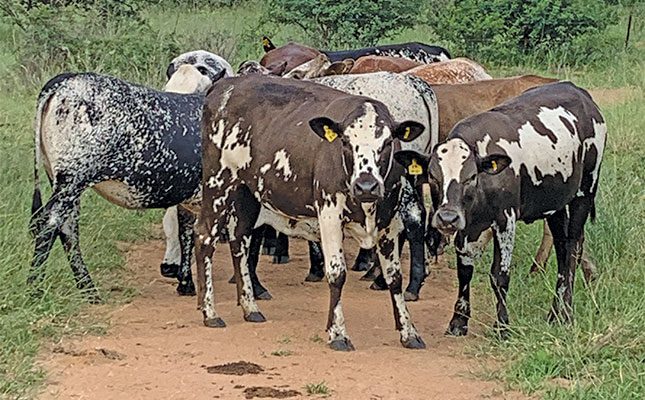
Cecilia Prinsloo-Van der Linde runs her Nguni stud under extensive farming conditions in the Waterberg area of Limpopo.
“As we started as weekend farmers, we required animals with ease of calving, that are healthy, hardy and robust enough, with the ability to maintain themselves through both browsing and grazing on the mountainous terrain we farm on. The cows need to be fierce protectors of their calves against predators, as we have leopard, caracal, jackal, as well as stock thieves. Although we started with a composite breed, it soon became clear that purebred Ngunis were simply better adapted to the challenging farming conditions in the Waterberg,” she says.
According to her, the Nguni’s value lies in the fact that the breed has been selected by nature for eons, resulting in a highly adaptive, fertile, and even-tempered beef cattle breed.
BergAlleen Boerdery
Prinsloo-Van der Linde’s BergAlleen Boerdery stud is near Marken, Limpopo, on portions of the farms Hottentots Holland and Marken.
“I am privileged that my husband Bennie decided four years ago to accommodate the herd and me, and was willing to sell his business to become involved with the farming enterprise on a full-time basis,” she adds.
The first BergAlleen Ngunis were acquired from Freddie Besselaar, owner of the Gariep Nguni stud, in 2018. The first purchase consisted of 10 in-calf polled heifers, followed by a second group of similar heifers, also from the Gariep stud, in 2019.
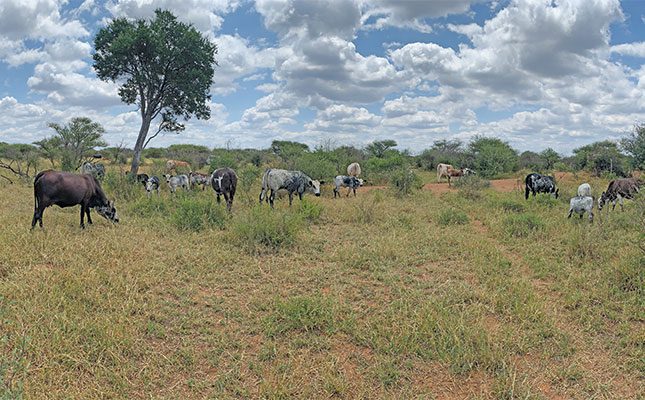
The first Nguni bull was purchased in 2021, named Witblits (FB15 162).
Currently, the stud includes Nguni genetics from studs far and wide: Makhanda, Harrismith, Hopetown, Coligny, Mooketsi, Louis Trichardt, Waterpoort and Piketberg.
Over the next few years, Prinsloo-Van der Linde says they hope to breed a more uniform and unique BergAlleen Nguni, slightly larger than medium frame, and preferably naturally polled.
Best decision
Asked by Farmer’s Weekly about the best decision she took in terms of the establishment of the stud, she emphasises the importance of actively exploring the breed’s genetics, its history, the different eco-types, and the traits of the breed, from well-established and long-time breeders.
Here she praises the Nguni Breeders’ Society of South Africa for the sterling service it renders to its members and the way the society accommodates and supports new members.
“Another good decision we made was to keep a proper farm record of all animals from day one until now. Bennie created a colourful Excel spreadsheet that can be used to easily look up performance, calving records, weights and so on.
“This is vital in order to determine whether the animals on the farm reflect the breeding objectives we are working toward.
“Detailed record-keeping is of utmost importance to keep track of the individual members of the herd. Bennie’s spreadsheet is a valuable herd management tool,” says Prinsloo-Van der Linde.
Attending Logix BLUP (best linear unbiased prediction) courses in order to get a grasp on genetics and traits for selection was an excellent investment. She says while the course information was overwhelming the first time they attended, but after a year or two they did the course again.
“Having had hands-on experience on the farm in terms of selection and breeding values, the course made much more sense the second time around,” she continues.
Prinsloo-Van der Linde also stresses the value they gained by attending beginner and junior inspectors’ courses. The practical information and visual course regarding the basic functionality and traits, with specific focus on the breed standards, were invaluable.
One of the most beneficial decisions the couple took, was to petition breed inspectors to be “ruthlessly strict” during inspections of the BergAlleen animals, given that they knew nothing about cattle breeding and breed standards when they first started.
As they started with a relatively small herd, and relatively late, they needed to only allow superior genetics in the stud.
“We also joined the Northern Nguni Club and continued to ask many questions to our fellow Nguni breeders. I have never asked a question and been snubbed. Farmers in general, not only Nguni farmers or cattle farmers, but all farmers, are so passionate about farming that they will gladly share information and their experiences.
“You just need to ask. The Northern Nguni Club is the oldest Nguni club, established in 1986, and has again won the Club of the Year award for 2024 and 2025. It remains a dynamic club with a fresh approach,” Prinsloo-Van der Linde explains.
In terms of the stud’s breeding criteria and philosophy, she emphasises that they are very careful to select for a wide variety of traits. They purchase animals from a varied selection of breeders in order to determine which eco-type will suit their farming conditions best.
Selection criteria include adaptability, optimum milk production, fertility with good mothering abilities, preferably from bloodlines known for longevity, and an even temperament.
“Having bought many animals from different breeders, we enjoy the challenge of bringing together different bloodlines and genetics. In doing so, bulls and cows are brought into the herd to create a new mix of genes as per our selection criteria. But most importantly, our objective is to optimally utilise the grazing on our land with minimal inputs in a cattle production system, hence we select and breed animals for adaptability.
“While the Nguni breed or specific eco-type may be well adapted to our particular environment, we follow the advice of Nguni stud breeder Kenneth Ball to select and breed the appropriate cattle to increase herd productivity,” she says.
According to Prinsloo-Van der Linde, productivity is the essence of profitability and sustainability.
Adaptation refers to the interactions between an individual animal’s genetics, physiology, and anatomy within an environment, expressing the conformation and observable characteristics indicative of functional efficiency.
Functional efficiency in cattle production essentially refers to cattle that are capable of optimally functioning in respect of all of their life functions, in harmony with the environment and its available resources.
The functional efficiency of cattle depends on their adaptability to the general environment.
“Our ultimate goal is to breed Nguni cattle that are adapted and thrive in our harsh environment, ensuring the profitability and sustainability of the farming enterprise,” explains Prinsloo-Van der Linde.
Climate change
She reiterates that climate change is a reality, and in that context the economic future of the Nguni is bright. The breed has successfully acclimatised over centuries under extreme conditions, ranging from semi-arid to highly humid areas.
This is, for instance, underpinned by the Nguni’s ability to regulate its temperature, resulting in continued feed intake despite the summer heat or heatwaves.
“Over the past three years we saw the effects of climate change. Winters became colder, with temperatures going down as low as -5°C, especially over the last three winters. We had black frost in 2022 and 2023. In the summer of 2024/25, we had a two-week-long heatwave, with temperatures in the high 40s. And through all of these changes the Ngunis maintained themselves at an optimum level, underscoring the breed’s outstanding adaptability and hardiness,” she explains.
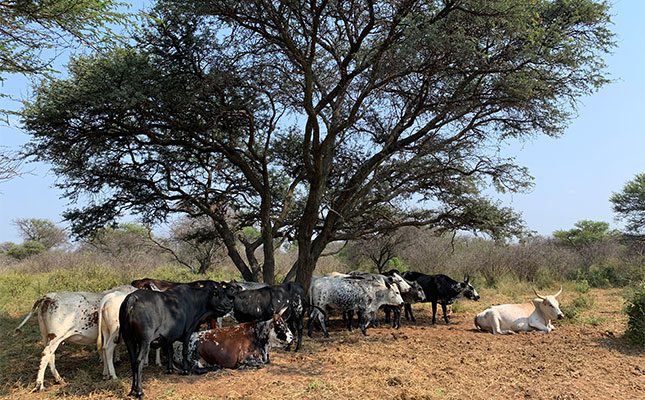
The Nguni’s large skin with an increased number of sweat glands adds significantly to its adaptation to extreme temperatures. The smooth, shiny coat reflects ultraviolet rays, keeping body temperatures even. Furthermore, their short, fine, oily coat and motile hide make them resistant to ticks and tickborne diseases.
“Lastly, the Nguni has naturally higher blood urea and rumen ammonia levels, which makes it possible for the animals to maintain body condition during winter.”
Production
The calves grow rapidly and are often weaned at more than 50% of their dams’ weight. The intrinsic qualities of the breed ensure easy maintenance and labour, and veterinary costs are relatively low.
Nguni produces meat at a lower cost per unit than most other beef cattle breeds.
“They require little supplementary feeding and are able to graze and browse on the virtually impassable areas of our land, because of their strong walking ability. It is an early maturing breed that is highly efficient at converting even poor-quality veld into prime beef.”
Feedlots
According to Prinsloo-Van der Linde, there are, unfortunately, indications that some feedlots or buyers for feedlots intentionally discriminate against Nguni and Nguni-type animals.
She therefore welcomes the recently announced agreement between the Nguni Cattle Breeders’ Society of South Africa and the Beefmaster Group, which, according to her, contradicts the false narrative about the breed’s performance in feedlotting.
Farmer’s Weekly reported on 24 June 2025 on an agreement that was reached between the Nguni Cattle Breeders’ Society of South Africa and the Beefmaster Group’s feedlots.
According to Nico Harris, president of the society, the agreement is good for the industry, as other feedlots penalise Nguni weaner producers by as much as R8/kg.
Breeding herd
“Our breeding herd currently consists of 48 females, with one bull. We change the bull after a breeding season or two and bring in a new one.
“The last two seasons we weaned the calves with nose rings, which caused much less stress,” adds Prinsloo-Van der Linde.
“After two to three weeks, the young bulls are separated from the females and put with all the other bulls.”
Heifers are put to the bull at approximately 24 months of age.
Marketing
The BergAlleen stud animals are marketed via the Northern Nguni Club annual auction held in February and the animals are also sold out of hand.
The couple has expanded and started producing ground Nguni beef, hamburger patties and boerewors. Animals not making the grade are grown out on the veld and used in this way.
For more information email Cecilia Prinsloo-Van der Linde at [email protected].