
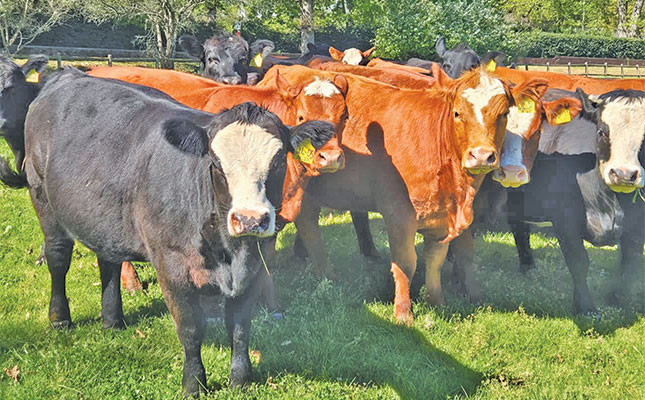
Introduced to Southern Africa from Europe in the 1890s, the Simmentaler has contributed more than a century of genetics to the region, evolving into a medium-framed, highly adaptable animal suited to local production conditions.
Jamie Berger, general manager of the Simmentaler Cattle Breeders’ Society of South Africa, defines the breed’s strength through a combination of measurable performance traits and functional efficiency.
Globally recognised as the largest dual-purpose cattle breed, the Simmentaler has, in Southern Africa, developed into a distinctly performance-oriented beef animal. Its competitive edge lies in its combination of growth, fertility, and maternal capacity.

Adapted across diverse climatic zones
Berger says one of the breed’s defining traits is its environmental adaptability.
Simmentaler breeders operate across a broad spectrum of production regions:
- High-rainfall sourveld and areas with high tick pressure in Mpumalanga and KwaZulu-Natal
- Bushveld regions of Limpopo
- Semi-arid areas of the Karoo, such as Hopetown
- Sweetveld regions of the Northern Cape and far North West
- Mixed crop and livestock systems of the Free State and North West
- The dry sweetveld Namibia and Botswana
- High-altitude cold regions of the Eastern Cape
- The Mediterranean-like climate of the Western Cape, with hot, dry summers and wet winters.
Through decades of selection, the breed has shifted from heavier European types towards a more moderate frame. This change improved its walking ability, forage utilisation, and resilience under veld conditions
The result is an animal that maintains condition and productivity across sweetveld and sourveld systems while coping with high tick loads, weather extremes, and variable rainfall.
Growth benchmarks and feed efficiency
Under well-managed conditions, Simmentaler herds consistently deliver competitive production metrics. Typical weaning weights range from 280kg to 320kg for bulls and 250kg to 290kg for heifers.
Pre-weaning average daily gain (ADG) is between 1,2kg and 1,5kg. Post-weaning, with backgrounding, growth rates increase to 1,4kg to 1,8kg per day.
In feedlots, where most Southern African calves ultimately finish, ADG commonly reaches 1,8kg to 2,2kg.
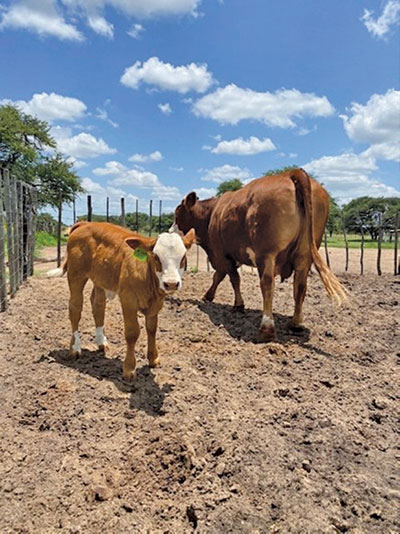
The breed consistently ranks among top growth and feed efficiency performers in structured performance testing schemes across Southern Africa.
An increasing area of focus is net feed intake (NFI), the genetic trait for feed efficiency that identifies the animals with lower body maintenance requirements.
Ongoing NFI testing within the breed aims to enhance feed efficiency without compromising growth or carcass quality. NFI benefits not only the feedlot but also cow and calf production on the veld.
Extensive systems vs feedlot performance
Simmentaler cow herds operate predominantly in extensive grazing systems and are able to maintain condition, produce sufficient milk, and deliver strong weaning weights on grass alone.
When weaners transition to feedlots, their genetic potential for rapid growth and feed conversion becomes evident. Producers report strong feed efficiency, high dressing percentages, and consistent carcass outcomes.
This dual capability in veld efficiency and feedlot performance strengthens the breed’s commercial appeal in integrated beef systems.
Carcass characteristics and market suitability
Berger says carcass performance is central to processor demand and retail appeal.
Simmentaler oxen typically achieve dressing percentages of between 58% and 62%, with some individuals reaching as high as 64%. These figures reflect favourable conformation and muscling.
Carcasses are commonly graded A2 or A3, with the following:
- Conformation scores of between 4 and 5
- Good carcass length
- High retail meat yield
- Balanced fat cover
- Strong eye muscle area
- Efficient bone-to-meat ratio
These characteristics align well with formal abattoir specifications and retail chain requirements throughout Southern Africa.
Maternal traits and fertility
Maternal traits are central to the Simmentaler’s success. Fertility is the cornerstone: cows must calve regularly, with short intercalving periods (ICPs) and high conception rates under commercial conditions.
Calving ease is closely monitored using EBVs for birth weight and calving ease in dams and their daughters, ensuring high herd fertility and calf survival.
Strong milk production supports calf growth, translating into above-average weaning weights. Replacement heifers retain these maternal advantages, contributing to long-term herd productivity.
Berger advises farmers to prioritise indicators that influence reproductive efficiency, including:
- ICP: the interval between successive calvings.
- Age at first calving: ideally between 24 and 30 months.
- Scrotal circumference: measured at 400 days, indicating male fertility and puberty.
- Structural soundness: proper conformation supports longevity and calving performance.
“Getting heifers to their target breeding weights and breeding them at 15 months allows them to calve at 24 months,” Berger explains, highlighting the link between growth and reproductive performance.
Genetic progress and performance efficiency
Genetic improvement within the Simmentaler breed is important. Berger outlines how EBVs and genomic tools are used to guide breeding decisions:
- Growth metrics: weaning weight, 200-day weight, and 400- and 600-day growth are core EBVs.
- Mature cow weight: selection favours medium-frame cows for better adaptability and efficiency.
- Feed efficiency: NFI traits help producers optimise feed conversion and reduce production costs.
- Reproductive traits: days to calving and scrotal circumference continue to influence herd fertility and sustainability.
The society recently adopted single-step genomic evaluations across Southern Africa, a major step in breeding accuracy.
“Our first release of this genomic analysis is set for the end of February. It enhances the accuracy of EBVs and allows breeders to make more informed selection decisions based on performance and genetic potential,” he explains.
For Berger, the combination of traditional selection methods and modern genomic tools ensures that Simmentaler cattle remain adaptable, productive, and efficient under Southern African conditions.
The breed continues to balance dual-purpose functionality with beef-focused performance.
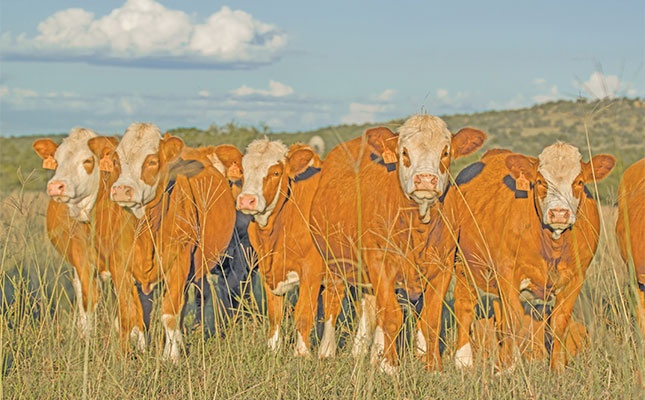
Simmentaler in crossbreeding
The Simmentaler’s versatility extends beyond purebred herds.
Berger explains that the breed excels in terminal and maternal crossbreeding systems, offering significant advantages to producers seeking hybrid vigour.
“In terminal systems, Simmentaler bull calves wean heavy, perform exceptionally well in feedlots, and deliver excellent carcass yield.
“On the maternal side, cows retain strong milk production and fertility, ensuring replacement heifers carry forward growth advantages and improved weaning weights,” he says.
This dual benefit allows producers to exploit heterosis while retaining high-quality Simmentaler genetics.
“Our bulls contribute growth, carcass value, and structural soundness in crossbreeding systems, while the replacement heifers continue to produce heavy weaners with strong fertility.”
Management practices for efficiency
Berger says genetic potential must be supported by the correct management practices. These include:
- Strict fertility selection: animals that do not produce consistently are culled.
- Controlled breeding seasons: this ensures optimal calving intervals and facilitates accurate selection of fertile cows.
- Heifer development programmes: targeted growth ensures first calving at approximately 24 months.
- Performance testing: systematic evaluation of growth, milk production, and structural traits ensures only top-quality animals contribute to the herd.
Practical advice for introducing Simmentaler genetics
For producers considering introducing Simmentaler genetics to their herds, Berger has several guiding principles:
1. Use trained inspectors to prioritise fertility and structural soundness.
2. Define your production system – extensive or feedlot – and select genetics or a breeding strategy, such as crossbreeding, to suit.
3. Use performance data from reputable Simmentaler breeders.
4. Buy registered bulls with certificates and documented fertility, growth, and carcass performance.
5. Support growth and reproduction through well-managed nutrition, breeding, and herd monitoring.
“Cow herd efficiency is everything. Your cows must calve regularly and produce calves with strong growth relative to their frame size,” he adds.
Advancing genetics with single-step breed plan
Berger says the breed’s progression has been accelerated through genomic technology.
Simmentaler breeders in Southern Africa now have access to single-step breed plan EBVs, incorporating DNA alongside pedigree and performance data. This marks a major leap in genetic evaluation accuracy.
The single-step breed plan simultaneously utilises pedigree information, performance records, and genomic (DNA) data.
By linking an animal’s DNA variants (SNP genotypes) to trait performance, breeders can achieve more accurate EBVs in younger animals, better outcomes for small herds, and greater returns on genotyping investment.
Traits such as growth, fertility, birth characteristics, and carcass quality benefit from more precise predictions, particularly in young or sparsely recorded animals.
Berger says that maintaining a strong reference population is important.
“Even with genomic data, ongoing performance recording ensures the reference population remains representative, allowing all traits, especially those difficult to measure, to benefit fully from DNA information,” he explains.
For more information email the Simmentaler Cattle Breeders’ Society of South Africa at [email protected], phone 051 446 0580/2, or visit simmentaler.org.