
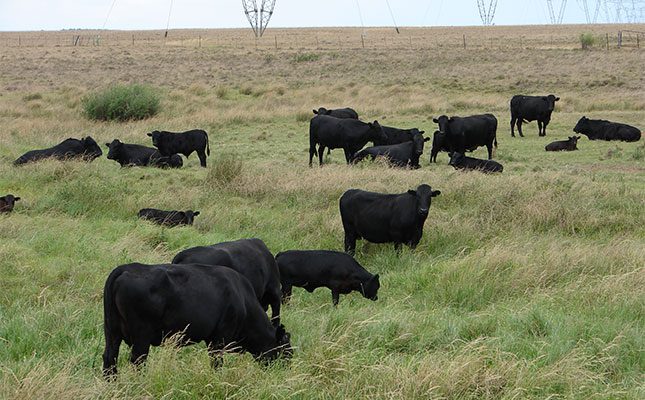
Indigenous black cattle was mentioned by the explorer Vasco da Gama in 1497 after he reached the southern tip of Africa. History has it that he apparently purchased an ox from local traders and was quite impressed by the meat quality.
As commercial cattle farming in the Cape colony increased after the arrival of the Dutch in 1652, Governor Willem Adriaan Van der Stel imported black Groninger bulls in the early 1700s. His objective was to cross the dual-purpose Groninger with indigenous cattle.
Groningen cattle, also known as Blaarkop, are typically black in color with a white head and belly. The breed’s ancestry can be traced to the Middle Ages. It has been mentioned in literature as early as the 14th century. The Groningen originated in what is now the northern sections of the Netherlands.
William Cornwallis Harris, a Victorian traveler and hunter mentioned the Vaderlander cattle, as the black cattle had become known by then, in one of his books after his arrival in South Africa in 1836. He referred to “the tough little Faderland oxen” and the fact they could endure hours on end without water in one of his books.
Vaderlanders
The cross breeding with, among others, the Groningens, eventually developed into a type of cattle known as Vaderlanders. Documented history showed that the Voortrekkers left the Cape borders by 1837 with teams of Vaderlanders pulling their ox wagons on their way into the interior of South Africa.
One of the trekkers, Jacobus Johannes Uys and his son, Dirk Cornelius Uys was to play an integral role in the development of the Drakensberger breed. Dirk, who was known as Swart Dirk, left Grahamstown in 1838 for the current KwaZulu/Natal.
Records show that the trekker families such as the Breytenbachs, Potgieters, Van Rooyens and Prinsloos also exclusively used teams of black oxen during the Great Trek (1835 – 1846).
Swart Dirk Uys (1814 – 1910) eventually settled in the district of Wakkerstroom in Mpumalanga. With methodical inbreeding and strong selection within a closed herd he took the breed to the next level in the development journey of the Drakensberger, as the breed is known known today. Swart Dirk’s breeding programme was continued by his son, Coenrad, and son-in-law MJ (Joey) Uys.
Uysbees
It was during the Swart Dirk-period that the animals became known as the Uysbees (“Uys-cattle”). Records show that the trekker families the Breytenbachs, Potgieters and Prinsloos who exclusively used teams of black oxen during the Great Trek.
Some Voortrekkers settled with their herds of Vaderlanders in the Free State Highveld, Transvaal and Northern Natal. The Drakensberger faced tremendous challenges in its development over the year. For example, in 1836 more than 5,000 of the Voortrekkers’ cattle were stolen near Heilbron in the Free State. The cattle were eventually recovered.
One positive outcome was that a number of local Nguni cattle was included among the recovered cattle. The recovered Ngunis were destined to play a decisive genetic role in the modern Drakensberger.
Rinderpest
The Rinderpest outbreak in the 1800’s drastically reduced cattle numbers in South Africa and its neighboring countries. Hundreds of thousands of cattle in South Africa, including scores of Vaderlands succumbed to the disease. Rinderpest was an acute, highly contagious viral disease of ruminants, primarily cattle and buffalo. It was declared as eradicated by the World Organisation for Animal Health Organisation (WOAH) in 2011.
According to the Oxford Research Encyclopedias Rinderpest reached the regions of modern Zimbabwe, Mozambique, Botswana, South Africa, Namibia, and southern Angola in 1986 before it burned out or was arrested by breakthroughs in vaccine therapy by 1900.
South African War
Rinderpest was closely followed by the outbreak of the South African War, also known as the Anglo-Boer War, which took place from 1899 to 1902. Scores of cattle were killed in the war as part of the British scorched earth policy, dangerously diminishing the number of Uysbees even more.
“However, Swart Dirk Uys not only fought in the war, but also fought hard to preserve his beloved cattle. He hid a portion of the family’s cherished cattle in the Drakensberg mountains and the cattle was never found by the British. After the war, he returned to his farm Gryshoek and the rebuilding of the Vaderland breed,” according to a report in the 65th Drakensberger Memorial Journal.
Act of 1934
The end of the South African War was not end of the Uysbees’ uphill battle The next challenge came from the South African government and specifically it’s infamous Livestock Improvement Act of 1934, which penalized breeders for using bulls from unregistered breeds in the country. At the time the Uysbees was not recognized as a bona fide breed.
Were it not for the efforts of an agricultural information officer, namely J.P. van der Merwe from Ermelo the Drakensberger could have been lost to South Africa forever. He is widely regarded as the one person that saved the breed from extinction by approving a bull named Gryshoek Konfoes under the Stock Improvement Law.
Drakensberger
That led to the investigation of the merits of the breed by a commission appointed by the Department of Agriculture. The commission recommended that Uysbees bulls be admitted, a selection committee be formed to select bulls and cows for further breeding and that the name Uysbees be replaced by the name Drakensberger.
The Drakensberger Cattle Breeders Associated was founded in November 1947. Following the society’s first official inspections in February 1948, 621 animals were allowed on the books. By the end of 1954 this figure had gone up to 1 723, and by 1961, a total of 4 752 animals were recorded. In May 1969, the Drakensberger Cattle Breeders’ Society was allowed to the SA Studbook as an associate member, and in 1972 as full member.
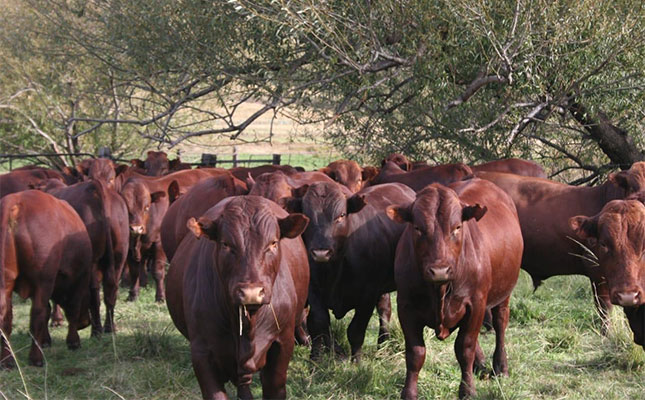
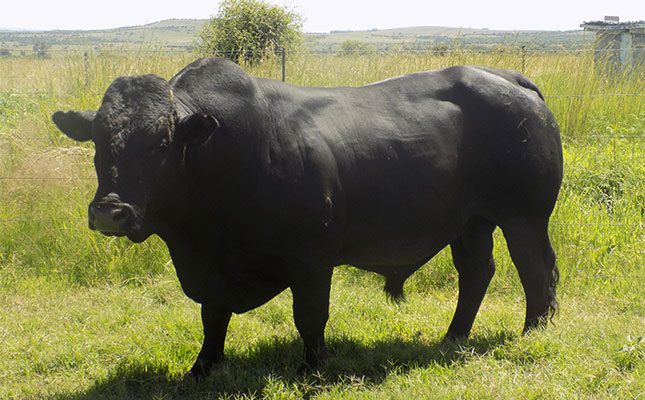
The Drakensberger has developed into a serious contender in the Southern African red meat production arena. It is extremely hardy, medium-framed with a smooth coat and an even temperament. One of the outstanding characteristics of the breed is its length and depth. strikingly long and deep body with a mild temperament.
Genetic worth
According to Dr Johann Fourie, President of the Drakensberger Breeders Society, the irreplaceable inherent and hard-won genetic worth of the breed makes it the ideal choice for both stud and commercial beef cattle producers.
“Not only is the breed known for excellent growth and top milk production, it has the ability to thrive under all farming conditions in Southern Africa.
“The top performers of this indigenous breed had been naturally selected over eons.
The natural selection coupled with the current scientific advances in cattle production resulted in a breed that encompassed all the important economic traits needed for profitable and sustainable red meat production,” he says.
Sources: oxfordre.com brittanica.com; drakensbergers.co.za.
For more information email the Drakensberger Breeders’ Society at [email protected].