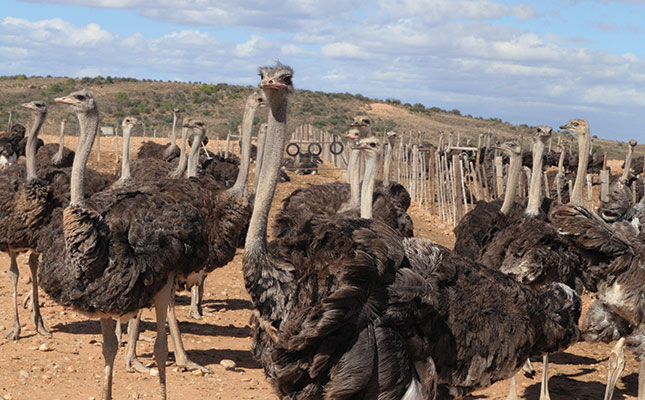
Peter Cunningham is one of only a few farmers still breeding ostriches in Zimbabwe. Speaking to Farmer’s Weekly, he said he started his operation in 1983, when the industry was expanding and global demand for meat and skins outstripped supply.
At that time, there were between 800 and 1 000 ostrich farmers in Zimbabwe, collectively accounting for up to 45 000 birds. Cunningham himself had more than 3 000 birds, along with an abattoir, an ISO-certified testing laboratory, and a tannery.
Today, he maintains about 200 of his top breeding birds due to land restrictions, market challenges, and other issues.
Cunningham, who runs his ostrich project in Matabeleland South, said most ostrich farmers lost their land when the government launched its land reform programme in 2000. He added that hyperinflation, which forced exporters’ earnings into Zimbabwe dollars, made the export industry unviable.
Unique ostrich genetics base
“I set up probably the biggest genetics base in the world, importing birds from South Africa, Kenya, Tanzania, Botswana, and Namibia. We had a very big breeding programme,” he said.
“We could slaughter a bird in six to seven months, whereas the average in South Africa is 11 to 12 months. We managed to get birds to slaughter weight on 250kg to 300kg of food. In South Africa, the norm is 450kg to 550kg.
“So, we had a very good genetics base here. Basically, I’ve just kept the breeding stock alive; we’re not doing anything commercial.”
Cunningham noted that Zimbabwe’s agriculture sector is now stable, and if it remains so for at least the next two years, he may consider going commercial.
According to him, the country used to export ostrich skins to the US, Korea, Japan, and China, and meat to France, Belgium, Germany, and the Netherlands, earning the country US$15 million (around R250 million) a year.
“We’ve kept a few of the top genetics from that time just in case the industry picks up again. Restarting the industry would take too much land and a lot of money. The veterinary controls for compartmentalisation and exports to Europe aren’t in place, so getting the industry going again would need a [major effort],” he added.
An industry led by small-scale producers
Cunningham said that at present, only a couple of safari operators are in the business, but there are no commercial operations left in Zimbabwe. The country’s ostrich farmer association ceased functioning around 2004.
He explained that during the industry’s golden era, 15 000 of the 45 000 birds were raised by small-scale black farmers contracted by commercial producers.
“[The other commercial farmers and I] used to raise 30 000 birds. We did the breeding, supplied the chicks, and then bought back the [finished] birds from small-scale farmers in communal areas,” he said.
Cunningham added that if Zimbabwe’s ostrich industry recovers, these small-scale farmers will also be back in business through contract farming.
Once a global leader
Dr Sitokozile Sibanda, director of the Department of Livestock Production and Development, said Zimbabwe was once one of the world’s top exporters of ostrich meat and leather, especially during the late 1990s and early 2000s. However, production later declined due to high input costs, market volatility, and disease outbreaks.
The country’s ostrich leather was particularly prized for its distinctive appearance and durability, attracting interest from US shoe manufacturers and other key international buyers such as Indonesia.
The meat was marketed as a healthy alternative to beef due to its low fat and high protein content. Export markets included Europe, the US, and Asia, with the industry being fundamentally export-driven, she added.
She added that ostrich farming in Zimbabwe has long been recognised for its economic potential, offering job creation in rural areas, increased revenue for farmers, and support for local businesses. It also offers a way to use land with limited value for conventional crops and provides an alternative source of income beyond the traditional livestock value chains.
“Today, Zimbabwe’s ostrich industry exists in a state of near-extinction. The infrastructure that once supported the industry has largely disappeared. Advisory networks and research initiatives have become dormant,” Sibanda said.
However, despite the industry’s grim current state, there remains theoretical potential for recovery, as Zimbabwean universities still possess research expertise in ostrich production, including veterinary knowledge on sanitary and phytosanitary measures, disease control, breeding practices, and farm management, she added.
Sibanda noted that interest in rebuilding the industry has resurfaced as farmers seek alternative high-value livestock enterprises.
She added that there are ongoing efforts by the government and private sector to revive ostrich production by offering technical advice and encouraging new farmers to enter the industry.
“However, any meaningful revival would require multiple conditions to be met, such as the restoration of investor confidence and international market access, reconstruction of processing infrastructure, development of reliable feed supplies, and significant capital investment.
“Most importantly, it would need a comprehensive support network, including veterinary services, research programmes, and advisory systems,” Sibanda concluded….