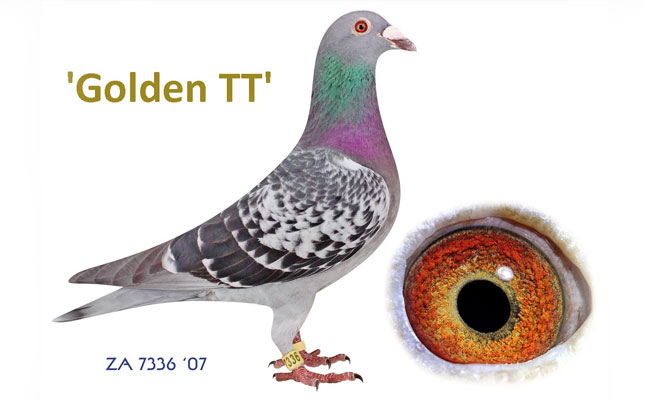
The focus is on a superior female racing pigeon known as Golden TT, bred by Pretoria-based father and son Johan and Mark King. In part 2 we will discuss the pedigree background of Golden TT and the impact of the females in her family tree. In demonstration of precision and clearness, I humbly have to share my own journey with high-quality pigeon breeding and the impact of a female in a winning foundation.
Decades of experience with racing pigeons
I turned 70 in May last year, and after 57 years in racing pigeon breeding, I have to conclude that we are at the mercy of the integral power of genetics being passed on, rather than pigeons that are perfect in phenotype. And we seemed to have missed the value of females providing the continuation of the golden thread in the success of a champion loft.
Battle of the sexes
The impact of women of worth in a male-dominated society is not always recognised. It’s a known gender-based issue of discrimination that is thankfully being addressed – socially, economically and politically. Reliant on the quality of leadership around the world, it’s not an easy journey for all, but there are signs of progress. Applied to pigeon racing, we should better analyse the impact of hens in a winning pedigree.
A high-quality foundation male racing pigeon has always been praised for its value and placed on the highest podium. The fact that it was actually hatched from an egg laid by its mother is for the most part often entirely ignored.
Acting as a selector for prospective buyers over many years, I often attended racing pigeon auctions. I studied the pedigrees of the pigeons available for sale and assisted pigeon fanciers with their choices of purchase. Since my preschool days I had been familiar with racing pigeons, referred to as homers then, and I received my first ‘official’ racing pigeon in 1968 at age 13 from a Dutch fancier, Jan Donk, who lived near our school. He was busy selecting his pairs with the help of an assistant during one of my visits. I was made aware that certain pairs were more successful as a match than others.
Success with females as a novice
I volunteered to care for champion fanciers’ pigeons in Pretoria during school holidays and studied their ‘click’ pairs. I then applied my findings at my own loft. Besides winning the Yearling National in my first season, I needed one point to win the club’s First Bird To Count Yearling Points League Champion Averages. Our club secretary, the late Rudolph van der Stoep, did his own calculations and found that I would have won the All Birds to Count Champion Averages had it been tabled.
I was told that there was a breaking point when the bigger packs start to split up when the pigeons enter Pretoria on race day. The flock sways to the east of the Soutpansberg mountain range. But I still weekly scored a number of top positions at union level while residing at the western flank on the wrong side of the mountain that is in the pathway of the returning pigeons. Pigeons are generally flock-bound, and inexperienced pigeons are scared to fly on their own during the races.
Race liberations were held from south to north. This means that the pigeons entered by the fanciers located north-west of Pretoria needed to break away from the front packs before or at the breaking point before the mountain to score well. Should they remain with the packs swaying to the east, they would need to make a U-turn at some point, but would miss the scoreboard. Most of my top-scoring pigeons were females. I had some brilliant males, but my hens were more reliable.
Meeting a mentor
We lived next to a café in Riviera, Pretoria, and shopping there while attending a nearby college in 1972, Prof EP de Jager from Worcester, Western Cape, saw my pigeons flying and came to meet me. I just completed the aforementioned successful pigeon season as a novice and changing to the senior club at the time of De Jager’s visit. He shared a few important pointers with me. He told me to distinguish between phenotype and genotype. As he handled my pigeons, he commented that my success came about as a result of the suitability of my matings that delivered well-balanced, streamlined racers.
Besides the quality within the genotype, the complementary difference of the variations of the phenotype between the matings creates a pathway that maximizes the genetic potential. It was notable that some of the female breeders ‘clicked’ with more males, but changing some of the males to different hens was disappointing. There were exceptions, but for the most part, my female breeders and racers were more consistent.
Male versus female progeny testing
Quality testing of the offspring disadvantaged the hens as between her resting periods a hen will annually raise 12 to 16 offspring compared to one male used in a stallion system that can breed 100 or more youngsters in the same year mated to different well-rested hens. Hens lay two eggs per round and may be mated with two to three males in the same season, but need a rest after the third round as they are not ‘laying machines.’ There are fanciers that claim their hens remain in good condition to breed four continues rounds with proper nutritional care. But in my view, they will then need a long rest of at least two to three months.
Quality versus numbers
Not everybody breeds according to the stallion system with their males, but can mate them to different hens and transfer the eggs of the hens to foster pairs. Thus, they produce a larger number of offspring that can be tested. It is often found that a male may produce his best offspring with a specific hen, which suggests an advanced ‘click’ between the mating. However, a hen with strong passing-on powers seem to more readily transfer her quality genes to her offspring with more consistency than the male.
Buying Golden TT
Acting as a selector for friends, I physically examined the pigeon Golden TT in lot 30 at the auction of Johan and Mark King on 9 August 2013. She was slightly larger than average, a muscular showpiece that ticked all criteria as a choice of purchase. I end up buying her at R40 000 for Vryburg cattle and wildlife farmer Willie de Jager in absence of his initial permission. He had no phone signal at a remote location during a car breakdown during the bidding, but gratefully accepted my recommendation afterwards and informed me that Golden TT would be co-bred with Alwyn Bester and friends.
Golden TT’s achievements
Golden TT achieved five top ten scores at union level and was crowned the middle-distance gold medal winner in the Pretoria Union. She was also the SANPO long-distance bronze medal winner and won R50 000 in the Expensive Ring Race. Fascinated by her quality, I selected a number of her kin at auctions for buyers.
- Golden TT’s mother Twilight Pearl, which I also bought for a client, bred a short-distance silver medal winner, a middle-distance gold medal winner, and an extreme long-distance gold medal winner.
- A daughter of Golden TT, which I bought for Johan Hamilton, was resold to Alwyn Bester at a friendship request to further the gene pool, and she bred the pigeon Dart that became the grand average champion at the Victoria Falls World Challenge Pigeon Race.
- The sister of Golden TT is 4790 ZA 15 K NWPK, the granddam of Turbo Kittel, third best all-round distance pigeon in the world in 2021, and six times SANPO gold medal winner.
- The offspring of Golden TT and her immediate relations include Julia ZA CRU 1955-21, winner of the Afrika Pro Final 2021 (US$170 000); Qatar Horse, fifth in the Afrika Pro Final 2021; Gys Pick, ninth in the Afrika Pro Final 2022; Valya 1, fifth in the Afrika Pro Final 2024; Sierra Blu, sixth in the Afrika Pro Final 2025; Fiero, second in the Final Afrika Pro 2025; Lara, third in the Final and Overall Ace, and Ace bird Long Distance Afrika Pro 2025. ‘Blue Moon’, first in the Final and grand average champion at Dinokeng One Loft, and sold for R400 000.
- Blue Bar Male 90692 ZA 18, bred from a full brother and sister of Golden TT, was a super breeder that bred 13 winners and was sold for R242 000.
- And many more scores, including car winners.
Foundation males are great, but females used within a successful colony appear to be extra special.
Golden TT’s family tree includes progenitors of combinations of extraordinary quality lines from Norbert Sierens, Banie Deetlefs Turbo Tom, Powell, and Twilight, and will be discussed in part two of this series.