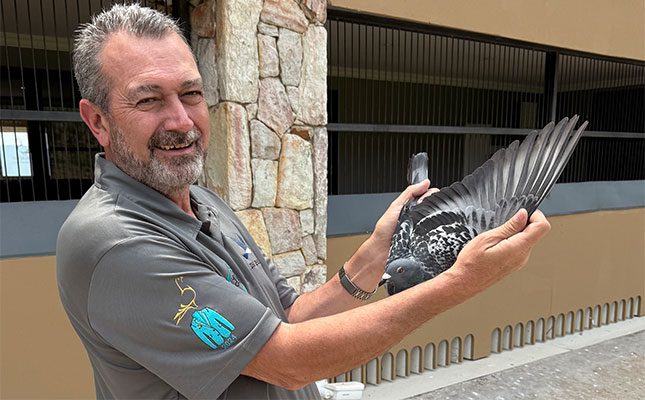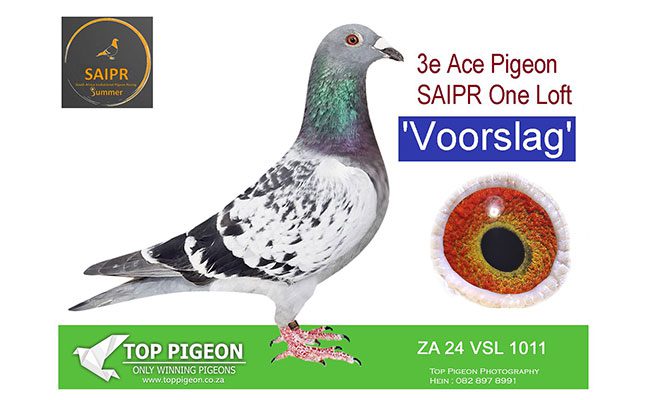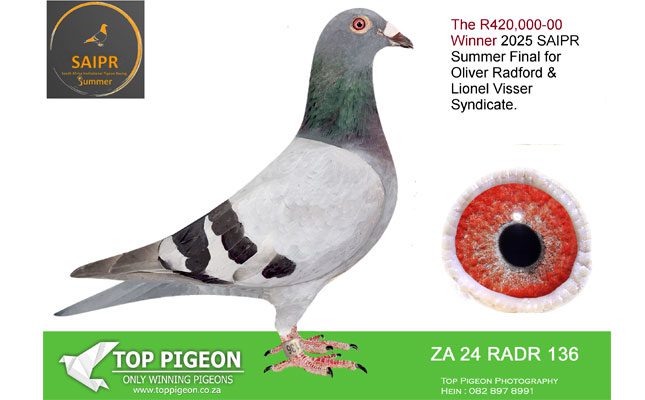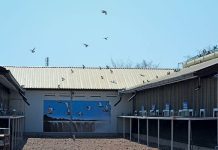

The Loft Complex is situated at the Phala Phala Wildlife game farm in Limpopo. As explained in part one of this series, fanciers that achieve the most consistent results over all 10 races with the majority of the 15 to 20 pigeons they entered, get the golden handshake and largest cut of the winning cash from the prize kitty.
South African team Pigeon Palace won R5,3 million in the AfrikaPro 2025 Series. Its syndicate members are attorney Gys Louw and his wife Judith, Mark and Rolien King, and Bianca and Cyle Bellamy. Headed by the expertise of veteran pigeon fanciers Louw and King, they combined their breeding talents from their lofts at Pigeon Palace in Pretoria four years ago.
Pigeon Palace performance highlights of 2025 (pigeons bred by King and Louw):
- US$100 000 Winner Fancier of the Year Award (Black Jacket competition). They also scored 10th position with their Syndicate Kings & Gys Louw (Team 2), winning a further US$2 400 in this category with their pigeons Fast Finfoot and Lively Turaco.
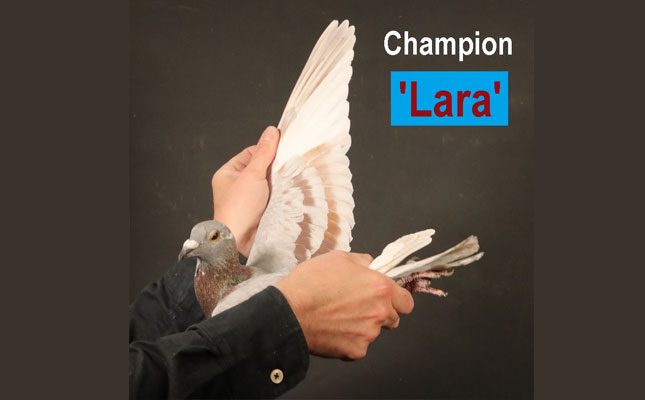
- US$75 000 Winner Blue Jacket, overall Ace pigeon award with Lara, which completed all 10 races in the fastest combined flying time (she scored top 100 in five of the 10 races). More top rankings in the Blue Jacket Competition of Pigeon Palace in their various syndicates, including these positions: 23rd Sierra Blue, 26th Nicolai, 43rd Path Finder, 47th Fiero, and 72nd .
- US$18 500 Winner Brown Jacket Enduro Champion won with Lara for the highest accumulated score in the furthest five races of the 10-race series. Lara was followed by Sierra Blu in position 26 and six more finishers in the top 100 in the Brown Jacket Competition.
- US$1 800 Winner Fancier of the Race Award with Fiero and Lara: shortest accumulated flying time in the 10 races.
- US$48 000 for 2nd place in the AfrikaPro final race, with Fiero arriving with the winner but entering the loft 11 seconds later.
- US$15 000 for 3rd place in the AfrikaPro final race 10 with
- US$4 800 for 6th place in the AfrikaPro final race 10 with Sierra Blu.
- 24th with Jingling Jacanain the Green Jacket competition.
- The Sprinting Champion Pigeon is determined by the shortest accumulated flying time over the first five races of the season. King and Louw had five pigeons within the Top 100 within this category in 2025.
Past performance highlights from Louw and King stock include:
AfrikaPro 2024
- 6th, 16th and 26th in the Fancier of the Year Award Black Jacket competition after dominating the series, leading the Black Jacket competition for eight weeks prior to the final.
- Four positions in the top 100 of the 2024 Final, and eight positions in the top 100 of the Blue Jacket competition. They scored 13th, 14th, 19th and 50th in the Fancier of the Race award.
- Second in the Country Cup. The accumulated flying time of the first three pigeons of each country determines the Country Cup winner over the series
- 3rd and seven more positions in the top 100 of the Green Jacket competition.
- Eight positions in the top 100 of the Brown Jacket Enduro Champions competition.
AfrikaPro 2023
- 3rd Fancier of the Year award in the Black Jacket competition with Numero Uno and King Africa, followed by 8th and 22nd positions.
- 22nd in the Final with Judsey and seven more positions in the top 100 of the Final.
- 4th and 16th in the Fancier of the Race award.
- 29th and 52nd in the Green Jacket competition.
AfrikaPro 2022
- 9th and 14th in the Fancier of the Year award (Black Jacket competition).
- 1st in the AfrikaPro Final with Julia, 6th in the Final with Speedwell, 9th in the Final with Gys Pick.
- 10th in the Final with Blueberry, 17th in the Final with Poison Olive (seven times in the top 100 in the series), 31st in the Final with Marula, 56th in the Final with Wild Pepper, 57th in the Final with Le Mans, and 60th with Dahlia.
- Ummbirka 14, the pigeon in 5th position of the Final, was also bred from King Louw stock. It also won the AfrikaPro Race 8 and scored eight times in the top 100 in the series.
- 6th, 14th and 19th in the Blue Jacket competition and three more positions in the top 100.
- 1st, 3rd and 4th in the Fancier of the Race award.
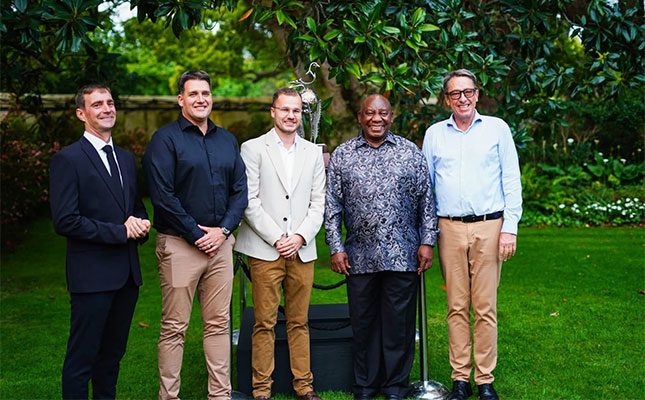
From left: AfrikaPro Premier One Loft series race director Hendrik van Wielligh, Pigeon Palace syndicate members Mark King and Cyle Bellamy, President Cyril Ramaphosa, presenter of the annual race, and syndicate member and attorney Gys Louw. Pigeon Palace won R5,3 million in various categories of the 2025 AfrikaPro series. Not present are syndicate members Bianca Bellamy, Rolien King and Judith Louw.
Planning and strategy – one swallow does not make a summer
King and Louw breed around 180 youngsters per season and select their candidates for Afrika Pro from them. They each have more than 50 years of experience in pigeon racing.
The general view amongst the champion fanciers in the racing pigeon Industry is that you are doing well if your success rate as a breeder is to produce between 5% and 7% of top racing pigeons per season from around 100 youngsters bred. In my research for this article, some fanciers were cautiously in agreement with this calculation.
However, both King and Louw say: “Pigeon breeders should stretch their ambition and raise their hit rate through strict discipline of selection of their breeding stock.”
Horses for courses, shape and size
Many fanciers are in agreement that there are racing pigeon families that demonstrate a preference for either fast- or slow-paced racing, whilst some are talented as all-rounders. Some fanciers are of the opinion that race preparation can be adjusted to get any pigeon in form for either fast or slow-paced racing events.
Whilst there may be some merit in this opinion, a study of the pedigrees of the top-scoring pigeons at the different money lofts in South Afrika show a preference for the climatic conditions and demographic demands between the different regions. The average comfortable speed of a racing pigeon varies from region to region as it’s influenced by heat and humidity, and also the pigeon’s genetic make-up.
Louw and King prefer a medium-sized racer and select from all-round criteria with special focus on champion racers, emphasising repetitive top performance as a result of world-class genetics.
In Johannesburg, statistics over the past 41 years demonstrate an increase of the average flying velocity. First measured in 1984, the average combined flying velocity after a completed season escalated from 1 230m/minute to 1 500m/minute in 1995, which is 90km/h.
The average wing beat of a racing pigeon is 5,5 beats per second, which equates to approximately 330 beats per minute. It’s influenced by its health and fitness level, aerodynamic efficiency (phenotype) and overall quality of breeding (genotype). During a race event, the average wing beat can increase due to flock motivation and extended level of fitness. The will to win and territorial temperament also come into play.
A fit racing pigeon’s heartbeat rises to approximately 600 beats per minute during flight compared to 150 beats per minute of that of a human being during exercise.
Some racing terminology explained
Sprinters. In 2022, the AfrikaPro final race was won by the King and Louw team with Julia at 1 501m/minute. It was the fastest final since the race’s inception. They scored 26th in race 6 at 1 993,0614m/minute (120km/h) with Gys Pick timing in only 40 seconds behind the winner. The talent for speed is not necessarily limited to fast-paced racing over short distances.
However, not all sprinters can handle the demands of a fast-paced race over an extended distance. Fast-paced race events are often accompanied by a helping wind blowing from behind, assisting pigeons towards their destination.
In the pigeon industry it is called a ‘blow home’ race. Sprinters may need extra care to assist with recovery. The AfrikaPro Green Jacket Sprinting Champion is determined by the shortest accumulated flying time over the first five races of the season.
Headwind stayers. This is an expression that applies to pigeons with a slower wing beat action, which means they are not comfortable in fast-paced race events. In addition to that, slower pigeons will be airborne for longer to cover the same distance as the faster racers, and will need to have the factor of endurance.
They may outfly the sprinters that fall behind on extended flights, where sprinters do not have the ability to endure humidity, heat and distance. The velocities of Louw and King’s 2nd, 3rd and 6th positions in the 2025 AfrikaPro Finale were between 1 136m/minute and 1 155m/minute, or between 68,1km/h and 69,3km/h.
If one deducts the extended hours of flight in race 6 by Fiero and recalculate his average speed based on nine races, his average flying velocity rises to 80km/h. The fact that he arrived with the winning pigeon in a tough Final rates him close to the high-class performance of Champion Ace bird Lara.
Regardless of the difference in their selling prices, Fiero’s genetic potential might be closer to that of Lara than you think. As a bonus they share the same father.
All-round champions. These are pigeons that are hereditarily gifted with a combination of enough speed, endurance and advanced direction-finding ability. They give their best on all distances in a diversity of loft locations and weather conditions.
Louw says all-rounders from a strong competition field are the first-choice genetics from which to consider your choice of purchase to enhance the gene pool of your stock. Both Louw and King are known over the years for the large number of all-rounders they have bred to take part in national competitions.
Much admired for their friendship and expertise by Louw and King are personal friends and mentors such as Belgium champion Jo Herbots, renowned veterinarian Dr Henk de Weerdt, and Thomas Gyselbrecht, owner of PIPA, the largest online auction sales house for pigeons in the world.
On the same world-class level as national medallists and international Olympiad achievers, it’s no coincidence that Lara sold for R2,4 million, Fiero for R360 000, and Sierra Blu for R280 000. On behalf of Farmer’s Weekly, a huge high five to King and Louw for doing South Africa proud with your passion for pigeon breeding and racing.