Riversdale Piggery, located outside Riversdale in the Western Cape, officially went into production in 2020.
It is collectively owned by Number Two Piggeries, an agricultural holding company primarily involved in the pork and dairy industries, and Jireh Foods, which owns several diversified farms and a dairy in the Riversdale area.
Jireh approached Number Two Piggeries with a mutually beneficial proposal: Number Two could provide piglets to Jireh, which they could grow out using highly nutritious whey produced during the cheesemaking process at Jireh’s dairy.
This means Number Two has an additional market for their piglets, and Jireh can turn whey – a waste product – into a money-spinner.
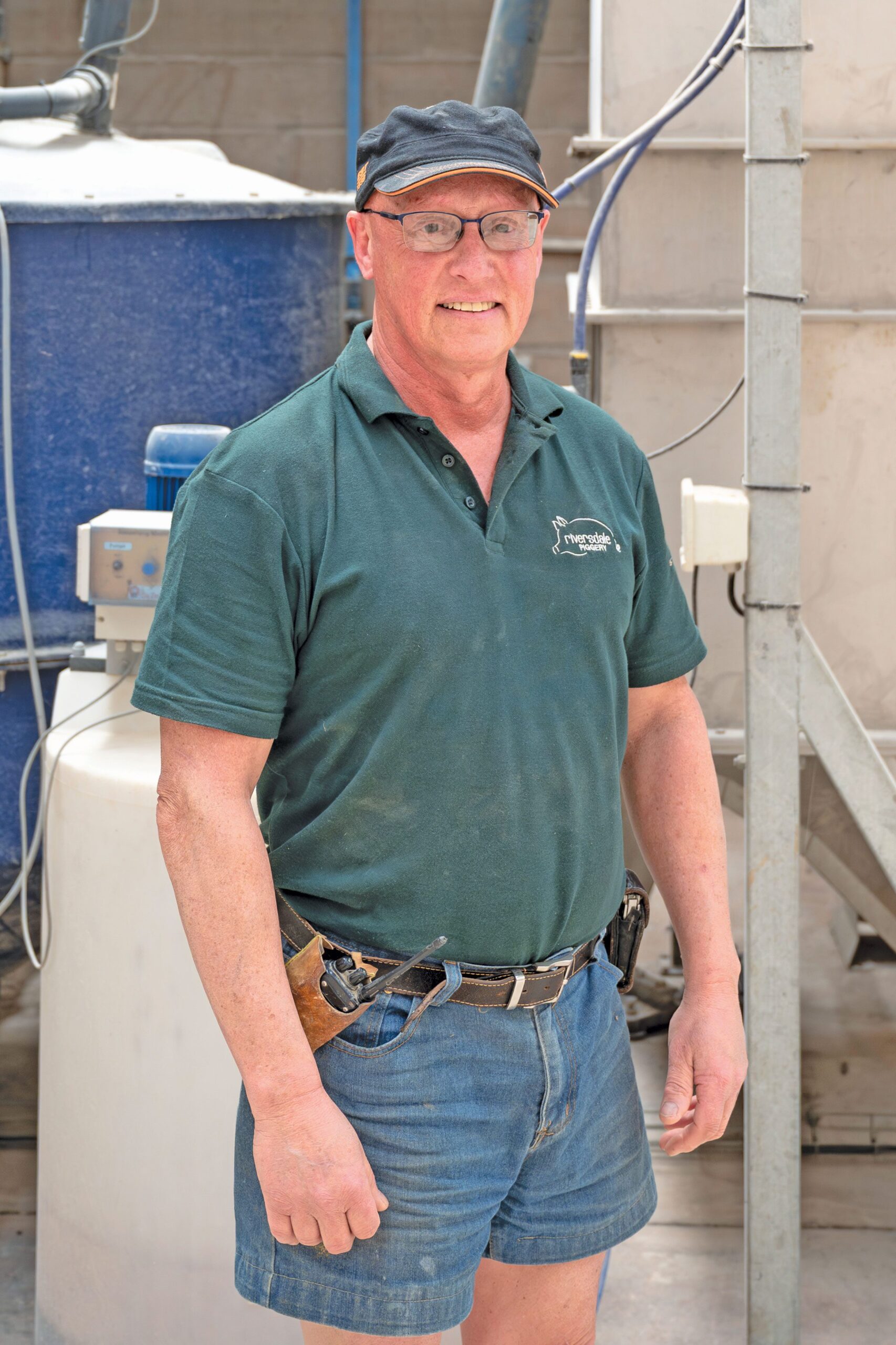
Jan Streicher, manager at Riversdale Piggery, has been in the industry for 22 years. He works alongside his wife, Susan, who manages the weaner piglets, and his son, Simon, who is an assistant manager on the farm. There are also six additional full-time staff members.
Riversdale Piggery is exclusively a boar weaner-to-grower farm; thus, no sows are kept.
The sows that provide piglets for Streicher are farmed separately in a farrow-to-weaner unit of 3 240 sows, located in Moorreesburg, called Alexandershoek Piggery, which is also owned by Number Two Piggeries. This way, Streicher avoids spending production time and input costs breeding his own piglets. Instead, he receives quality offspring from Number Two Piggeries.
“Sows are kept separately so that we have better outbreak control when diseases like African swine fever become a risk.
“Separating the operations allows us to avoid the entire production cycle potentially coming to a halt, which could cause major losses,” says Streicher.
He also divides the units because each has its own growth cycle, particularly with regards to how much time and nutrition is needed. Sows are grown out for longer periods compared to boars.
Streicher does not castrate his boars, so they must be sent to market before they reach 160 days old to avoid boar taint, an unpleasant odour and taste in boar meat caused by chemical compounds released when males reach sexual maturity.
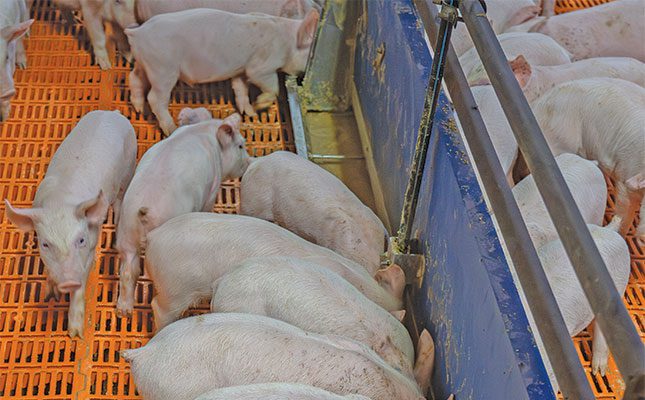
Riversdale Piggery houses 14 000 Landrace and Large White pigs in seven large housing units divided between the weaner and grower phases, with a stocking rate of 1m² per pig for growers, and 0,4m² per pig for weaners.
“The Landrace and Large White pigs are popular commercial breeds that produce good- quality meat. They also have good mothering characteristics and have steady growth rates,” he says.
Streicher receives 750 piglets per week from Alexandershoek. The sows are artificially inseminated with PIC 337 genetics and each produces up to 31 piglets per year. Alexandershoek maintains an 87,6% farrowing rate. The weaned piglets are 26 days old, weighing around 8kg when they arrive at Riversdale Piggeries.
Growth cycle
New weaners are placed in the weaner unit for 38 days under strict automated temperature control. The unit is kept at an average of 28°C because piglets are sensitive to cold weather, and they cannot properly regulate their body temperature.
Streicher aims to more than triple the weaners’ weight over the 38-day period. To achieve this, he utilises liquid feed eight times a day, with one-and-a-half hour periods between feeds.
Each piglet consumes approximately 1,45kg of dry feed and 6ℓ of whey per day, mixed in a ratio of 1:3. After 38 days, the weaners weigh 26,5kg and are then transferred to the grower units. Weaners average a daily weight gain of 500g. Streicher uses Piglet Creep and a weaner feed from Meadow Feeds.
Whey is a by-product left over from producing cheese. Dairies have no use for whey, so piggeries feed it to pigs for its high nutritional value. It is rich in protein and minerals and is easily digestible, which ultimately supports rapid weight gain.
The use of whey for their feed programme significantly reduces costs. Being able to utilise the dairy’s waste product is one of the main reasons the establishment of the piggery was feasible. Riversdale Piggery does not pay for the whey that they receive, only for transportation costs. Feed cost is the piggery’s biggest expense, so cost-effectiveness is key. The piggery receives 35 000ℓ of whey per day, adding to over 200 000ℓ on a weekly basis.
“We are using the whey as fast as the dairy can produce it. It plays a crucial role in how we manage consistent weight gain,” says Streicher.
The grower units are not under strict automated temperature control. The focus shifts away from heating and more towards adequate ventilation, cooler internal temperatures, and airflow to prevent heat stress. The pigs stay in the grower unit for roughly 92 days until they reach a target weight of 121kg.
Once the target weight is reached, they are sent to an abattoir for slaughtering. Streicher sends pigs to market three times per week on average.
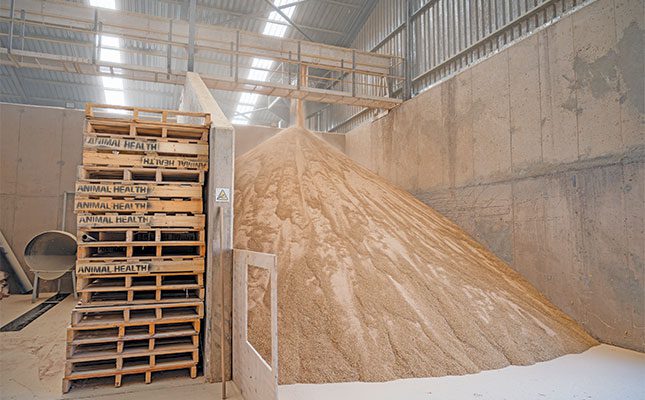
Grower boars are fed five times per day with three-hour periods between feeds. They receive three different grower feeds in varying stages of growth, gaining about 1,02kg per day. Streicher produces his own grower feeds, referred to as ‘Grower 1’ and ‘Grower 2’. The grower feed is made on-site using maize, soya oilcake, and a premix that is recommended by an animal nutritionist.
Grain is delivered almost daily to sustain the feeding programme. ‘Grower 1’ is used for the first four weeks, followed by ’Grower 2’ for five weeks, and then backgrounding is done using a finisher feed for the last three to four weeks.
The grower feeds are used in conjunction with 6ℓ of whey per pig per day. Each pig consumes 2,1kg of dry feed per day mixed with the added whey in a ratio of 1:3.
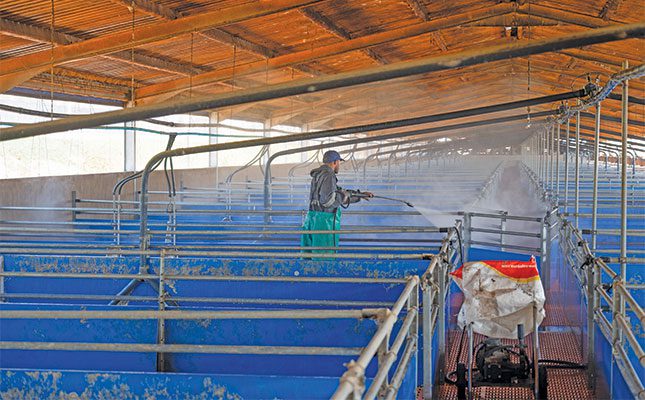
Because grower piggeries follow a consistent, high-volume feeding programme, the staff need to ensure pigs have feed available at all times. Riversdale Piggery utilises an automated Big Dutchman liquid feeding system that uses software to control production and distribution of feed to each house based on the average age and weight of every pig.
Staff monitor each grower and weaner house daily to determine the rate at which pigs are feeding and whether volumes need to be adjusted.
Although the system removes the need for manual feeding, it requires constant maintenance and upkeep as the feeding pipes can get blocked or start leaking.
Grower or weaner dry feeds are mixed with the whey to form a mash, which is pumped through a pipeline to every unit. Although this system contributes to high input and maintenance costs, it increases overall efficiency and output. Streicher maintains a feed conversion ratio of two, meaning that 2kg of feed is required for every 1kg of animal growth.
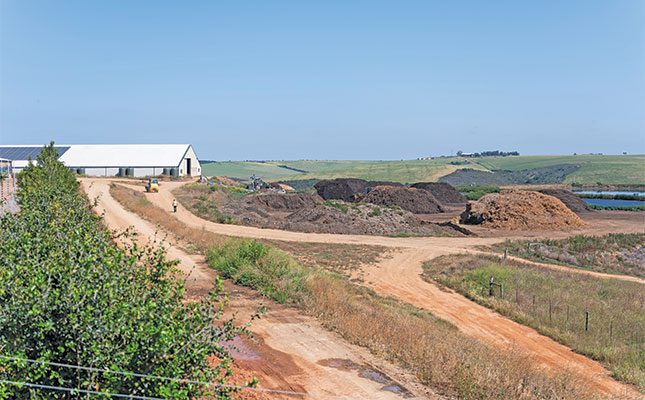
Jireh Foods uses the pig manure and the water extracted from the manure to fertilise and irrigate their crop farms, to aid soil health and decrease fertiliser costs. The manure is rich in nitrogen, phosphorus and potassium, which are essential nutrients for crop growth. The unit floors have spacings to collect manure in a catchment system.
The manure is then flushed out and collected in a press separator to separate water from the solids. The solids are used to make compost for the Jireh farm crops, and the water is purified for use in irrigation systems. This process receives yearly internal and external audits to ensure safe practice.
Biosecurity measures
Streicher highlights the importance of thorough biosecurity measures on pig farms.
“Good biosecurity is by far the most crucial practice. We can suffer major losses within a matter of days caused by one lapse in adherence to protocol.”
Riversdale Piggery adheres to state-enforced compartmentalisation safety measures, and the farm receives annual audits.
Streicher’s first line of defence is fencing both on the property line and around the housing units, with cement barriers to prevent other animals from digging under the fence line. The farm’s entrance has a spray booth for trucks to be decontaminated upon arrival and departure.
All staff and visitors must sign a register and shower before changing into provided clothing, and all objects are decontaminated before their intended use.
Internal staff undergo extensive training in order to ensure good hygienic practices and to learn how to monitor both the housing units and the surrounding areas.
All housing units have foot baths at every entrance and have multiple doors that divide pens to prevent pigs from escaping or accessing another pen. This system is part of the farm’s compartmentalisation safety measures.
External truck drivers must also adhere to strict distancing to ensure the non-physical biosecurity barrier is not broken. This barrier acts as a divide between the farm and external factors such as contractors and vehicles.
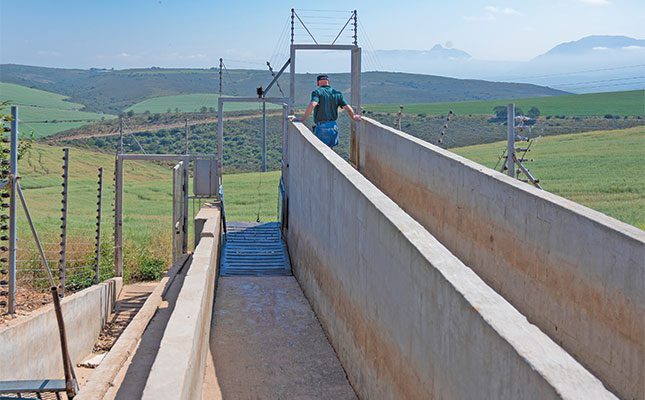
Drivers stay in their trucks when pigs are being handled, and only farm staff may perform the loading or unloading process.
Staff may not touch the truck. All loading ramps are disinfected after use.
Blood tests are done twice a year on pigs to test for high-risk diseases like foot-and-mouth disease, classic swine fever and African swine fever. These strict preventative measures have allowed Streicher to avoid any outbreaks.
“We have retained a good health status on our farm. As long as we ensure our biosecurity programme stays consistent, we have done our due diligence.”
Streicher hopes to see market conditions for pork meat stabilise over the coming years.
Ensuring success
“In South Africa, the demand for pork fluctuates and prices are generally lower than international markets,” says Streicher. Although pig farming carries constant risk, Streicher manages the large-scale piggery with thorough preventative biosecurity and an advanced feed programme that allows the production cycle to run optimally.
Get trusted farming news from Farmers Weekly in Google Top Stories.
➕ Add Farmers Weekly to Google ✔ Takes 10 seconds · ✔ Remove anytime