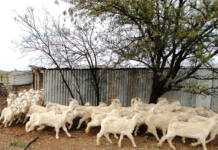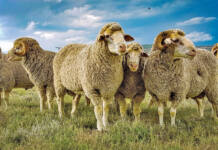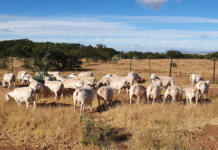

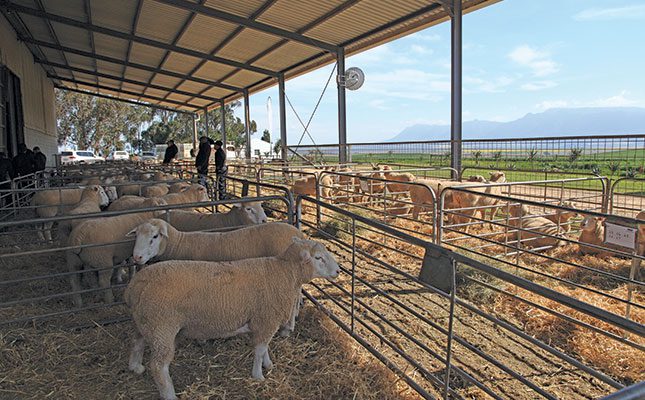
If you are looking for top-class Dormer genetics, the Kinko Dormer stud in Swellendam should be on your radar.
The stud’s story began in 1999, when Johan Swart bought the entire Dormer stud belonging to a family friend, Thys Swart. At the time, the stud had already been running for several decades and was well regarded in Dormer circles.
“We used to buy a lot of Dormer rams in a year from ‘Oom’ Thys, and I always asked if I could buy a few ewes as well. Then one day he agreed to sell me a few of his animals, but when I saw the ewes in the yard, I ended up buying the whole flock at R390 an ewe, and R900 a ram, which was double the price of commercial ewes at the time. ‘Oom’ Thys was already well advanced in his years, so he wanted to scale down,” Swart recalls.
Thys used to be known locally as Thys Kinko, after the Kinko River that flows through what used to be his farm. To honour his legacy, Swart decided to reregister the stud as Kinko Dormers.
“Oom Thys bought his first 10 Dormer ewes back in 1963, and registered the U-Dormer stud in 1974,” he says.
Swart recalls that Thys, back then, used to trade an entry-level ram for three or four slaughter lambs, and his better rams for five.
Efficient systems
Like his father, Streicher, Swart invests in Dormer sheep to boost the meat production of his Merino ewes through crossbreeding.
“We predominantly farm with grain, but we keep sheep to add value to lucerne,” he says. “We run a cash crop cycle that includes wheat, canola and barley, followed by a lucerne cycle that lasts about five years.
“The lucerne allows our family business to get grass weeds under control again before the next round of cash crops are planted.”
While Swart initially bred his own Merino ewes, he now buys in Merino ewes at 11 to 14 months of age from nearby producers. The move has improved both efficiencies and flock size.
“By buying in young ewes, we eliminate the risk and cost of raising replacements ourselves, and can keep up to 25% more Merino ewes than we could have otherwise,” he points out.

Around 20% to 25% of the flock is replaced annually, meaning each ewe remains productive for four to five years.
Young Dormer rams – between seven and eight months of age – that meet Swart’s strict selection criteria for structure, growth and conformation are used on the Merino ewes at a ratio of 4% to 10%.
“This is slightly higher than the industry norm, but produces good conception results. It is also a tough soundness test of the young rams,” says Swart.
Ewes are given two chances to prove themselves. “We clip the ear of an ewe in the front if she fails to conceive, and at the back if she fails to raise a lamb. Two clips and she is out,” Swart explains.
The Dormer-Merino crossbred lambs are sold for slaughter at a target live weight of 44kg.
About 80% of the lambs reach this weight by four to five months of age; the rest are kept for a month or so longer.
“It makes sense to keep the lambs longer, as they continue to grow at about 300g per day after weaning,” adds Swart.
The farm runs three groups of Merinos and two groups of Dormers, which are shorn every eight months.
Merinos are sheared first due to their finer wool, averaging around 19 microns in fibre diameter, followed by the hybrids (if shorn), and then the Dormers to avoid wool contamination.
“Dormer wool averages between 28 and 30 microns. You do not make much money from it, but that is not the point. My goal with the Dormers is to boost meat production, not produce a fine clip,” says Swart.
Data-backed selection
In the early years of the stud, selection focused on structure and weaning index, as these were the only metrics available for growth at the time. But this led to a narrow-framed, milky type of ewe that did not align with Swart’s meat goals.
In 2002, he received his first BLUP (best linear unbiased prediction) data, which confirmed strong maternal milk values, but low growth traits in his stud.
With guidance from livestock experts, like the late Casper Swart, and Dr Buks Olivier, who has since retired, he shifted to selecting rams based on breeding values for growth and fertility, as well as physical traits like eye muscle and fat depth.
Eye muscle scanning was later dropped, after a positive correlation between structure and muscle depth was confirmed.
Since then, the Kinko Dormer stud has made huge genetic strides, with estimated breeding values for various traits exceeding the breed averages:
- Weaning weight direct is estimated around 3,28kg above the basis year compared to the breed average of 1,73kg.
- Weaning weight maternal is a bit lower, estimated at 0,71kg below the basis year, compared to the breed average. Swart, however, points out that this is not important for terminal sires.
- Post-weaning weight is estimated at 3,85kg above the basis year, compared to the breed average of 1,45kg.
- The percentage of lambs weaned is estimated at 3,73% above the basis year, compared to the breed average that is 0,71% above.
- The total weight weaned is estimated at 20% above the basis year, compared to the breed average of just over 2%.
More importantly, Kinko Dormer rams produce crossbred lambs that, on average, weigh 1kg to 2kg more at slaughter age than those sired by the average Dormer ram.
“My rams basically pay their way on a farm. If each produces about 200 offspring, with each lamb weighing about 1,5kg more than the average at slaughter, then the ram would generate an extra income of R16 500 for the farm based on the current meat price of R55/kg,” says Swart.
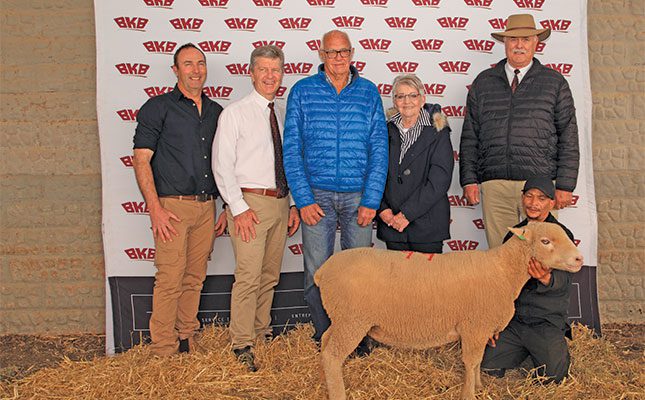
Some of his buyers credit their high lambing and weaning percentages to favourable environmental conditions, but Swart ascribes it to his selection of lots of small lambs that can survive.
He explains that he read a scientific paper, published in the Journal of Animal Science in June 2000: ‘The evaluation of Dorset, Finnsheep, Romanov, Texel and Montadale breeds of sheep: the effects of ram breed on productivity of ewes on two crossbred populations’.
That proved to him that rams influence the number of lambs born, as well as the ability to raise more viable rams.
Staying ahead of the curve
Swart studied various international stud and commercial producers over the years and has been particularly impressed with the results of Meat Elite, a collaborative group of Poll Dorset breeders from across Australia that aims to give clients a genetic edge with their sires.
According to the group’s website, Meat Elite genetics deliver a 21% faster genetic improvement than the average for terminal sire groups.
Inspired by their success, Swart has implemented similar practices, specifically the quick rotation of rams and ewes.
He explains that ewes are kept in his stud only for four years to maintain genetic turnover.
“The daughters of these ewes should be better than their mothers, if you are selecting right.
“The practice helps to ensure that we stay ahead of the game and only offer the best rams and ewes to the industry,” he says.
From each lambing season, only the top 10 to 12 young rams are selected for use on the stud, based on growth, conformation and reproduction data.
After breeding, only the top two or three are kept for another season.
“I follow the practice as closely as possible, but it is not rigid. I might buy in or reuse a ram if needed,” Swart adds.
Where the Merino ewes lamb once a year, the Dormers lamb every eight months, with lambing staggered between March, July and November, depending on the group.
Accurate record-keeping
While only colour tags are used to keep track of the age of the Merino ewes, RFID (radio frequency identification) tags are used to streamline data capture in the Dormer stud and flocks.
“RFID helps us record weights and other data quickly and accurately, without the risk of human error,” says Swart.
An electronic scale feeds data directly into BenguFarm – a stock management program he uses to track performance, pedigrees, reproduction, treatments and sales.
“BenguFarm calculates key growth and reproduction traits and integrates with Logix and the breeders’ society. It also has a handheld and mobile app that allows us to input data in the field,” he says.
Through disciplined selection, ongoing genetic benchmarking, and a strategic ‘speedy’ ram and ewe rotation, Swart has managed over time to position Kinko Dormers as a leading source of performance-proven terminal sire genetics.
“For producers focused on maximising lamb growth rates, weaning efficiency and slaughter returns, a Kinko ram represents more than just good genetics; it’s also a measurable investment in herd profitability,” he says.
For more information email Johan Swart at [email protected].