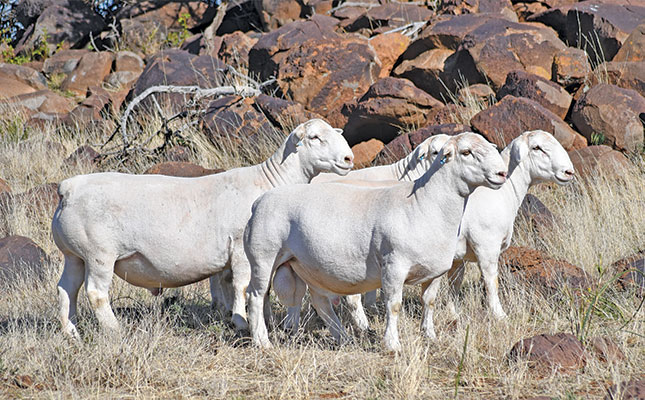
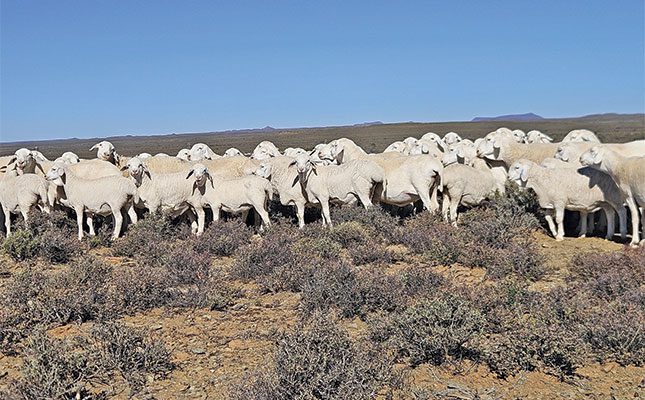
Pieter Wiese, chairperson of the Van Rooy Sheep Breeders’ Association of South Africa, describes the breed as hardy and adaptable.
“The Van Rooy represents all the genetic traits needed to excel in even the most challenging conditions in South Africa. The breed is also known for outstanding meat quality, high fertility and extreme resilience under the harshest of environmental conditions, such as the semi-arid Karoo.
“The breed’s unbeatable low cost of production makes it the obvious choice, “ he explains.
Origin and Development
The development of the Van Rooy started early in the 20th century through the crossbreeding of breeds such as indigenous Ronderib Afrikaners with Rambouillets and Blackhead Persian sheep. This resulted in a robust, hardy and very adaptable breed.
In 1906, Senator JC van Rooy of Koppieskraal farm in the Bethulie district of the Free State started experimenting with sheep breeds for slaughter lamb production. His objective was to breed a strong and resilient breed that could endure the regular South African droughts. The sheep had to be highly productive to maintain optimum production and needed to exhibit first-rate conformation.
Fat rumped-tails
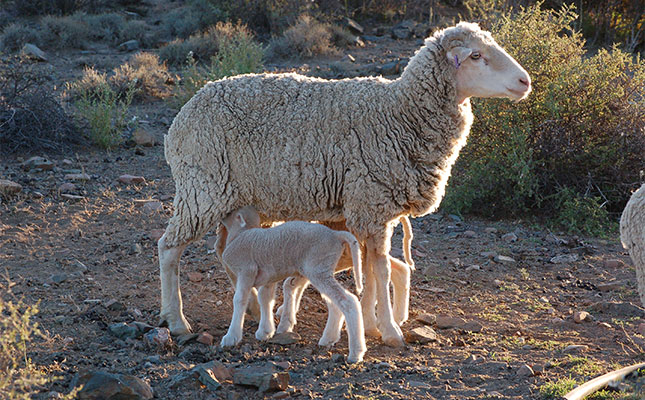
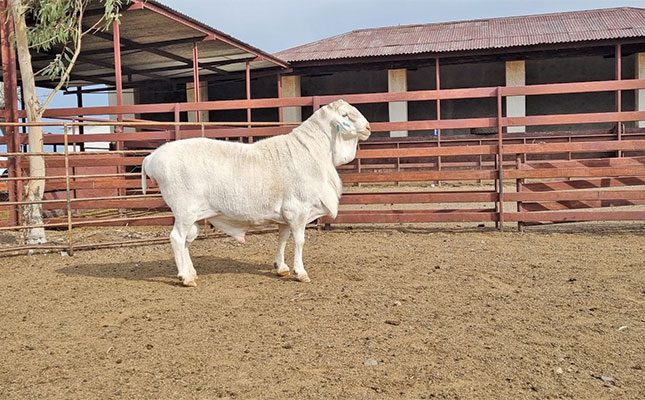
Van Rooys are medium to large-sized animals with a well-developed, well-muscled body. The animals are uniformly white with woolly hair on the upper part and short hair on the head, legs, and lower body.
The introduction of polled Wensleydale genetics added to the breed’s conformation, with as little as possible fat localisation on the body and some fat on the rump. The animals have fat-rumped tails that serve as an energy reserve, allowing them to thrive in low-nutrition environments.
Hardemans Karoo
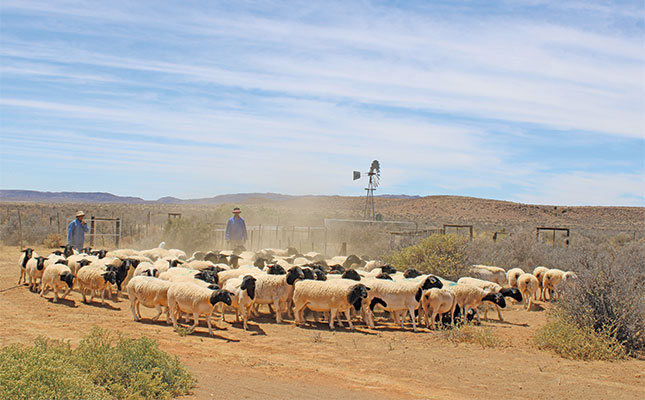
Wiese runs his Van Rooy flock in the so-called Hardemans Karoo near Loxton in the Northern Cape on the farm Kasteel.
The Wiese family has been farming on the land since 1980. Wiese started farming Van Rooys at the age of 17, after his father Dries bought some of the sheep.
“I was impressed by those Van Rooys and recognised the breed as a highly economical option for me in my own business. My philosophy always was and still is that money not spent is money in the pocket, without being penny wise and pound foolish. I have never been disappointed by the Van Rooy,” says Wiese.
The sweetveld grazing on his farm is characterised by a wide variety of Karoo grassy shrubland vegetation types. The grassy component includes tall bushman grass (Stipagrostis ciliata) and silky bushman grass (Stipagrostis uniplumis). The herbaceous shrub component includes African sheepbush (Pentzia incana). Wiese follows a stocking rate of between 8ha and 10ha per ewe.
Wiese prefers to have more than two watering points per camp.
“We farm on a vast scale. One piece of our land comprises 8 500ha, with 21 camps. The camp sizes vary from 200ha to 500ha, but we also have camps of 1 000ha. My five-camp grazing system means that each camp is used for three months and rested for at least a year before sheep are introduced again,” he explains.
Low cost
Wiese chose the Van Rooy because he finds the breed aesthetically pleasing, but most importantly, the breed’s low maintenance requirements and ability to excel under challenging farming conditions adds to sustainability and economic viability.
“The breed’s strong herding instinct makes for easier management and reduces labour costs. The Van Rooy’s mothering ability and resilience under challenging conditions such as drought are beyond par. It is a true income-generating breed,” he says.
Top-quality carcasses
According to Wiese, Van Rooy sheep produce outstanding carcasses, and in terms of crossbreeding for weight on the hook, the breed is nearly unbeatable. The Van Rooy crosses excellently with breeds such as the Dorper, Dormer and Merino. Van Rooy meat is of the highest quality, with outstanding marbling.
When the Van Rooy is crossed with any non-fat-tailed type, whether ram or ewe, the required covering of fat on the carcass is achieved sooner than in a cross between two non-fat-tailed types. The objective is to breed sheep with as little concentration of fat as possible on the carcass, with the exception of the rump.
This localisation of fat in the tail serves as a storage of energy, and this ensures fertile sheep that can successfully cope in times of adversity.
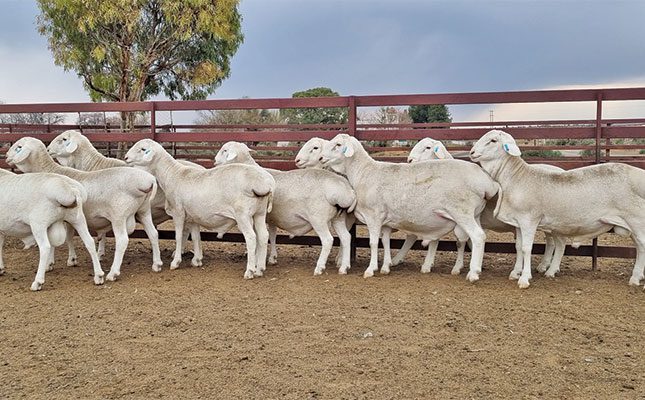
The tail consists of two parts: the main upper part, and the switch. The main portion should be broad and firm, and affixed as high as possible. It is oval in section towards the rear, with a slight upward tilt at the end from which the switch hangs down vertically.
Wiese’s Van Rooy’s slaughtering percentage fluctuates between 46% and 50%, depending on the condition of the veld.
Wiese strictly adheres to the Van Rooy breeding standards as set out by the breeders’ society to ensure phenotypic correctness.
“This results in, among others, well-balanced, symmetrical males and females, without excessive localisation of fat behind or in front of the chest. My motto is to breed highly functional animals that are adaptable and hardy and able to thrive in the semi-arid area we farm in.”
He maintains six breeding seasons based on the uneven months of the year. This means that lambing takes place during the even months. The rams are left with the ewes for 34 days and rested for 26 days. He uses between three and five rams per 100 ewes.
The average weaning weight fluctuates between 30kg and 40kg at a weaning age of between three months and four months of age, depending on grazing conditions. The Wiese ewes are early maturing and are bred between eight months and 10 months, with an inter-lambing period of between seven months and eight months.
Minimum inputs
“Because of the inherent qualities of the Van Rooy, I am able to keep input costs at a minimum. I’ll only consider a production lick under the most extreme drought conditions. The economic realities of South Africa nowadays are such that farmers cannot continue to measure the success of their farming concerns only by the money generated by the business.
“Fact of the matter is that the economic success of any farming enterprise depends on how input costs are managed and kept to a minimum. The Van Rooy has proved over and over again that it can’t be beaten as far as low input requirements are concerned,” says Wiese.
He calls himself his own biggest client, because he breeds his own rams to be used in his commercial flock. The stud flock consists of about 500 ewes. On the other hand, he considers the commercial sheep production sector as his most important client base and sees it as his responsibility to provide the best possible genetics to commercial farmers.
Predation and stock theft
According to Wiese, predation by black-backed jackal and caracal poses a grave danger to sheep farmers in the Northern Cape. He says it is one of the reasons behind the fact that the average weaning percentage in the province stands at only 36%.
Wiese adds that stock theft is worsening at an alarming rate, and together with the impact of predation, it is putting a real strain on farming communities’ ability to continue with the production of sufficient food to ensure food security.
For more information email Pieter Wiese at [email protected].