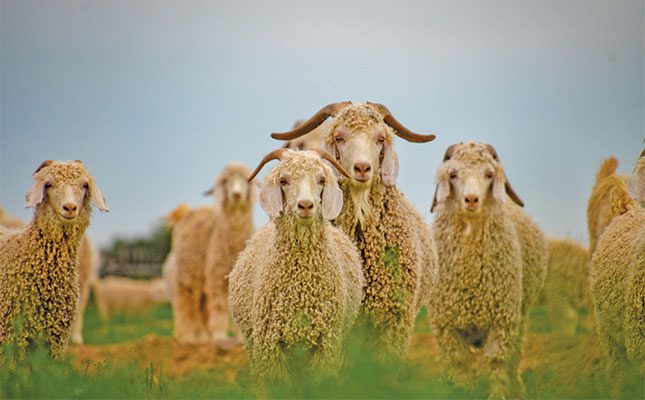
Michau Nortjé is not new to Angora farming. His father began farming Angoras more than half a century ago, and the family has been breeding purpose-suited Angoras for their farm near Willowmore in the Eastern Cape for as long as he can remember.
Improvements in his management practices and selection over the last five years, however, have seen Nortjé enter the ranks as one of the top mohair producers in the world.
The right goat
The Angoras that Nortjé are running have been under development on the family farm for decades. He says his father had first introduced the goats as far back as the 1960s, as well as running a registered stud.
“I remember my father buying a stud Angora for R1 400 in about 1967,” he reflects.
In the early 1990s, his father developed Alzheimer’s and the stud component was not maintained.
However, they continued breeding and producing mohair, with Michau gradually taking over. The goats he runs today are a bigger, tougher type of Angora, capable of performing extensively in the tough Willowmore region.
He says although there has been a sacrifice in terms of micron quality, the type has other benefits that suit his farm and his system better.This does, however, mean he needs numbers to produce sufficient hair to make a bale.
“You would be amazed at how many kids you need to get enough classed hair to make an 80kg bale,” he says.
The quality and value of a mohair clip is determined by a classification system that grades hair according to both the fineness of the fibre and the age of the goat. The younger the goat, the finer the fibre, with the fleece becoming coarser as the goat matures.
Industry classifies mohair into three standards, namely kid mohair, young goat mohair, and adult mohair, which is further separated into fine adult/strong adult.
Kid mohair is sheared from goats under 12 months of age, with a micron range of 24 to 30 microns. It is in this standard that Nortjé has had great success over the past five years, with one of his 25-micron bales sold for a new record price this year.
The production of superior-quality kid mohair forms the core of his operation, which therefore relies on an annual lambing percentage of over 100%.
Extensive operation with intensive focus
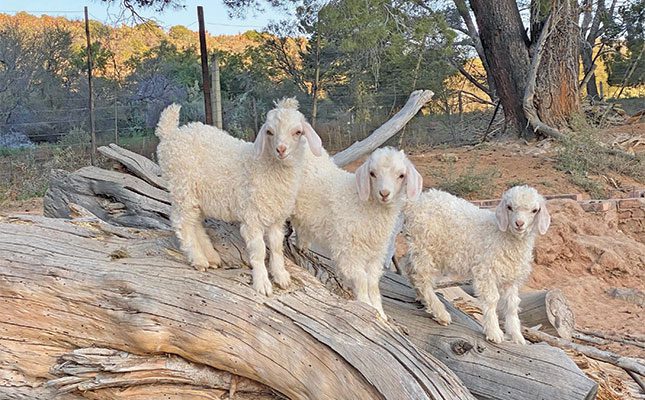
Nortjé has about 1 500 Angora ewes lambing annually, with the goal being to produce as many kids as possible to gain maximum volume of premium-grade fibre. The hair from the kids is characterised as the finest and softest, with a silky sheen sought after for fashion items worn close to the skin.
‘Super kid’ mohair is described as an even finer, more exclusive grade.
The kids are weaned at six months and it is at this stage that they are shorn or clipped for the first time. “This is really when you get your best hair,” Nortjé explains.
They are shorn for a second time as kids at around 12 months old and in their second year the clip will enter the Young Goat standard.
In terms of selection, Nortjé applies criteria based on both hair quality and suitability for his environment and system.
He keeps both male and female goats of a suitable standard for hair production for the first two years, with young rams not considered for stud or breeding purposes castrated at a young age. Once they reach the Adult Standard, Nortjé sells these neutered males (wethers/kapaters) to producers who are farming on what he terms “kapaterveld”, or terrain not suitable to farming kids.
In terms of longevity, this trait is limited in an Angora goat due in large part to the decline in hair quality as the animal matures.
“I can use a goat for about five or six years and then it is time for her to go,” he says.
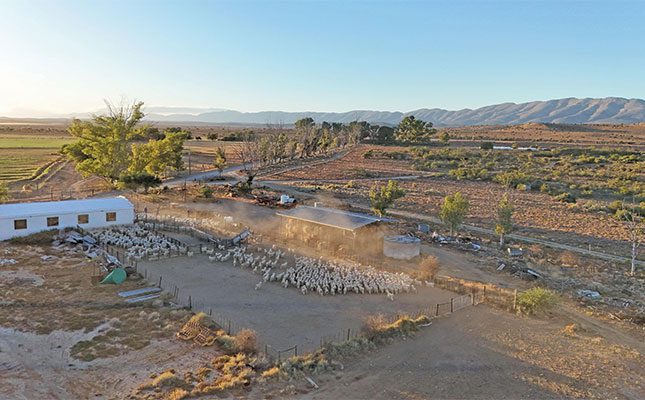
Nortjé’s system has been developed over decades, based on a feel for his land and his animals. Although largely extensive, he adapts to handle the seasonal variations from year to year. Last year, for example, was a fantastic year in terms of climate, and he ran his goats on leased land further from home with minimal feed intervention.
This year has been tougher and drier, though.
“They are lambing in camps located around the homestead this year and are being fed added rations of ‘chocolate mealies’ and maize residue bales,” says Nortjé.
Aside from intensive feeding, when necessary, and hair management practices, though, the goats are otherwise expected to perform mostly on their own steam in the tough conditions in which they are known to thrive.
Willowmore a promineny angora hub
Nortjé says there is a large concentration of Angoras in the Willowmore region, with several of the most respected names in the industry, both in terms of hair quality and superior genetics, farming there.
“I think we have the second-largest amount of Angoras in the country in Willowmore. So we farm goats here; that is what the area is known for.”
The success of Angora goat farming in Willowmore is linked to the region’s climate and vegetation. According to various online sources, including saexplorer.co.za and willowmoreinfo.com, these are as follows:
- Climate: Willowmore has a semi-arid climate with warm summers and cold, dry winters. Average maximum temperatures range from 16,9°C in July to 30,1°C in January. The climate is ideal for the goats with low rainfall (approximately 152mm annually), occurring mostly in summer, helping maintain health and prevent parasitic issues associated with wet conditions.
- Vegetation: The area is characterised by a mix of dwarf Karoo shrubs, succulent bushveld, and mostly sourveld grasslands. Angora goats are browsers, making them efficient at utilising the local veld and positioning them as a more sustainable livestock choice for the area’s delicate ecosystem.
In Nortje’s case, goats lamb in the veld and live out at all times, except when being brought in for dipping, cleaning or shearing.
The only time he would provide shelter is if there is unexpected bad weather directly after they have been shorn. However, shearing is planned as far as possible to avoid this.
Lambing season is once a year, starting from 1 August until mid-September, with the bulk (70%) of the kids arriving over a three week period.
Reproduction is allowed to proceed entirely naturally with four to five selected rams running with groups of about 100 ewes.
The biggest threats are predation, which takes a toll on numbers, and drought, which affects profitability as there is an increased economic burden with extra feeding, as well as parasites and disease.
A clean clip
Nortjé says his successes over the past five years have come with guidance from two mentors in the area, namely Fred Colborne and Cassie Carstens.
Colborne is a third-generation Angora farmer, whose FEC Farming and Stud operation is recognised for top-quality Angora genetics and mohair quality. Carstens is the technical adviser in the region for the broker House of Fibres and is also known for his knowledge of Angora genetics.
Nortjé says Colborne is a master when it comes to classing mohair.
“One year I was chatting to Fred and he said to me I should stop messing around and start focusing on the basics, like improving my shearing practices.”
This process starts with general management, involving day-to-day farming aspects but also shearing-specific interventions in the months and weeks in the run-up to shearing time.
Nortjé dips his goats monthly, during which time the animals are also cleaned and twigs or other veld debris is manually removed from the hair.
He says it is also important to replace dirty, mucky water with clean water regularly so as to ensure the hair is properly cleaned.
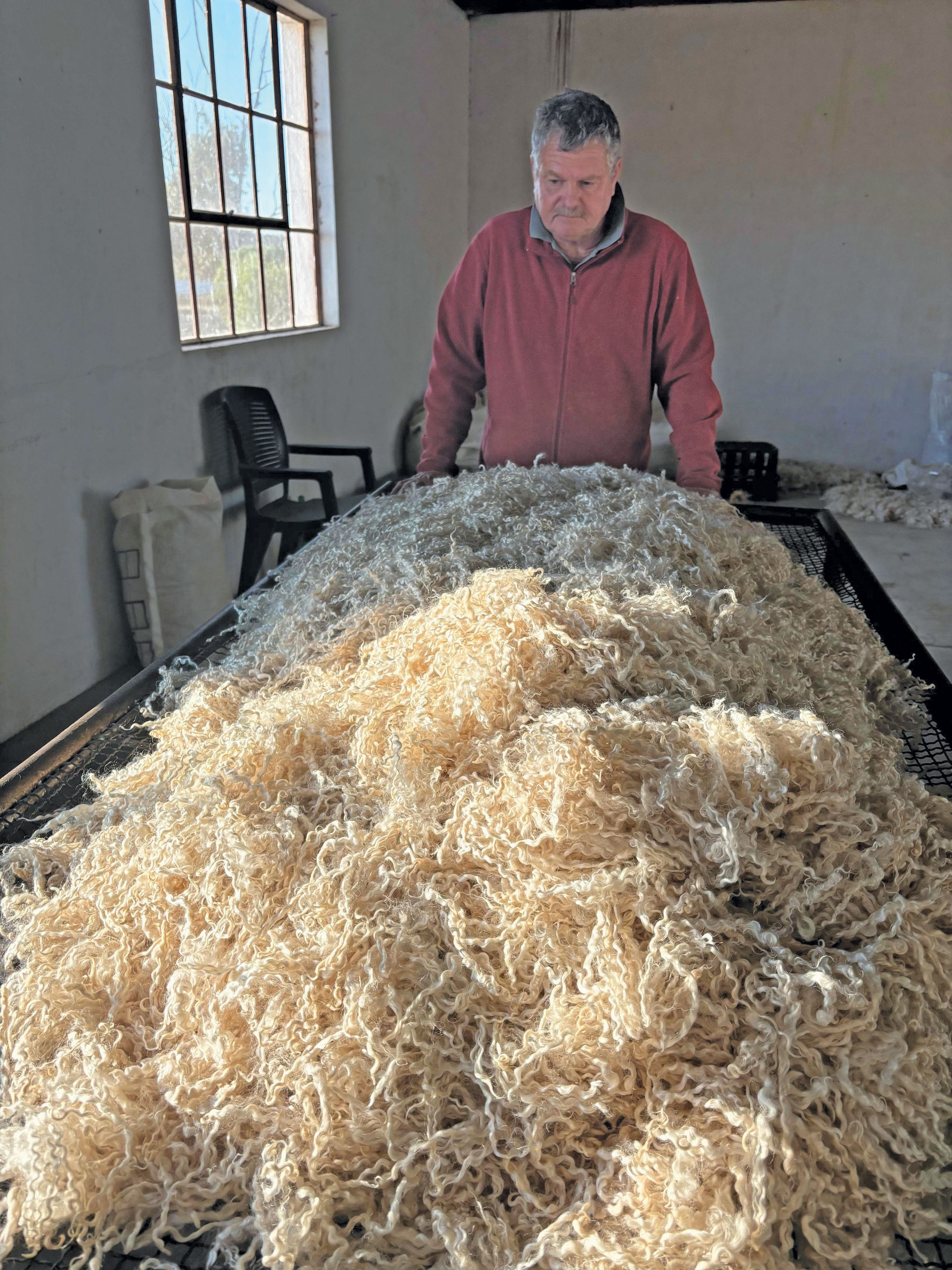
In the final month before shearing, cleaning is done on a weekly basis.
Shearing is done by a contractor, Hardie van den Heever from Cradock. Nortjé says this has also made a massive impact in recent years, saying contractors in the mohair industry provide a brilliant service.
“They work well with the animals, their equipment is of good quality and well maintained, and they are incredible at classing the fleece.”
Nortjé also takes great pride in his facilities, saying these are maintained to his own high standards, as well as subscribing to the industry standards and the Responsible Mohair Standard production criteria.
In this regard, he says the administration and record-keeping requirement is intense, but he sees it as something that is necessary in line with market demands.
Other management priorities
As he speaks to Farmer’s Weekly, Nortjé is in the middle of lambing season. It is a tough season compared to last year, but he is stoic about the realities.
“We have had two great years, but drought is part of farming and you need to plan according to that.”
He says he is not one for fancy systems, and he manages his goats much as he has been doing for decades, relying on a feel for his animals and his veld.
If the semi-arid Karoo bossieveld is taking strain, he will implement different strategies, ranging from supplementing feed to leasing land to reducing numbers, depending on the severity of the situation.
He implements rigorous dosing and vaccination practices, ensuring that kids receive their first vaccinations against diseases, including pulpy kidney and Pasteurella, among others, at two months, followed again by a booster three weeks later and another primary course shot at six months.
This is followed up by annual vaccinations. Dosing is done regularly, with manure samples collected on occasion in order to dose based on faecal egg counts.
Nortjé does not use fancy feeds and technical diets, instead relying on the effectiveness of maize for feed and harvest residue for fodder. This, however, needs to be sufficient for their needs.
He believes a pregnant ewe needs nutritional support to produce and rear a healthy kid.
“If she is not in good condition and cannot sustain the kid, there is a risk she will discard it,” he says.
He also allows his maiden ewes to grow out and mature properly before breeding them for the first time to ensure they are able to produce strong, healthy kids.
Ease of lambing and mothering ability are some of the traits that his large Angoras bring to the table for his operation and are included in his key selection criteria.
World-class product
In recent years, Nortjé has combined a lifetime’s experience in rearing and breeding Angoras with expert advice from respected individuals in the industry on improving genetics and adding value to the final product.
Nortjé says the motherlines in his flock have been tailored for years, with no ewes having been bought in for decades.
He does not want to try and fix what isn’t broken by bringing in random new genetics. Instead, he is focusing on better selection to continue to improve quality without sacrificing the big, tough goats he has created for his environment. Although mating is allowed to proceed naturally, a lot of planning goes into ram selection and mating.
In the past five years, with guidance from Carstens and Colborne, he got his records in order and reregistered the stud, with his first sale of select stud ewes taking place in February 2026. This will be in collaboration with several other breeders, including Colborne.
The results of his new approaches can be quantified in record-breaking prices achieved at national mohair clip sales, as well as international recognition through the Miyuki Awards, which celebrates the world’s finest mohair. Nortjé was named Reserve Grand Champion during the 2025 Miyuki Awards ceremony on 7 August, with the clip from his farm ranked as the second-best in the world at present.
“I am still surprised. I am really chuffed with the result, to be honest,” he says.
He also achieved record-breaking sales, with a bale of his 27-micron winter kid mohair selling for a record price of R741/kg in November 2024. Another 25-micron bale fetched a record R886/kg at a sale on 27 May 2025, according to a House of Fibre mohair market report.
Nortjé is excited to “see what will happen” during the sale* in which he is participating.
Email Michau Nortjé at [email protected].
*The Grootrivier Angora Ram and Production Sale takes place at Smithskraal in Willowmore on 18 February 2026. Participating breeders are Fred Colborne, Michau Nortjé and Hein Truter.