
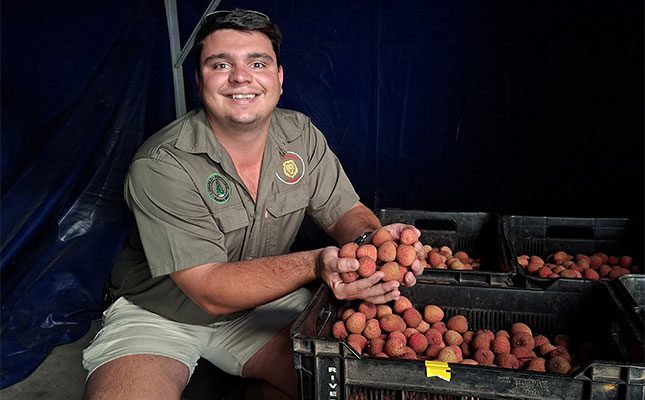
Henery is part of Komati Fruit’s subtropical fruit management team at Riverside Farm, near Malelane, Mpumalanga. Their summer harvest season means thorough plant preparation throughout the year to ensure flowering and a desirable fruit profile by November.
“What we do leading up to the end of the year makes or breaks our yield,” he says.
Production cycle
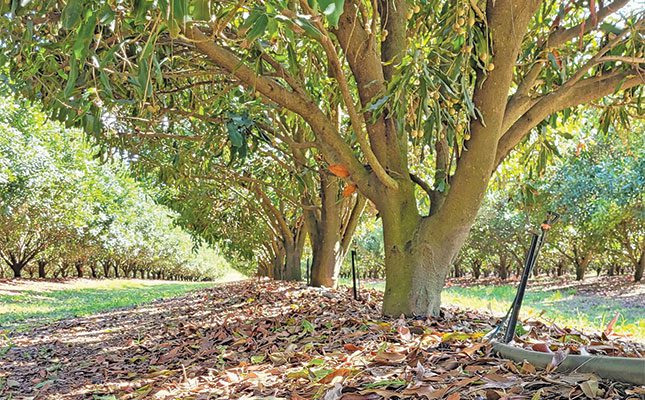
Riverside currently has 98ha of litchis in production, all of which are the Mauritius cultivar. It remains the most popular variety in the Southern Hemisphere to date because of its high yields and adaptability.
However, Henery says they have been testing different cultivars such as Fay Zee Siu and Kaimana for their bigger fruit size and different flavour profiles.
He adds that growers continually experiment with new genetics and practices to improve the trees’ climate adaptability without compromising yield, appearance, or flavour.
Litchi plants are highly sensitive to changes in temperature, wind, and humidity. Producers occasionally see dips in export volumes, mostly due to unfavourable weather.
The South African National Litchi Growers’ Association states on its website that producers exported 2 637t of litchis in the 2023/24 season, which was 2 449t less than the 2022/23 season. Thus, farmers try to control as many of the growing conditions as possible.
To test optimal growing standards, a trial block of younger trees is being grown under netting to reduce sunburn and wind exposure, with top-down misting used to regulate humidity during sudden temperature spikes.
Henery explains that the trial is being used to compare overall tonnage and fruit condition between trees under netting and those in exposed orchards.
Aside from taking preventative measures against the harsh weather, Henery must maintain an optimal production cycle to ensure the best yields possible in the given climatic conditions. To achieve this, the staff prepare the trees for the upcoming cycle soon after harvesting ends in mid-January.
From January to April, the trees are pruned, shaped, and given their first round of fertiliser. Post-harvest pruning encourages uniform flushing, as litchis only flower on new growth.
After flush preparation, Ethephon, a plant growth regulator, is applied and irrigation is restricted to prevent premature winter flowering.
When winter arrives, irrigation is halted to mimic stress, which suppresses additional growth and encourages the accumulation of starch, which later acts as an energy source for flowering and fruit development.
Cool winter conditions are crucial, as warmer-than-usual temperatures can cause uneven flowering and excessive vegetative growth, reducing fruit set.
The trees are gradually returned to a moderate irrigation programme to support budding and flowering without risking fungal disease or excessive vegetative growth. Flowering lasts three to four weeks, during which bees are introduced to pollinate the flowers. By late September, the flowers set fruit.
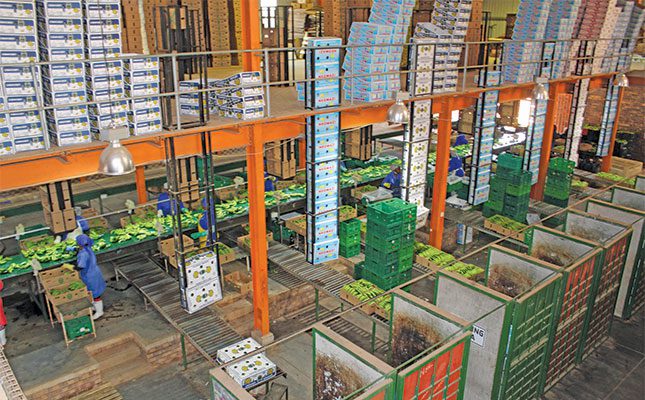
Seasonal workers harvest by hand from November to January. Due to their high perishability, litchis must be harvested, packed, and cooled within 24 hours. Upon arrival, the fruit is fumigated with sulphur dioxide to prevent browning and extend shelf life.
It is then placed in an acid bath to neutralise any remaining sulphur and maintain bright skin colour before being sorted, packed, and stored in cold storage below 5°C for transport.
Market conditions
Although South African litchi producers have faced tough conditions, such as unusually high winter temperatures and drops in humidity that cause uneven or delayed flowering, overall yields have remained stable.
Exports accounted for 60% of the overall 2023/24 harvest, with demand from Europe and the US in particular steadily rising during the summer harvesting season.
Henery says the import tariffs on South African goods set out by the US have significantly impacted trade, but he remains optimistic that possible changes could boost export volumes.
Market conditions are stable, and local producers continue working to meet export demand. By expanding cultivar ranges and adapting to climatic challenges, the commercial industry has achieved healthy growth.