The Capsicum frutescens species of chilli pepper is grown worldwide in various quantities, but it’s more common in warmer climates. Many varieties grow rather tall. They can cross with C. chinense and C. annuum, but there is often some incompatibility, resulting in fewer seeds produced in the crosses.
C. frutescens’s pungency level varies between 100 000 and 350 000 Scoville heat units. Another characteristic is that the fruit hang downwards when ripe. The pods are green when immature and then colour up when ripening. More than one flower is borne per node, whereas in C. annuum, there is only one flower per node.
C. frutescens is listed as being good for easing coughing, toothache, and other ailments. My first thought is that the burn derived from eating these hot chillies will take one’s mind off the disorder so that it can focus on the pain inflicted by the chillies.
Perhaps the best-known variety of C. frutescens is Tabasco, from which the name of the popular hot sauce is derived.
Green leaf variety
There is also a C. frutescens variety known as Tabasco Green Leaf. I assumed it had a greener leaf, but it was in fact named after Prof Robert Greenleaf from Auburn University in Alabama, US. He was tasked with introducing resistance to the tobacco etch virus, which had become problematic in the area where the sauce was produced.
The subsequent Tabasco Green Leaf variety does look a little different, and it solved the virus issue.
I would still rather grow the regular variety where the virus is not a problem, as I find it more productive and earlier maturing. Tabasco also has ornamental appeal, so it can be introduced into a formal flower garden.
The McIlhenny Company has been making Tabasco sauce for five generations. The ripe chillies are mashed, mixed with salt, and placed in oak barrels for three years. They are then milled and vinegar is added.
I make my own sauce by mashing chillies with salt in a blender, placing the mixture in a glass bottle, and leaving it for a year. I then add vinegar and blend it again, then strain the sauce into containers for the table. It tastes just like the original.
African bird’s eye chilli
Another well-known C. frutescens variety is the African bird’s eye chilli, which is found in many gardens in warmer African countries. In South Africa, it is grown in subtropical regions, as it is late maturing and affected by the frost in cooler areas.
These chillies are also commonly referred to as bird chillies. The story goes that birds favour them because of their convenient size and because they dislodge easily from the plant when ripe.
Birds don’t have sensors for pungency and aren’t affected by even the hottest chilli varieties.
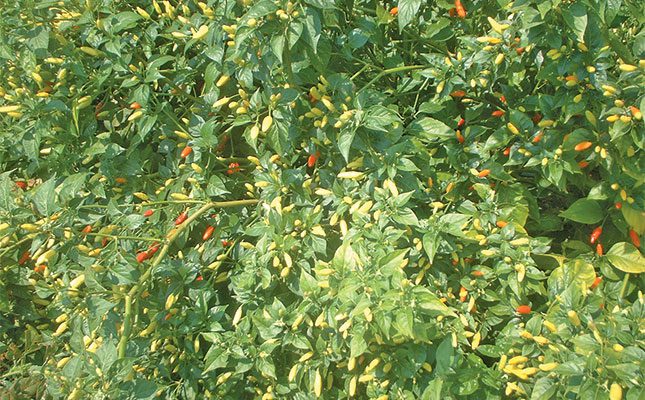
Bird’s eye chillies are small and can be red or yellow. They are fiery hot and often referred to as devil chillies or peri-peri chillies. Visitors to Mozambique will likely spot a plant in just about every garden.
They are used sparingly because of their pungency, and when included in sauces, the level is adjusted to suit the required strength of the product.
Their small size makes harvesting bird’s eye chillies labour intensive, which restricts commercial use in South Africa due to the cost.
Bill Kerr is a vegetable specialist and breeder.