Farmer’s Weekly (FW): What causes foot-and-mouth disease (FMD), and how is it transmitted between animals?
Dr Dave Midgley (DM): FMD is caused by a virus which, as with the COVID-19 virus, is spread in various ways.
The most important confirmed route of transmission is by contact introduction. Farmers buy and bring an infected animal onto their farms or into their herds or flocks. Such an animal can be an asymptomatic carrier of the virus or be in the incubating phase, where it does not yet show clinical signs but is already in the early stages of the disease. The incubation period for FMD is generally between two and 14 days.
The virus can also be introduced by people, vehicles, insects, rodents, birds, and as fomites (infection-carrying materials) through water and in the air. High concentrations of virus are found in excretions, for example, in the blood, saliva, milk, faeces, and urine of infected animals.
FW: What are the early signs of FMD, and are there visual symptoms farmers can recognise in the field?
DM: FMD got its name from the distribution of lesions, with small blisters, or vesicles, found mainly on and between the feet or hooves of cloven-hooved animals, as well as on their lips and in their mouths. Vesicles are also seen on the teats and udders of female animals, and dairy cattle can develop serious cases of mastitis as a result.
The most common symptoms are fever, excessive salivation, and animals ‘playing with their tongues’. Affected animals normally either just stand or walk with difficulty when moved, as a result of pain in their hooves.
With the current outbreak in South Africa, we have noticed other manifestations, such as increased calf and lamb mortalities, including cases caused by ‘tiger heart’, a heart muscle condition mainly in cattle where the heart develops pale and dark striping due to fatty degeneration and muscle damage. Abortions have also been reported recently.
On closer examination, blisters and ulcers are seen in the mouths and on the udders and feet of infected animals. Lesions differ according to the stage of the disease: during the active stage, blisters pop and excrete massive amounts of the virus into the environment. Healing starts within the ulcers, and after two weeks, scar tissue lesions are often left behind.
FW: Can all species of cloven-hooved animals contract FMD?
DM: Yes, all cloven-hooved animals are susceptible, including domestic and wild ruminants. Domestic pigs can act as multipliers of the virus, while wild pigs such as warthogs and bushpigs don’t. Elephants are another example of animals affected by FMD, despite not being cloven-hooved.
FW: Can humans contract FMD from infected animals or animal products?
DM: No. There is a similar virus that causes a disease called hand, foot, and mouth disease in humans, but it is not caused by the same virus that causes FMD in animals.
FW: Is there any treatment or medication for FMD in cattle, or is management mainly supportive?
DM: Antibiotics do not kill viruses, thus there are no registered medications available in South Africa that can claim effectiveness against FMD.
Veterinarians provide supportive treatment. We strive to break the fever and treat the associated pain and inflammation. Antibiotics are sometimes used to combat secondary bacterial infections in the lesions.
FW: Can cattle recover from FMD, and are there any long-term effects on productivity?
DM: Traditionally, we said that FMD is not a disease that kills animals but rather one that ‘kills’ households and communities. The socio-economic impact of the disease is massive.
The South African Territories (SAT) strains were previously considered not highly pathogenic. In other words, they spread slowly and did not cause severe clinical signs. This has changed, as the current strains now show similar behaviour and symptoms to those of overseas FMD strains.
From a clinical perspective, more than 95% of affected animals recover without treatment. That said, recovery doesn’t always mean a full return to previous productivity levels. In dairy cattle, for example, milk yield can be temporarily reduced during illness, and in severe cases, mastitis or teat lesions may affect long-term milk production.
Fertility is generally not permanently affected in most adult animals, but stress, fever, and systemic illness can sometimes cause temporary reproductive setbacks, especially in young or breeding stock.
Put simply, while most cattle survive, farmers may notice short-term drops in production, slower growth in young stock, and localised health complications.
This is why FMD is such a devastating disease socio-economically, even if mortality is low: losses come from disrupted productivity, additional veterinary costs, and broader market and trade impacts.
FW: What complications can arise from FMD?
DM: Over many years of FMD in South Africa, most animals have recovered without lasting effects. This is attributed to the virus’s historically low virulence and to our indigenous hosts and breeds having strong natural immunity against FMD.
Most calves with tiger heart die, and we do not yet have data on the after-effects for those that survive the current outbreak.
FW: Are there any home remedies for FMD, and what should farmers avoid doing?
DM: There is much speculation, but with up to 95% of affected animals recovering without intervention, it is virtually impossible to prove that home remedies make any real difference.
Some people see this crisis as an opportunity to market products and, in doing so, make a quick profit by selling these ‘home remedies’.
FW: How does FMD spread between farms, and what practical biosecurity steps can farmers take to prevent further spread?
DM: Biosecurity is not just a general concept; each farmer should have a standard operating procedure tailored to their farm’s specific circumstances. I cannot emphasise the importance of this enough. Farmers should work out a practical plan for their farm in consultation with their veterinarian.
Let us be practical: what are the chances of a virus spreading on the tyres of a vehicle that has just travelled more than 50km and whose tyres have heated up? In comparison, I believe the role of people’s hands in spreading the disease is often overlooked.
Farmers are inquisitive by nature; they perform post-mortems on dead calves to see what tiger heart disease looks like. This is done outside, after which they often just wash off excess blood with running water before opening vehicle doors and touching the steering wheel, not to mention neglecting to clean and disinfect the soles of their shoes.
Water does not kill the virus, and contaminated surfaces then become a source of infection. The same hands touching these surfaces are later used to greet others in town or along the road.
Biosecurity is something we must live and practise continuously. It is not something you write down on a piece of paper and then forget.
FW: What immediate steps should a farmer take if they suspect FMD in their herd, and is it a notifiable disease in South Africa? Who must they report suspected or confirmed cases to?
DM: FMD is a state-controlled disease, and farmers are legally required to report it to their local state veterinarian immediately. Unlike notifiable diseases such as lumpy skin disease, FMD is a government-controlled disease, placing it a step above in terms of importance. The Department of Agriculture lists the diseases in each category on its website.
Unfortunately, lists on provincial websites are often out of date, so I strongly recommend that farmers find out who the state veterinarian and animal health technicians are in their specific areas. This information can also be obtained from the local private veterinarian, who often operates on the first line of defence.
Farmers should keep a list of contact numbers for everyone they need to call once the disease is suspected or confirmed on their farm. By law, they are also expected to inform their neighbours.
FW: How do FMD outbreaks affect livestock movement, auctions, and the sale of animals or animal products?
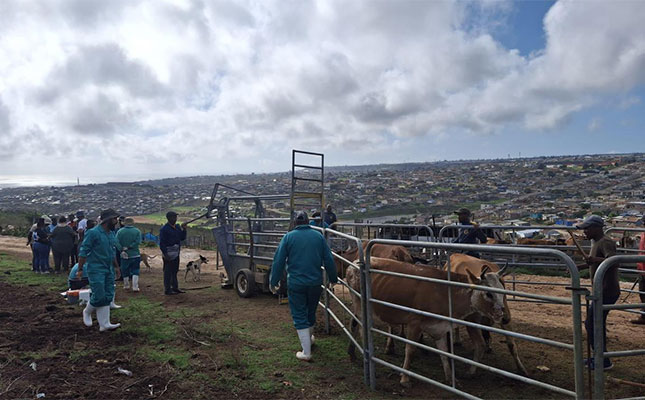
DM: This disease has affected all these things we have always taken for granted. Moving animals is the biggest cause of the spread of FMD. The disease most often enters farms through the gate, via animals brought in, vehicles that have transported infected animals and were not properly washed and disinfected, or people driving and accompanying those vehicles, who act as mechanical carriers of the virus.
Wherever animals are grouped together, especially from different farms during an outbreak, the risk of spread increases. They often drink from the same water troughs, so the role of water in transmitting FMD must not be underestimated.
FW: Is there an FMD vaccine, and when is vaccination used as part of official control measures?
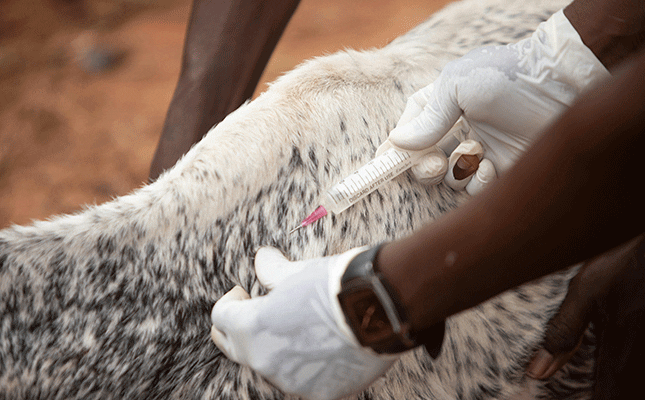
DM: Yes, there are many vaccines against FMD worldwide. The situation in South Africa is different and has improved over the past month. At present, we are in the process of making several vaccines available shortly, including:
- The Botswana Vaccine Institute vaccine, which is currently in use
- The ARC-Onderstepoort Veterinary Research Campus vaccine, which will be available in relatively small quantities
- The Dollvet vaccine from Türkiye
Getting good vaccines into the country has been a difficult process, but there is light at the end of the tunnel.
Vaccination is not the be-all and end-all; it is one link in disease control. It may be used to manage outbreaks on positive farms, for pre-emptive ring vaccination, or to help contain the virus and push it back into endemic areas such as Kruger National Park.
FW: Does vaccination mean animals are fully protected?
DM: No. Vaccination does not give full protection against FMD. Immunity depends on many factors, including age, nutrition, stress, population density, and individual immune response. Vaccination helps reduce virus levels in populations and remains an important tool, but it does not eliminate risk.
FW: How long is a farm typically quarantined for following a suspected or confirmed outbreak?
DM: This is not an easy question. The local state veterinarian has jurisdiction and must consider many risk factors. Cooperation with government is essential, and the interests of farmers, communities, and South Africa as a whole must be balanced.
FW: Are meat and milk from affected animals safe for consumption?
DM: Milk can contain high levels of the virus during the active phase. By law, milk for human consumption must be double pasteurised. The sale of raw milk is illegal unless strict regulations are followed. Milk intended for personal use should be boiled and cooled before consumption.
The virus is mainly present in soft tissues and secretions during the acute phase. Meat from clinically affected animals is generally not used for human consumption, and strict controls apply.