The escalation of both internal and external parasites in South African livestock needs to be managed through an integrated management system rather than by blanket dosing, according to Dr Dave Midgley, CEO of the Ruminant Veterinary Association of South Africa (RuVASA).
For the purpose of this article, the focus will be on parasites in beef cattle.
“Parasite control can best be achieved through an integrated management system and feeding programme. Efficient management is important when dealing with parasites, and the lack of proper management is often the reason behind treatment failure and increased resistance to anthelmintic remedies.
“Anthelmintics are a type of medicine that kills helminths. Helminths are worm-like parasites such as flukes, roundworms, and tapeworms.
Anthelmintics must be used wisely as every application increases the risk and degree of resistance in the parasite population,” Midgley had already warned in a Farmer’s Weekly article published 15 years ago (18 June 2010).
Internal and external parasites significantly impact the health of cattle herds, adds Dr Dirk Verwoerd, head veterinarian at Karan Beef. “Many people underestimate the impact parasites and their associated diseases have on cattle herds.
“For example, if tick burdens are not controlled, farmers can lose a large portion of their herd through tick-borne diseases such as redwater, gallsickness, heartwater and lumpy skin disease. Farmers must implement effective integrated dipping and deworming protocols to support the health and production of their cattle herd, and the quality of their beef products,” says Verwoerd.
Cattle health
“Parasites and diseases are some of the main factors that impact beef cattle health across South Africa. It is crucial that farmers, both large and small, focus on ensuring the health of their herds. Deworming and dipping cattle are simple, yet highly effective measures that all farmers can take to guarantee the health of their cattle,” says Verwoerd.
In an article published by ScienceDirect in 2024, a systematic review of ticks and tick-borne pathogens of cattle reared by smallholding farmers in South Africa identified a total of 26 tick species belonging to seven genera. The most frequently reported tick species were Rhipicephalus (Boophilus) decoloratus and R. evertsi evertsi. The most frequently reported tick-borne pathogens were Babesia bigemina, B. bovis and Anaplasma marginale.
The Eastern Cape accounted for most of the tick-borne pathogen reports.
A six-year retrospective report of livestock parasitic diseases in the Eastern Cape found the prevalence of parasitic diseases markedly higher in autumn and spring. The Amahlathi, Dr Beyers Naudé, Intsika Yethu, Makana, Mbhashe, and Mhlaba municipalities recorded the highest prevalence of fly parasites, ectoparasites, endoparasites, protozoa diseases, and hemoparasitic diseases, respectively.
Ticks as vectors
Ticks are economically the most significant external parasites in the livestock production sector. Heavy infestations cause direct harm (blood loss, reduced rate of live weight gain, lower milk yield, and degradation of hide quality), and indirect harm (tick-borne diseases such as redwater, heartwater, anaplasmosis, and sweating sickness) – visit za.virbac.com.
Ticks (vectors) are infected with the disease when feeding on an infected or carrier animal. The disease is transmitted from the larval stage via the nymph stage to the adult. Infected females dropping off the host animal carry the disease through the egg stage (eggs are laid on the ground) and then to the next generation of larvae in a process called trans-ovarian transmission. The nymphs and adults of the next generation transmit the disease to susceptible host animals (Farmer’s Weekly, 29 June 2015).
Blue tick
The role parasites play in the spread of disease is clearly illustrated by the lifespan of the blue tick, which is one of the most dominant vectors in the transmission of parasites in the country.
These ticks transmit the parasites B. bigemina and B. bovis, which cause redwater in cattle. It also transmits A. marginale, which causes gallsickness in cattle. Under ideal conditions the life cycle may be completed in two months, resulting in up to four generations per year. Overwintering eggs hatch in spring.
The blue tick is a one-host tick, which means every stage of the tick (larva, nymph and adult stage) occurs on the same host. Cattle are their main hosts.
The female blue tick (R. decoloratus) lays between 2 000 and 2 500 eggs over a period of four to six days. The eggs hatch within three to six weeks under ideal conditions into larvae, the first active stage. The larvae then search for the ideal host and attach to it, feed for five to nine days and then moult to the nymphal stage.
The nymph, still on the same host, will feed for five to nine days and moult into adult ticks, the next stage. The adult ticks feed and mate within seven to nine days. The engorged tick will be ready to drop off to start laying eggs – visit za.virbac.com.
Midgley says farmers are often unaware that they have a resistance problem, because after dosing they find that faecal egg counts have been reduced by 80%, taking it as a good sign.
“In truth it actually means that 20% of the worms are resistant and have survived. Only the more susceptible portion of the population has been killed, leaving the resistant portion behind and eventually leading to a more resistant total population,” he says.
Record-keeping
Midgley stresses the importance of combatting remedy resistance by keeping detailed records.
“Know which parasite species are present in your flock, know their life cycles and when they appear. Know the symptoms of infection, and know which remedies work when and how well,” he adds.
The latter is especially important; it helps producers avoid using the same remedy repeatedly without effect, eventually leading to the parasite population building up a resistance against it.
Midgley warns against a so-called ‘blanket’ approach when dosing animals. “Don’t treat them for every possible problem with every possible medicine when they get sick, in the hope that it will kill everything in one go. Don’t underdose either, as this doesn’t kill parasites – instead, it promotes their resistance.
“Consult your records before you dose your animals. This way you can reduce use, modify regimens and switch to narrower-spectrum anthelmintics.The more remedies you use, the greater the resistance build-up is,” he explained.
Internal and external parasites significantly impact the health of cattle herds.
Verwoerd explains: “Many people underestimate the impact parasites and their associated diseases have on cattle herds. For example, if tick burdens are not controlled, farmers can lose a large portion of their herd through tick- borne diseases such as redwater, gallsickness, heartwater and lumpy skin disease. Farmers must implement effective integrated dipping and deworming protocols to support the health and production of their cattle herd, and the quality of their beef products.”
Dipping
An important step in ensuring optimum beef cattle health, according to Vervoerd, is controlling external parasites. Ticks and other external parasites have an impact on beef cattle health and cost farmers time and money through deaths, as well as lowering calf numbers produced.
There are different types of dipping methods available to farmers, namely plunge dips, spray race, topical (pour-on) treatments, hand spraying, and hand dressing.
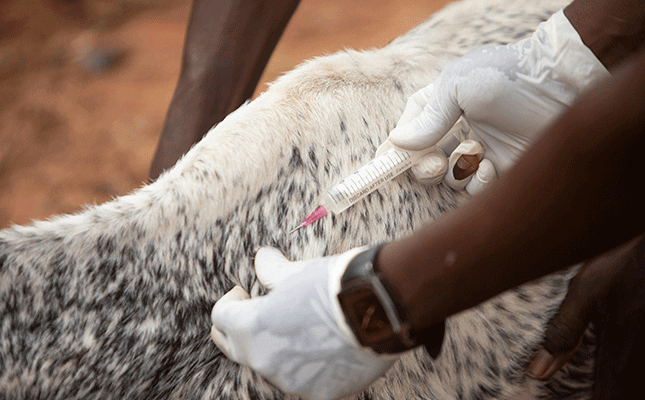
The control of ticks should be part of an integrated parasite management programme, as injectable (endectocides) products in the ivermectin family are effective against both internal parasites (worms) and external parasites (ticks, mites and lice), and should strategically complement the use of dips, pour-ons, and so on.
The only cattle that should not be dipped are very young calves or heavily pregnant cows to minimise the risk of injuries during the process.
Deworming
Regularly deworming a cattle herd is, according to Verwoerd, vital for beef cattle health. Worms and other internal parasites can lead to significant weight loss in cattle, negatively impact fertility and milk production, and even impact cattle growth.
The three internal parasite groups include roundworms, tapeworms, and liver flukes.
Verwoerd makes it clear that young calves should be dewormed as a matter of priority.
Suckling calves should be dewormed at three months old, and then again between seven and eight months of age to reduce the risk of heavy worm infection.
Sources: sciencedirect.com; shorturl.at/BnUva; penveterinaryjournal.com; shorturl.at/9IOzK; karanbeef.com.