The first impression was encouraging, and when the price (R695 000, excluding VAT) is taken into consideration, it’s clear that autonomous spraying has moved from concept to a practical option for orchard and vineyard producers.
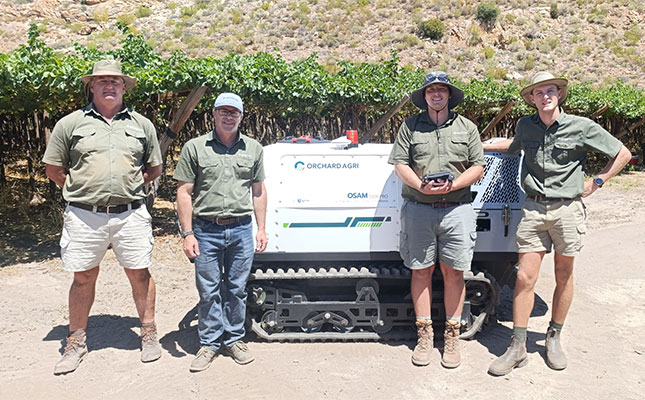
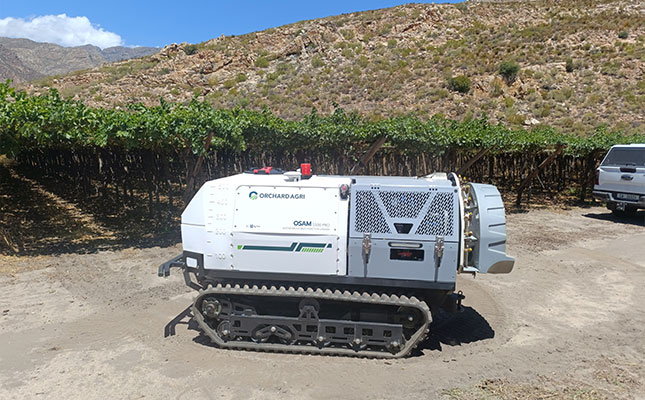
Orchard Agri imported South Africa’s first fully automatic orchard and vineyard sprayer, the OSAM S500 PRO, manufactured by LJ Tech, in December last year.
“A couple of driverless sprayers have been imported into South Africa before, but those machines were too large and unsuited for vineyards and orchards,” Heinrich Lategan, Orchard Agri sales and marketing manager, told Farmer’s Weekly at one of several demonstration days across the Western Cape.
“The price was also exorbitant, which discouraged most prospective buyers from venturing into autonomous spraying.”
However, this is beginning to change. According to Lategan, farmers are now far more open to autonomous sprayers, not for the novelty, but because of rising compliance costs and operational pressures.
“Spraying regulations are becoming more stringent, requiring producers to invest in tractors fitted with enclosed cabins and additional safety features to limit operator exposure to chemicals,” he explained.
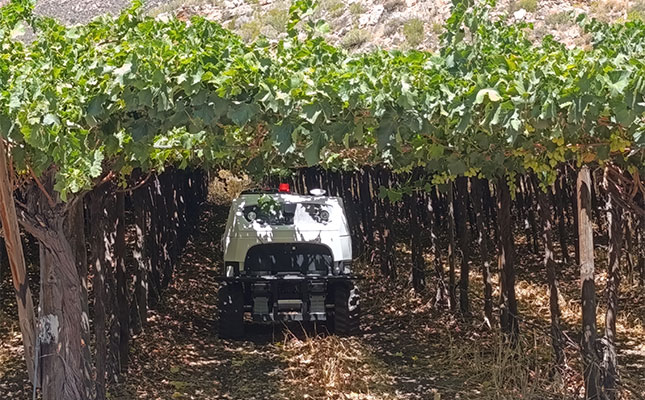
“In table grape vineyards, these tractors also need a low profile to operate beneath trellised vines, which significantly increases their purchase price. In that context, autonomous sprayers are emerging as a more cost-effective alternative to highly specialised tractors.”
Farmers’ tough choice
This leaves many producers with a difficult decision: stick with the tried-and-tested yet increasingly costly specialised tractors, or step into the unknown with autonomous systems that promise regulatory compliance, efficiency, and lower operating costs.
In terms of efficiency, the OSAM S500 PRO is significantly lighter than tractors fitted with enclosed cabins, and it is powered by a hybrid drive system combining a 33kW diesel engine with a 15kW supercapacitor, rather than a conventional battery.
“When additional power is needed, the supercapacitor assists the engine, and when demand is lower, it recharges itself,” Jasper Bothma, Orchard Agri’s technical manager, explained.
“Supercapacitors also have far more charge cycles and a longer lifespan than standard batteries.”
The lighter weight and hybrid drive translate into substantially lower fuel consumption per hectare. While conventional tractors typically use between 4ℓ/ha and 7 ℓ/ha during spraying operations, the autonomous sprayer’s fuel use is 3ℓ/ha to 4ℓ/ha.
However, Bothma cautioned that fuel savings alone don’t tell the full story: “The biggest savings come from labour efficiency, consistency, and reduced waste.
“With human operators, there is always variability – spray valves opened too late or shut off too early, rows skipped or sprayed twice. An autonomous system removes much of that human error.”
Precision through autonomy
Using artificial intelligence, precision spraying algorithms, GPS, and light detection and ranging technology, the rubber-tracked OSAM S500 PRO navigates orchards and vineyards autonomously, applying chemicals only where needed.
This targeted approach improves spray accuracy and coverage while reducing wastage, with trials showing input savings of up to 20%.
The machine has a standard 500ℓ spray tank, which can be increased to 1 100ℓ by adding a trailer tank, allowing it to cover larger areas before refilling.
Changing how labour is used
Labour constraints put the difference into sharper focus. Skilled, reliable tractor operators are becoming increasingly difficult to find, while spraying remains one of the highest-risk farm activities due to prolonged chemical exposure. By removing the operator from the spraying environment, autonomous sprayers improve safety, reduce health risks, and ease pressure on scarce specialised labour.
Autonomy also changes how labour is deployed. Instead of working directly in the spraying environment, a single semi-skilled operator can oversee multiple machines remotely using a handheld controller.
“In practice, one operator can supervise up to four units at a time. This shifts labour from physically demanding, high-risk work to a supervisory role, while helping address the growing shortage of skilled tractor drivers,” Lategan explained.
Bothma added that managing the machines is relatively straightforward. “If you can operate a smartphone, you’ll be able to operate these machines. The more complex part is setting up the driving paths, which should be done by the farmer, as this determines turning points and working boundaries.”
The paths are set up and controlled with the help of base stations (R95 000 each, excluding VAT), which can coordinate up to six machines simultaneously.
Maintenance and usage
Each machine also requires a maintenance monitoring service subscription of R500 per month or R5 500 per year, excluding VAT. This service provides continuous cloud-based monitoring, early fault detection, maintenance scheduling, remote diagnostics and support, and ongoing software and firmware updates, ensuring optimal performance, reduced downtime, and long-term protection of your investment.
Instead of refilling fuel and chemicals at a central point on the farm, Bothma recommends taking the fuel, chemicals, and water directly to the machines, saving both time and money.
The operator is then responsible for monitoring the machines, refilling them as needed, ensuring they spray correctly, and removing obstacles such as stray branches that could cause them to stop.
The sprayers can operate around the clock, allowing farmers to potentially halve their tractor fleets when switching. Bothma noted, however, that the industry isn’t yet ready to leave the machines completely unsupervised overnight, as they could get stuck or run out of fuel.
A practical response to farm challenges
As regulatory pressure, labour scarcity, and rising costs continue to reshape orchard and vineyard operations, autonomous sprayers are increasingly seen not as futuristic technology but as a practical response to challenges farmers already face.
For producers in regions like the Hex River Valley, the OSAM S500 PRO shows how autonomy can combine efficiency, labour management, safety, and cost savings in a single package.
For more information email Jasper Bothma at [email protected].
Get trusted farming news from Farmers Weekly in Google Top Stories.
➕ Add Farmers Weekly to Google ✔ Takes 10 seconds · ✔ Remove anytime