
Adapting the Isuzu D-Max to South African conditions is a time-consuming issue. This, according to Dominic Rimmer, Isuzu South Africa’s executive vice-president of manufacturing and product engineering, who spoke at the carmaker’s State of the Company address at its Struandale plant in Gqeberha in early February.
Apparently, once the bakkie is launched in Thailand, a two-year ‘time freeze’ must pass first. Only after this can markets assembling it from complete knock-down (CKD) kits begin adapting it for local conditions.
Thus, the D-Max went on sale in Australia soon after its global launch in Thailand in 2019, because it was fully imported rather than assembled from CKD kits. Meanwhile, the time freeze, combined with the COVID- 19 pandemic, meant it was only rolled out in South Africa in 2022.
More than meets the eye
Rimmer said product localisation involves more than changing one or two components in the Thai-spec model. Adapting the D-Max for South Africa requires changes to more than 10 areas, including the body and doors, loadbox and tailgate, and suspension.
And it doesn’t end there, as the various alterations are then made to a pre-production or pilot D-Max imported from Thailand. This is followed by intensive testing under various conditions, from high-speed gravel driving to in-house testing at Struandale in a climatic chamber.
The built-up unit must complete 100 000km of testing, after which refinements are applied. Final testing is then conducted on the consumer-ready product. Once this is complete, production officially begins.
No 2,2 for now
Up front, the revised D-Max is likely to retain the existing RZ4E-TC 1,9ℓ and 4JJ3-TCX 3ℓ DDI turbo-diesel engines.
Despite the introduction of the 2,2ℓ RZ4F Max Force oil-burner in 2024, the unit first needs to be tested under local market conditions.
“We are looking at the 2,2, but we first need to test it locally. It will come, but we need to make it ready for South Africa,” Rimmer added.
New touches
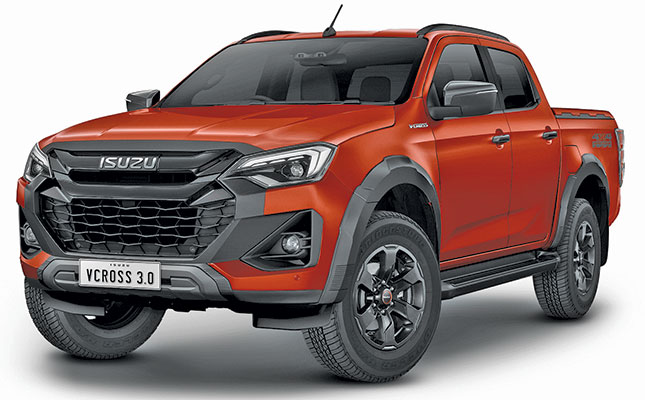
Exhibited in top-spec V-Cross guise, the noted changes include new headlights, a revised bumper, new daytime running lights, and a restyled grille.
The updates to the rear are more subtle and include a revised bumper and tailgate, and new wheel arch cladding for the range-topper.
The interior features improved materials, along with a new 7” digital instrument cluster on higher-end derivatives, while USB-C ports replace the previous USB-A units.
Also new, both the 7” and 9” infotainment systems lose the physical shortcut buttons at the base of the display in favour of touch-sensitive controls.
Physical knobs
Other new features include a pair of physical knobs for the radio tuner and volume, and wireless Apple CarPlay, while Android Auto remains wired.
A new adaptive cruise control system, designed specifically for models fitted with the six-speed manual gearbox, rounds off the changes.
Rimmer admitted that applying for the changes themselves isn’t an easy process, as they need to be presented to both Japan and Thailand. In some instances, the requests are either not granted or require serious convincing based on scale and cost.
Only after this, and the completion of the freeze period, can a vehicle be imported before setting about adapting it.
No date set
As it stands, no official date for the face-lifted D-Max’s reveal has been set. However, given the timing of the mentioned teaser, expect an announcement sooner rather than later.