One of the central messages of the conference was that food insecurity often stems not from insufficient production, but from systemic failures within food systems.
Spencer Maxwell, chief operating officer at the non-profit Heart for Africa, shared insights from Project Canaan, a 1 000ha agricultural and community development initiative in Eswatini that tackles hunger through integrated farming, employment, and education programmes.
He explained that malnutrition across Africa reflects deeper structural challenges in how food is produced and distributed.
“Children aren’t malnourished because there isn’t enough food in this world. They are malnourished because the systems that produce, distribute, and sustain nutritious ingredients are broken.”
Project Canaan combines farming with social programmes, including orphan care, employment creation, and skills training. Maxwell added that the initiative shows how agriculture can operate as part of a broader economic ecosystem, describing it as ‘purpose-led economics’, where social impact and commercial sustainability work together.
“When you have your mission at the centre of everything you’re doing but recognise that you also have to pay for that mission, you create a system that can scale and become sustainable,” he explained.
The farm now produces a range of crops and livestock products while supporting food distribution programmes across Eswatini.
Maxwell added that the project currently delivers more than 7 000 meals per day, while employment opportunities created through the initiative support hundreds of families.
“Our goal is to become fully self-sustainable within the next five years by generating enough profits to offset the operational costs of our mission,” he added.
Promoting agritourism for local economic growth
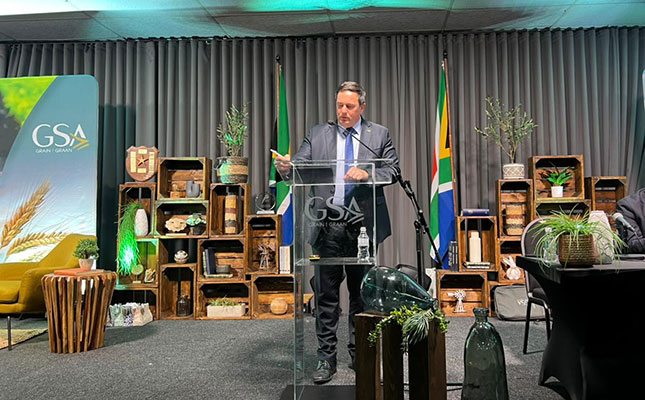
Another area explored at the conference was how agriculture can be linked with other sectors to strengthen rural economies. Cllr Bassie Kamana, member of the Mayoral Committee for Economic Development, Tourism and Agriculture in the Nelson Mandela Bay Municipality, spoke about the economic potential of integrating tourism with agriculture in coastal regions.
“Coastal regions possess unique economic assets. They’re often endowed with fertile agricultural land, vibrant fishing industries, and natural landscapes that attract tourists from across the globe,” he said.
However, Kamana added that agriculture and tourism often operate as separate sectors, limiting opportunities for local economic development: “When tourism and agriculture integrate strategically, they can generate a powerful economic ecosystem.”
He explained that stronger links between the two sectors can create local food supply chains that benefit farmers and tourism operators alike.
“Tourism creates demand for food, cultural experiences, and rural visits, while agriculture provides the products, landscapes, and traditions that enrich them.”
He highlighted local procurement, where hotels and restaurants source fresh produce directly from nearby farms, as a key way to strengthen these connections.
“When products are sourced locally, the tourism economy directly supports rural farmers,” he said.
Empowering communities through small-scale agriculture
The importance of equipping communities with practical agricultural skills as part of broader food security strategies was also discussed.
Reverend Rachel Ssekimpi from Makhanda (formerly Grahamstown) shared the story of Gardens of Faithfulness, a high school-based initiative that teaches students sustainable farming while encouraging community engagement.
Launched in 2022, the project gives learners 1m x 2m school plots to grow vegetables using the Farming God’s Way (FGW) method. FGW is a Bible-based, low-tech farming programme that helps poor farmers restore degraded land, break the cycle of poverty, and contribute to household food security.
“After three months, each of these gardens has the potential to feed a family with produce worth around R500, and the seedlings only cost about R20,” Ssekimpi explained.
Beyond food production, the project helps young people gain a deeper understanding of farming and encourages them to share these skills within their communities.
“Farming God’s Way does not encourage handouts but rather teaches people to grow their own crops,” she added.
Learners who complete the programme later assist in establishing community gardens at other local schools and organisations.
Collaboration across the agricultural value chain
Across the sessions, delegates repeatedly emphasised that sustainable agribusiness models must combine innovation, collaboration, and long-term thinking.
Maxwell concluded: “Each of us plays an important part in the agriculture sector, from seed manufacturers to farmers, logistics providers, and retailers. Our central mission must remain feeding people around the world,” he said.