
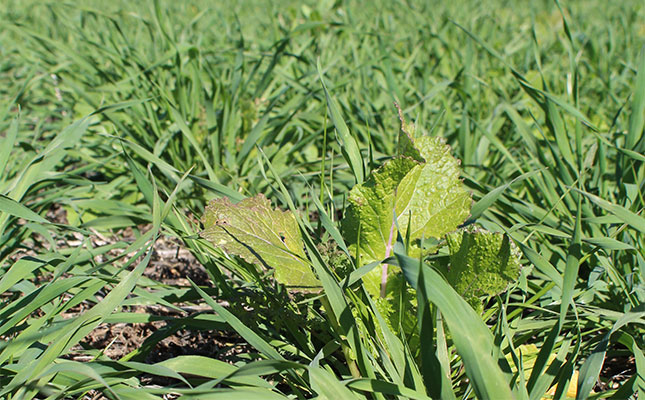
Conservation agriculture (CA) focuses on building soil health through minimal disturbance, unlike conventional tillage (CT), which involves tilling the soil to prepare the seed bed and manage weeds.
A key CA practice is building soil health and suppressing weeds by planting cover crops and maintaining living roots in the soil, which feed beneficial micro-organisms. However, an ASSET Research study found this is where most farmers struggle when transitioning from CT to CA.
Other key findings were that farmers who were successful in keeping the soil covered for most of the year, and where living roots were maintained in the soil, fared far better than those who did not.
Furthermore, the researchers interviewed farmers who had abandoned CA and returned to tillage practices since the former had not produced any benefits. In all three cases, farmers had not planted cover crops.
“Integrating cover crops into a grain operation is not difficult per se,” says Dr Hendrik Smith, CA facilitator and programme manager at ASSET Research.
“But farmers find it difficult to make the mind shift to adapt to a different way of managing their fields throughout the year. They are too comfortable with the old system.”
Interestingly, challenges faced by farmers transitioning to CA also persist among those who have practised it for some time.
According to the study, soil health-oriented CA systems must reach certain soil function thresholds, such as soil organic carbon, biology, structure, and pH, before they function properly and deliver expected ecosystem services. This is because soils degraded by decades of tillage take time to recover.
Cover crops matter
Cover crops are important for maintaining living roots in the soil throughout the year so that beneficial micro-organisms have enough food and can boost soil health.
The resulting weed suppression is also important, since weeds cannot be tilled away under a CA system.
Smith notes that the transition to CA usually corresponds with a changing and even higher weed pressure that needs to be controlled through crop rotations, diversity, and livestock integration.
He explains that the biomass provided by cash crop residues is insufficient to keep the soil covered and suppress weeds. Thus, a cover crop is needed in the off-season to provide biomass and living roots. This should include a multispecies mix, which can also provide grazing for cattle, allowing farmers to derive income from the cover crop.
Regarding the best mixes to plant, Smith advises consulting cover crop specialists and learning from other farmers, since solutions can be region-specific. Multispecies mixes should include legumes, grasses, and broadleaves in the right ratios.
Planting date is also crucial, as some species of cover crop are better suited to specific seasons, and poorly timed establishment reduces biomass and leads to higher weed pressure.
“Cover crops should be managed with the same level of attention as cash crops and should not be neglected,” says Smith.
“A big mistake farmers make is not planting in time and not considering fertiliser applications to boost biomass. Nitrogen applications need not be as high as those for cash crops, but around 50kg/ha is generally needed to get the required biomass.”
Grazing management should consider the optimal number of cattle needed to graze the fields. A high-density grazing system is preferable to ensure proper use of all the cover crops and allow the soil to benefit from cattle manure and urine.
Optimal biomass for maximum results
Obtaining optimal levels of biomass is crucial. Andrew McGuire, senior extension fellow at the Center for Sustaining Agriculture and Natural Resources at Washington State University in the US, says biomass is the measure of additional energy that cover crops put into the biological field-soil system.
“It tells us how protected the soil surface is from the elements. It shows how much sunlight, water, and nutrients the crop took away from weeds. It also indicates the amount of time the soil has living roots in it,” he explains.
“Because of these relationships, most of the benefits of cover crops are related to biomass production.”
McGuire provides two approaches to managing cover crops for biomass production:
- Determine the available growing window after the cash crop season and adjust management for biomass production. The cover crop’s growing window determines its biomass potential and the benefits that can be expected.
- Choose the cover crop goal – erosion control, soil improvement, or weed suppression – and adjust the growing window to obtain the needed biomass.
“Either way, you will end up with one or more goals for your cover crop, a growing window, and an estimated biomass target,” he adds.
“Because biomass thresholds and benefits are related to the physical biomass itself, they shouldn’t vary much by region, climate, soil type, or cover crop species. Whether it’s in arid or humid regions, 2,2t/ha of biomass is the same.
“What will vary is how your biomass target is achieved, which depends on many factors, including growing window temperatures and precipitation, species selection, seeding rate, and soil nutrient status.”
McGuire advises that farmers adjust their management practices based on the desired level of biomass:
- Level 1: for a low-biomass cover crop with a single goal of providing as much erosion control as possible, plant as early as possible and terminate as late as possible. Choose a species that is well suited to a short growing window and has inexpensive seed. Increase seeding rate as much as economically feasible.
- Level 2: for erosion control and soil benefits, follow the steps for level one, but consider using a two-species cover crop mix of a legume with a non-legume. Consider fertilising the cover crop if nutrient deficiencies could limit biomass production.
- Level 3: for erosion control, soil benefits, and weed suppression, follow the steps for level one and two, but use a monoculture or legume grass cover crop mix for best suppression of weeds by both the living cover crop and its residues after termination.
Cropping systems
Farmers have several options for incorporating cover crops. Small-scale trials should, however, be done for at least two seasons before deciding on a winning option and expanding the practice to the rest of the farm.
Smith notes that intercropping works well with maize and sunflower. The planting date must be carefully balanced so that the cover crop grows into the winter but is not planted so late that the cash crop grows too tall. However, this requires an interrow planter, which can be prohibitively expensive for cash-strapped farmers.
Relay intercropping is possible for those who have access to a drone or aeroplane that can disperse the seeds in the field. Timing is also important here, as sowing must be done in a week that was preceded by rain and where the following week is likely to receive rain.
For soya bean fields, Smith says cover crops should be planted after the harvest, since it is difficult to get the seed into the soil while the crop is still on the land.
Row widths are an important consideration with relay intercropping, as the cover crops need access to enough sunlight to grow. “A 90cm row width is ideal, with 50cm being too narrow,” says Smith.
Another option is double cropping, where a cover crop is planted directly after the cash crop is harvested. Here, fertiliser applications should be considered, as these crops would not have benefitted from the fertiliser applied to the cash crops.
At the start of the cash crop season, the cover crops can either be terminated chemically two to three weeks before planting, or cash crops can be planted into the cover crops. The cover crop can then be chemically terminated shortly after planting.
McGuire adds that biomass is key to cover crop benefits. “Biomass is the physical protection of the soil, the energy that drives all the biology, and the competitive suppressor of weeds. If you want benefits from cover crops, focus on biomass production.”
For more information email Dr Hendrik Smith at [email protected].