
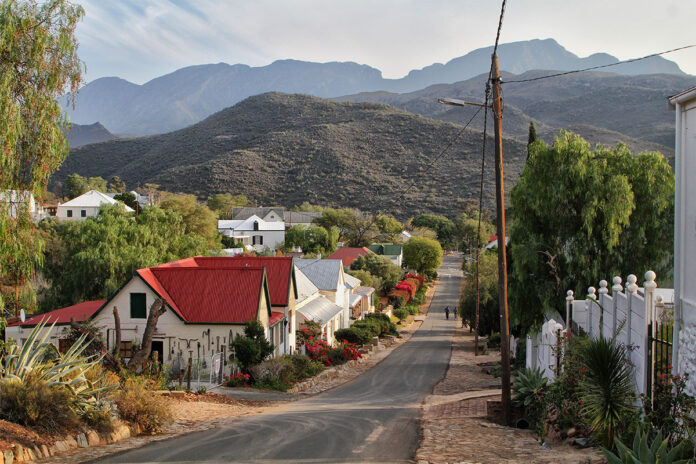
Visitors to Domein Doornkraal Guest Farm outside the De Rust village in the Klein Karoo are usually tickled pink in two ways.
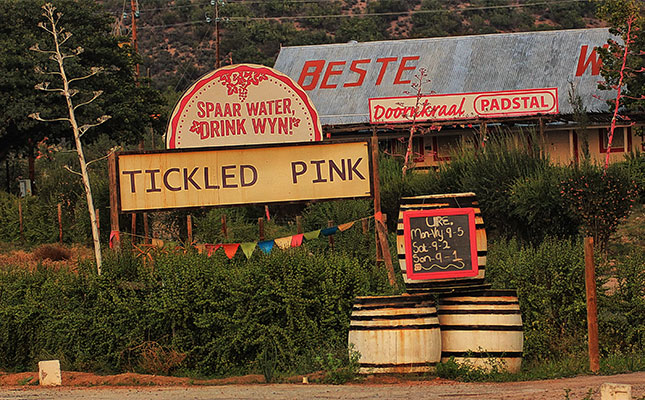
Their hosts, the Le Roux family, make a fine semi-sweet sparkling wine using Muscadel grapes that is a perfect drink for a picnic on a hot summer’s day.
Unsurprisingly, it is labelled ‘Tickled Pink’ and it comes complete with an artist’s impression of an ostrich on the run.
The next bit of ‘pink tickling’ arrives when you sit down and have a drink with Doornkraal’s legendary owner, Oom Swepie le Roux (Gerrit Cornelis), while listening to some of his fabulous family anecdotes.
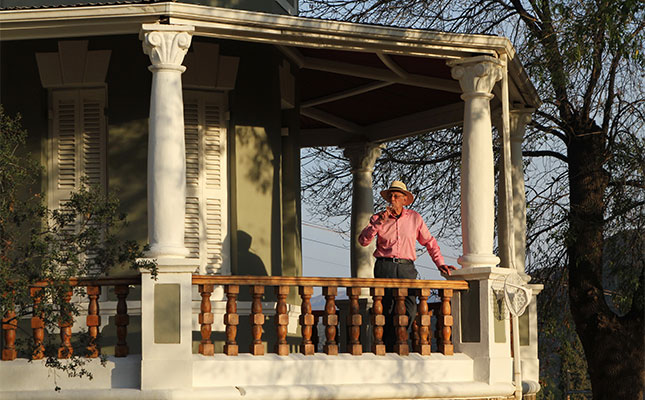
He lives in one of those fabled ‘feather palaces’ you sometimes spot in the Klein Karoo and, to a lesser extent, the Eastern Cape Karoo. They were built at the height of the ostrich feather boom years before World War I, and filled with goods imported by ship from Britain and Europe.
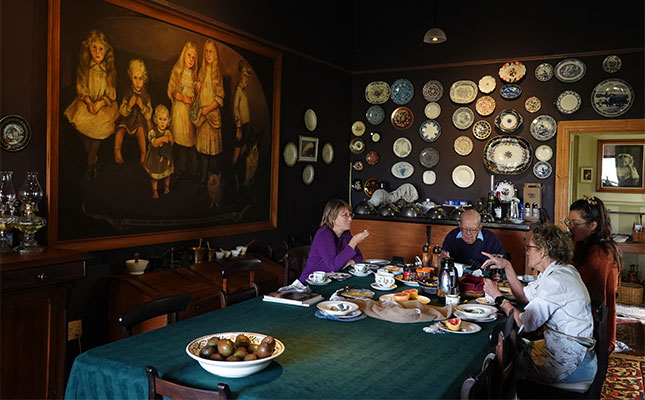
The Doornkraal feather palace itself is absolutely beautiful. Inside, it is like a museum.
Portraits of past Le Roux family members grace the walls. You walk along an ultra-wide passage to an enormous dining room with its 14-seater table.
Stoeps, stairs, stained glass windows, towers, and turrets are everywhere. You can get lost in local history right here.
The house was built in 1914, just as the feather industry peaked, and then crashed. War, anti-animal cruelty sentiment, and open-top Model T Fords left no place for an ostrich feather market.
Those who had invested everything in ostriches were soon out on the street, trying to fashion new lives for themselves. Those who had always diversified their farming operations survived to plough another day.

The Storyteller
If you stay at one of the lodgings at Doornkraal, you might glimpse the farm’s patriarch, Le Roux, and his rescue dog Skimmel. Now 90, Oom Swepie farmed here for 60 years before retiring, and is still fit and active.
According to the ladies who attended fitness classes in De Rust, Le Roux is able to do a two-minute plank exercise without strain. “That’s impressive,” we thought.
We spoke about the ostrich industry, which once dominated farming in this region and neighbouring Oudtshoorn.
The one issue that exercised the mind of Swepie’s grandfather (Gert Cornelis) was the fact that a seasonal river, the Olifants, flows through the farm. It is often dry, but any heavy rains in the Great Karoo, on the other side of the Swartberg Mountains, would fill the river via one of its major tributaries, the Traka. How could this water be captured and used?
A Scottish engineering marvel
Oupa Gert bought two large pumps, but they were swept away by flood waters. “Back in 1912, Doornkraal was doing well thanks to the feather boom,” says Oom Swepie. “My grandfather decided to invest in the best pump to irrigate his lands during flood conditions, one that could be moved out of harm’s way if needed.
“Oupa sent for a very expensive three-cylinder Crossley gas suction pump made by Stewarts & Lloyds in Scotland. It came by ship, then by railway to De Rust. Oupa even built a short sideline to get the machine to its designated place next to the river. The pump came with an engineer, a Mr Gush, who put it together for Oupa and tried to show him how to operate it. The pump was a fantastically complicated contraption, flywheels and other moving parts. “You had to light a fire, then build up pressure to a certain level, and there were all kinds of levers and valves,” he says.
Oupa Gert tried his best to follow the directions, but after three concerted attempts, he was nowhere close to getting the pump started. He then made the engineer Gush an offer he couldn’t refuse.
He said: “I have a proposal for you – I will build you a house, pay you five pounds a month, and give you five pairs of ostriches.” So, Gush went back to England and brought back his wife and child.
“All was well until the feather collapse, when keeping on a dedicated pump-man became unaffordable. So, Oupa asked the engineer to teach his son PK how to use the pump.
“My father PK went to boarding school in George. The train drivers would give a special whistle as they passed the siding to let us know when there had been good rains in the Great Karoo. It would take a day or two to get to us through Toorwater Poort.
“So Oupa would call the school principal, who would put my father on a train. He’d come and set up the pump, and with the water flooding through from the Great Karoo, they would irrigate the entire farm for three days and nights.”
Building the feather palace
We stayed with the subject of the flightless birds that had given the Klein Karoo its golden-era status in the late Victorian era. Besides various industry dips over the decades since the crash of 1914, the local ostrich business has innovated itself and made every part of the bird marketable in some form. Even the toes are used for doggie chews these days.
We remarked on the stately old mansion he lived in with one of his daughters, Julia, who looks after the catering and hospitality side of Doornkraal.
“Just before the feathers fell, Oupa said to his wife Maggie that since there was still a little money left over from the purchase of the pump, he would build her a new house,” says Oom Swepie. “In those days you chose from a catalogue and the house came in kit form from Britain. She made her choice and insisted on one special item: a very wide passage.
“Ouma Maggie was a large woman, and she didn’t want to have to squeeze past anyone else of her own size as she walked down the passage.
“He hired an architect called Steenhuizen, who told him the extra-wide passage would not only cost more, but would add six months to the construction time. When Oupa was told what the total cost of the entire ‘feather palace’ would be, he was horrified. It was more than his precious Stewarts & Lloyds pump.”
So, Oupa began to haggle with Steenhuizen. “I will make the bricks,” he said. But still, the quote was too high for his liking.
“Why does it have to have a double-layered roof?” he had asked Steenhuizen.
“To protect against wind and rain,” came the reply. “Ha! This is a desert, it hardly ever rains here. What’s the total if we only use one overlap?”
Steenhuizen, who by then had ascertained exactly what the Stewarts & Lloyds contraption had cost, replied: “Exactly what your pump cost!” The deal was done, the feather palace was built and everyone was happy. And to this day, it stands firm and strong, despite the storms that occasionally ravage the region.
Dealing with the Smous
The following Oom Swepie story needs some context: Oudtshoorn built its international reputation after the arrival of the Lithuanian Jewish feather merchants in the 1890s, and their dealings with the mainly Afrikaner farmers were amicable.
There was usually a special room on the farmstead for the wandering trader, who was regarded as a ‘human newspaper’ by the isolated families.
“The smous visited all the homes of his clients, travelled far and wide, and could usually update his host on farming trends around the district,” says Antoinette le Roux in her Master’s thesis on the development of agriculture around Oudtshoorn.
Oom Swepie remembers how the Jewish feather merchants would come and visit his grandfather to buy feathers.
“Doornkraal was rather popular, in part because their food and barrel-aged brandy was so good. There is a tradition here of growing vines, and Oupa Gert was not a drinker. He only used brandy for medicinal purposes,” says Oom Swepie.
It was Ouma Maggie’s lifelong ambition, although never fulfilled, to convert one of these Jewish pedlars to Christianity.
Her desire was to feed them well and then make sure they attended the evening prayer service that preceded the meal.
But, first she would make them bath. After weeks on the dusty road, they would need to clean up. After supper, Oupa would show the smous the ostrich feathers.
By lamplight, they gleamed, sumptuous and beguiling.
Then, fortified with some fine Doornkraal brandy, farmer and smous would get down to feather business.
Growing up and listening to his grandfather’s advice, Oom Swepie was instructed to diversify the farm when he came of age to take over Doornkraal.
“Oupa said: ‘Don’t just farm with one thing,’” recalls Oom Swepie.
“When I went off to study winemaking, he approved, but with one proviso: I was not to become a drunkard!”
Today, Doornkraal no longer farms with ostriches, but they do still make delicious dessert wines. And of course, the slightly addictive Tickled Pink bubbly.
Julia the chef
Swepie’s daughter Julia is the one you’ll usually find in the kitchen, busy turning the fruits and vegetables on the farm into something rather magical that you might either taste at their irregular Long Tables, or at their Doornkraal Padstal, which has been operating for 40 years.
Her plum cordial is famous and her plum jelly scooped up first prize in the 2025 Agri-Expo Preserve Awards.
The padstal also stocks her Mauritian lemon atchar, citron preserve, quince jelly, lemon marmalade, and along with pasture-fed lamb (losbandige lam) and whatever is fresh and in-season on the farm, typically pumpkins, quinces, plums and more.
Celia’s passion for Cape horses
Julia’s sister Celia is the farmer on Doornkraal, cultivating lucerne, vegetable seed, export-quality stone-fruit and grapes, as well as raising cattle, sheep, and her first love, Cape horses.
There have been horses on Doornkraal Farm for more than 140 years. The Le Roux family has a preference for the gentle, versatile, sure-footed Cape Riding Horse that is also very comfortable to ride.
There are eight riding packages on offer, trails that lead guests around the farm and also into the dramatic valleys and ravines in the area.
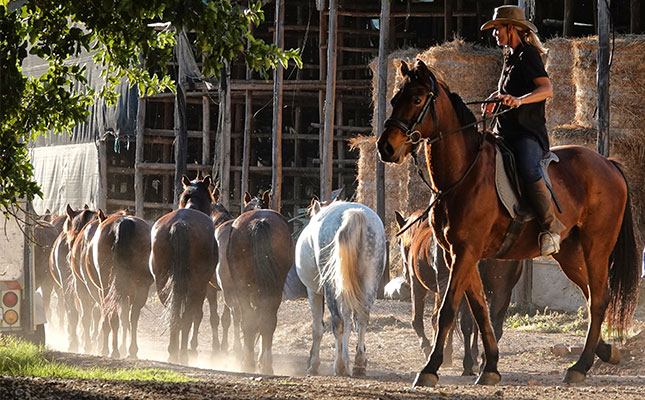
When some farmers in the nearby Meiringspoort were isolated by the devastating storms in May, Celia and members of her staff went in on horseback to bring them much-needed supplies.
“We cater for all levels of riding experience,” she says. “Your ride can be tailor-made to suit your needs and your time frame.”
The various rides listed have names like Kudu Trail, Spekboom Trail, Spookdrift Trail, Karoo to Coast, and Stof en Sterre (Dust and Stars), a four-day bucket list adventure that comes with a mobile hot tub!
Doornkraal also offers a three-day sleep-over Pony Camp for children, a specially designed and very safe farm holiday that even includes an on-site child psychologist.
A ghostly visitor
Like her father Swepie, Celia has storytelling talents. She told us a rather Gothic but utterly Karoo ghost story.
“One night, a local doctor was doing a house call. Suddenly, a woman appeared before him on the road. He stopped and rolled down the car window. The woman, pale of face and wrapped in a blanket, was clearly cold.
“She pointed at a distant side road and begged him to take her there. He protested, saying he had an urgent call to attend to. She begged some more. Eventually, he invited her to climb into the vehicle.
“She was silent as they came to a farmhouse deep in one of the klowe (ravines). The woman jumped out and ran inside.
“The doctor followed her, and found a baby lying in a cot, cold and hungry. He turned around, and saw the woman behind him lying dead on the floor.
“Her spirit, it seemed, left her body and went out to seek help for her newborn baby, who was saved by the doctor.”
For more information, phone Marinel on 082 763 5296, or Celia on 082 899 4531.