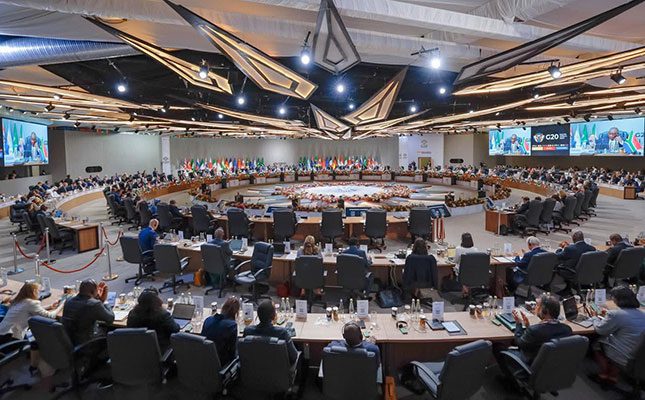
After the summit, which the US boycotted, G20 leaders adopted a declaration covering wide-ranging global challenges, including food security and agriculture.
Although Zimbabwe and other African countries are not part of the G20, the group’s agenda will affect their respective agriculture sectors.
Speaking to Farmer’s Weekly, Dr Vimbai Gobvu, a lecturer at Zimbabwe’s Marondera University of Agricultural Sciences and Technology, said that despite Zimbabwe not being a member of the G20, it could still benefit from the summit decisions through several indirect, albeit impactful, channels.
She explained that with the African Union (AU) now a permanent member of the G20, the interests of African countries, including Zimbabwe, are better represented, opening up initiatives addressing the continent’s priorities, such as the development of the agriculture sector.
She added that the outcomes of the G20 summit, especially those regarding climate action, food security, and sustainable development, hold significant potential to influence the policy direction and strengthen support systems in Zimbabwe’s agriculture sector.
Smallholder farmers prioritised
“The G20 Leaders’ Declaration emphasises support for smallholder farmers, especially women and youth, as a priority group.
“Zimbabwe’s agriculture sector is dominated by smallholders, who occupy close to 70% of the total agricultural land, according to Zimbabwe’s National Agriculture Policy Framework [NAPF]. Smallholder farmers in Zimbabwe are predominantly women and youth, with women managing the majority of smallholder farms and bearing the brunt of the work,” Gobvu said.
“Supporting smallholder farmers has a profound impact on the nation’s agriculture sector by increasing agricultural output and reducing national food imports. Different support like training, finance, and inputs can allow for diversification of production, since smallholder farmers grow a wide range of crops and [raise] livestock, leading to a more balanced and resilient sector.”
She added that the G20 summit highlighted that despite progress in reducing global hunger, up to 720 million people continued to experience hunger in 2024, reaffirming global efforts to achieve Sustainable Development Goal (SDG) 2, zero hunger, by expanding access and affordability to safe, healthy, and affordable food.
Gobvu said a core target of SDG 2 is to double the agricultural productivity and incomes of small-scale farmers. This can be achieved by ensuring secure and equal access to land, knowledge, financial services, and markets, which directly reduces poverty and boosts livelihoods.
“Zimbabwe has developed a strong policy environment, including the NAPF and the Zero Hunger strategy, which align national priorities with global goals and attract necessary investment and cooperation,” she added.
Declaration translates into targeted agriculture investment
Zimbabwean economist Michael Takudzwa Pasara said the leaders’ declaration carries profound implications for the global agriculture sector, moving beyond basic discussions on food aid to outline a sophisticated, multipronged economic strategy focused on systemic resilience and sustainable market integration.
He added that at the technical level, this year’s G20 Leaders’ Summit recognised that the agriculture sector operates under severe macroeconomic and climate constraints, posing significant threats to global development objectives like SDG 2.
“Strategically, the [2025] summit’s [theme of] ‘Solidarity, Equality, and Sustainability’ translates into targeted investment mandates for fostering inclusive growth within food systems. Leaders pledged to strengthen agriculture, aquaculture, and food systems for future generations, with a particular focus on smallholder and family farmers, especially women and youth.
“This approach necessitates improved access to finance, digital tools, markets, and climate-resilient infrastructure for these vulnerable groups,” he explained.
Pasara said a pivotal strategic outcome of the summit, especially for Africa, is the focus on supply chain decoupling and regional autonomy.
He explained that the G20 Leaders’ Summit encouraged investment in local food production, storage, and distribution capacities to reduce dependency on volatile global supply chains. This approach is supported by specific policy endorsements, including the implementation of the AU’s Comprehensive African Agriculture Development Programme and the African Continental Free Trade Area.
“Market imperfections are addressed via the adoption of the Ubuntu Approaches on Food Security and Nutrition, which target the negative economic impacts of excessive food price volatility on low-income households.
“In essence, the G20 agenda positions the agriculture sector not merely as a recipient of aid but as a critical node for global economic stability, requiring significant, derisked financial intervention and comprehensive structural reforms, particularly those that empower decentralised, local production systems in developing economies,” Pasara added.
Regarding policy responses, he said the leaders’ declaration calls for modernising agriculture and enhancing food system resilience through crucial environmental and technological interventions, including the effective management of land, soil biodiversity, energy, and water; promoting adaptation and mitigation strategies; and supporting sustainable technologies and innovations…