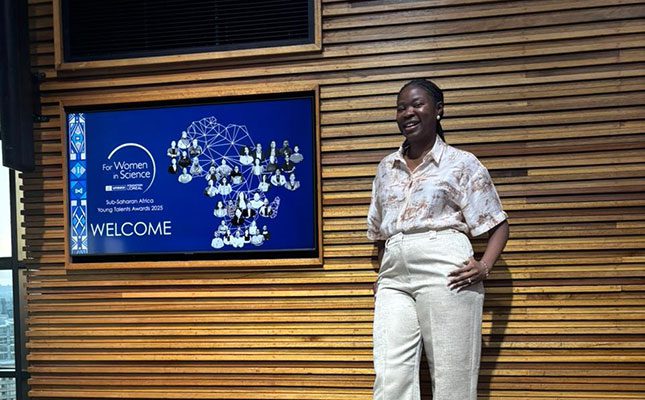
The presentation ceremony for the awards, sponsored by the Fondation L’Oréal and UNESCO was held in Johannesburg on 11 December.
One of the award winners, Cameroonian national Claude Yasmine Hamany Djande, a postdoctoral researcher at the University of Johannesburg’s Centre for Plant Metabolomics, said that her research focuses on understanding how barley plants respond to stress at a metabolic level.
She said her aim is to address key challenges in barley production, particularly those linked to disease pressure and environmental stress.
Research addresses problems faced by farmers
Djande said her research addresses a very practical problem for farmers; crop loss due to environmental and disease pressure. In barley, these stresses can significantly reduce yield, plant vigour, and ultimately a farmer’s income, thus her work focuses on understanding the interaction between barley plants and their environment, particularly fungal pathogens.
She said by studying how different barley varieties respond to infection and stress, she aim to differentiate resistant plants from susceptible ones.
“This knowledge helps us develop practical strategies to manage disease outbreaks and improve preparedness, especially in the context of climate change,” Djande said.
“The key tool I use is called metabolomics, which you can think of as listening to the plant’s internal signals. Plants produce thousands of small molecules when they are healthy, stressed, or defending themselves. By measuring these molecules, I can identify which barley cultivars are naturally better prepared to cope with stress.”
She said in practical terms, this work helps to:
- Identify more resilient barley lines;
- Reduce reliance on chemical inputs;
- Support more stable yields under challenging conditions.
Using advanced chemical analysis, molecular techniques and controlled experiments, she is able to detect problems early and guide smarter, science-based crop improvement strategies that translate into real-world farming conditions.
Djande’s research focuses on barley, a crop that is both economically important and biologically vulnerable. It plays a key role in food systems, animal feed, and the malting and brewing industry, supporting many farming livelihoods.
“At the same time, it is often grown under rain-fed conditions, where farmers have limited control over stress factors such as drought, soil constraints, and disease pressure. This makes barley an ideal crop for resilience-focused research. By improving how it copes with stress and disease, we directly support farmers’ productivity, income stability, and long-term sustainability. The impact is not abstract and is felt in the field,” she added.
According to Djande, she was drawn into agricultural science because food security is real; she has seen how a single poor harvest can affect not only income, but also dignity, education, and opportunity for entire families, particularly in Africa.
“I chose agriculture because it allows me to connect science directly to people’s lives. Working on crops like barley is my way of contributing to that vision; using science to build stronger plants, more resilient farms, and more secure communities,” she added.
Initiative to improve potato production in Mozambique
Tamara Jose Sande, a Mozambican scientist and PhD student in the department of soil and geological sciences at Tanzania’s Sokoine University of Agriculture, said her research focuses on soil science and plant nutrition to improve potato production in Mozambique through integrated nutrient management.
“I combine inorganic fertilisers, vermicompost, and bio-enriched rock phosphate to improve crop yield, tuber quality, and soil health. This approach is important because it helps farmers use locally available and affordable inputs, reducing dependence on expensive imported fertilisers,” she said.
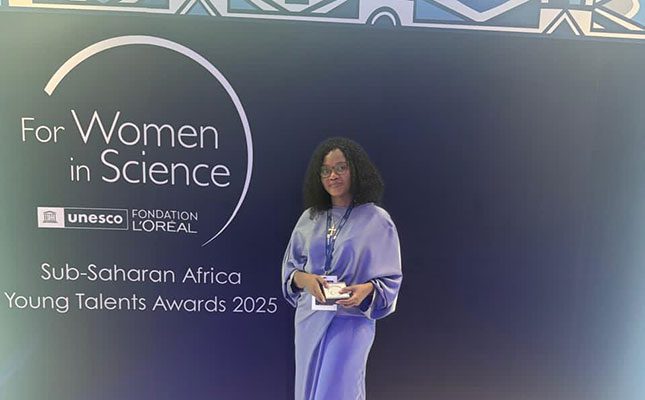
“The research uses field experiments, soil and plant laboratory analyses, and nutrient balance evaluations to understand how different nutrient sources work together to improve productivity and sustainability.”
She added that in her country, potato yields are much lower than they should be, mainly due to poor soil fertility and nutrient limitations.
By focusing on potatoes, Sande said her research directly addresses a problem faced by smallholder farmers, with the goal of increasing productivity, improving food security and supporting rural incomes.
Sande became a lecturer in higher education, teaching soil science and plant nutrition. Through teaching, as well as working with students and farmers, she realised how important strong scientific knowledge is in solving practical agricultural problems.
“This motivated me to pursue advanced research, so I can contribute to sustainable agriculture and farmer support in Mozambique,” she added.
Applying machine learning to precision agriculture
Tanzanian researcher Rehema Mwawado, a PhD student specialising in embedded computing systems at the University of Rwanda’s African Centre of Excellence in Internet of Things (ACEIoT), was recognised for her work applying machine learning to precision agriculture.
Her research focuses on harnessing machine learning – where computers recognise patterns in data to generate predictions or recommendations – to support more precise farm management.
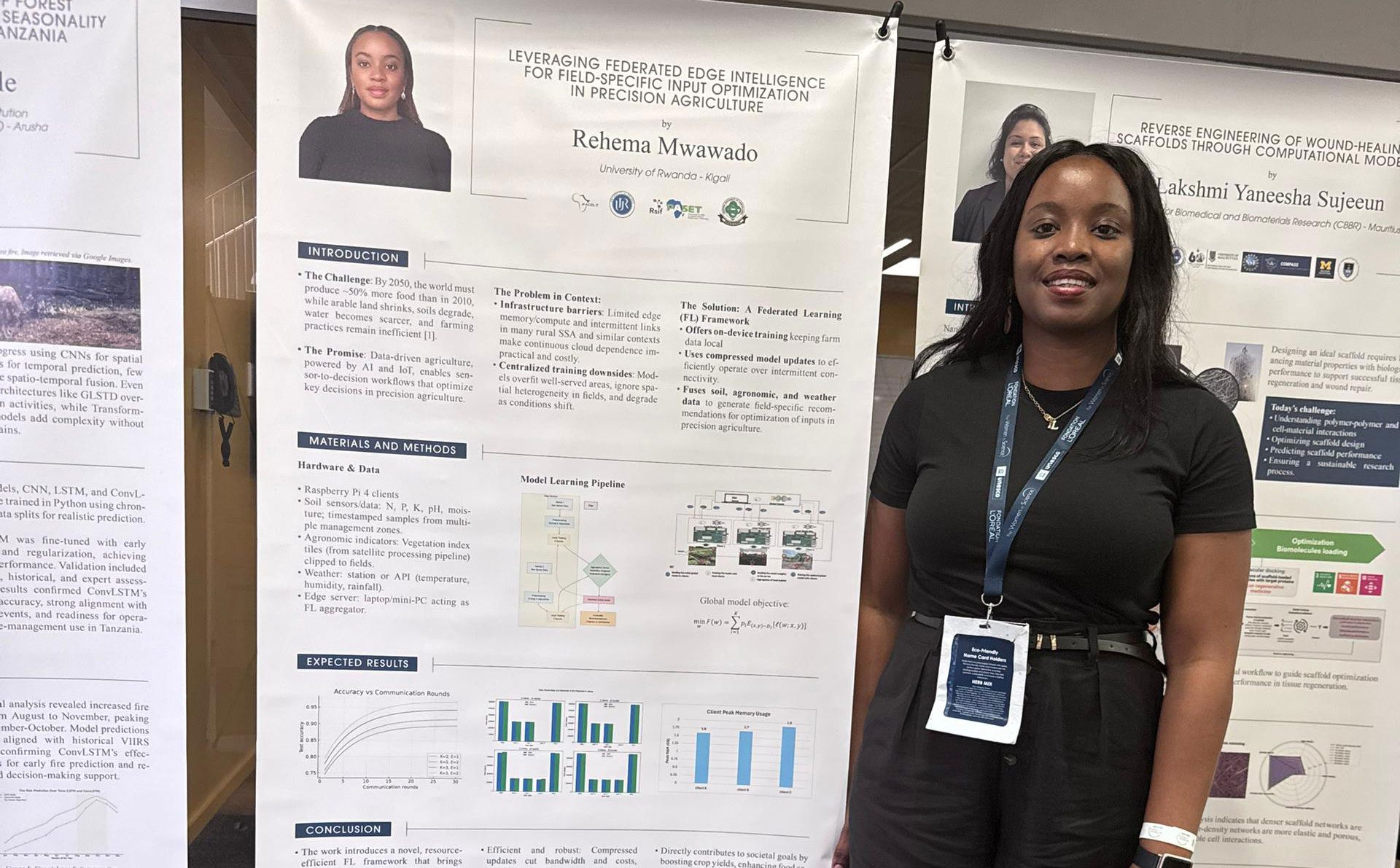
Mwawado’s approach uses edge devices, meaning affordable technologies that can process data locally on or near the farm, such as smartphones, sensor nodes and small on-farm computers or gateways. This reduces reliance on constant internet access and enables real-time recommendations.
By integrating soil, weather and crop data through these technologies, she is developing adaptive models that help farmers make scalable, efficient and site-specific decisions on when and where to apply appropriate quantities of agricultural inputs.
Mwawado said that even small improvements in day-to-day management, such as fertiliser application or irrigation scheduling, could significantly influence productivity and farmer incomes.
Data-driven tools can complement extension services
“In many African countries, farmers still depend heavily on general knowledge or guidance provided through extension services,” Mwawado said.
“Extension officers play a critical role, but they are often responsible for supporting large numbers of farmers across wide areas. This makes it difficult to provide frequent, field-specific advice to every farm. Data-driven tools can support farmers with timely, precise recommendations and help extension services scale their impact. That is what motivated me to work in precision agriculture.”
She added that satellite and remote-sensing data could be highly valuable for understanding crop conditions and variability across landscapes, particularly where farms differ widely in soil properties and microclimates.
However, she emphasised that practical solutions work best when remote sensing is combined with local data sources so recommendations remain relevant under real-world farming conditions.
Mwawado, who is trained in electronics engineering and is an assistant lecturer at Sokoine University of Agriculture, said her work at the university strengthened her commitment to applying embedded and digital technologies to solve practical challenges in agriculture.
She added that her research is highly collaborative and draws on expertise across multiple disciplines.
In a statement, the Fondation L’Oréal and UNESCO said the 30 award winners were selected from more than 550 applications and chosen by a jury of 10 scientists, chaired by Professor Priscilla Baker, a chemistry professor at the University of the Western Cape.
The statement added that the awardees’ research contributes directly or indirectly to addressing key challenges in food security, public health, sustainable development and inclusive digital transformation.