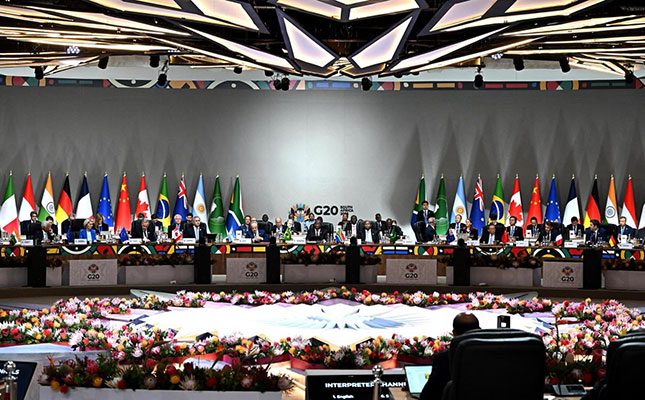
Nineteen G20 members adopted the declaration, which places strong emphasis on agriculture, food security, and sustainable development.
However, analysts warn its value will depend entirely on implementation, an area where global processes often fall short.
Agriculture recognised as central to global stability
In the declaration, the G20 reaffirms its commitment to ensuring “resilient and sustainable food systems and food security through open and non-discriminatory trade policies consistent with [World Trade Organization] rules.” This is a critical assurance for South Africa’s export-oriented agriculture sector.
Agbiz chief economist Wandile Sihlobo welcomed the declaration’s emphasis on agriculture, noting that it recognises the need to modernise food systems through science-driven innovation.
Quoting directly from the declaration, he highlighted its call for improving resilience through “land, soil biodiversity, energy and water management, reducing food waste, adaptation and mitigation, support for sustainable technologies […] and investment in smallholder and family farmers”.
In a press release, Sihlobo argued that this aligns closely with South Africa’s own policy trajectory. “We must be guided by science rather than rhetoric and politics on food matters,” he said, emphasising the safe, balanced use of agrochemicals rather than ideological bans.
He added that South Africa’s advancements in improved seed cultivars and animal genetics, as well as appropriate and safe applications of agrochemicals and fertilisers, have underpinned productivity and climate resilience.
South Africa’s G20 achievements
Diplomats pointed to several substantive outcomes during South Africa’s G20 presidency:
- Consensus on the Leaders’ Declaration, despite geopolitical divisions
- Acknowledgement of the Africa Engagement Framework, supporting deeper cooperation between Africa and the G20
- Endorsement of working groups focusing on illicit financial flows, infrastructure, air quality, artificial intelligence, sustainable development, and health
- Launch of the Ubuntu Legacy Initiative, a mechanism for cross-border African infrastructure development
- Successful coordination of more than 130 G20 meetings, including ministerial meetings and technical working groups
Vague commitments raise implementation concerns
Nonetheless, analysts warn that the declaration’s broad language may limit its impact. While it identifies key priorities – including debt relief, development finance, inequality, climate resilience, and sustainable agriculture – it contains few concrete commitments.
There are no deadlines, no measurable targets, and no accountability mechanisms.
This lack of specificity is especially concerning for Africa, where more than 20 countries are in or near debt distress. Without practical action, governments will continue to face impossible trade-offs between servicing debt and investing in agriculture, climate adaptation, and infrastructure.
Stakeholders call for concrete next steps
Experts argue that African governments and institutions will need to drive implementation themselves. Recommended actions include:
- Establishing a regional borrowers’ club to coordinate African positions on debt and development finance
- Strengthening accountability mechanisms to monitor follow-through by governments and creditors
- Pushing for International Monetary Fund operational reforms to incorporate climate vulnerability, inequality, and gender considerations
Sihlobo stressed that commitments must translate into tangible gains, adding that unlocking agricultural growth across Africa requires improvements in land governance, infrastructure, safe agrochemical use, the adoption of technology, and open trade.
“These are all lessons that can be drawn from South Africa’s agricultural story,” he said.
While South Africa’s diplomatic success is widely recognised, agricultural leaders caution that declarations alone do not build resilience. The G20 has delivered a promising framework; what happens next will depend on whether governments, institutions, and the private sector turn high-level commitments into real support for farmers on the ground.
Get trusted farming news from Farmers Weekly in Google Top Stories.
➕ Add Farmers Weekly to Google ✔ Takes 10 seconds · ✔ Remove anytime