
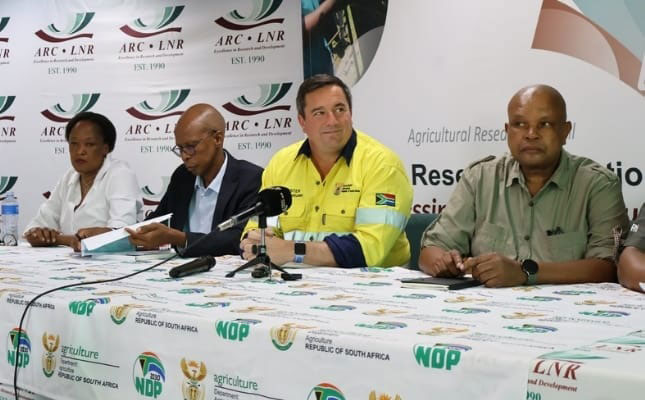
During the visit, ARC president and CEO Dr Litha Magingxa formally handed over the first batch of 12 900 doses, produced by South African scientists using local infrastructure, to government.
Speaking to Farmer’s Weekly at the ARC, Steenhuisen said the moment marked a turning point in the country’s response to the disease.
“We’re here today at the Agricultural Research Council where the announcement was made of the first production and rollout of our own locally manufactured vaccine against foot-and-mouth disease. It’s a multivalent vaccine covering SAT 1, 2, and 3, and it marks the first time in 20 years that South Africa has produced its own foot-and-mouth disease vaccine,” he said.
He added that the local breakthrough came at a critical time.
“As the crisis of foot-and-mouth rages around and we’ve been subject to waiting lists on international vaccines, this marks an important step.”
Production to be ramped up in March
While acknowledging that the first batch is limited, Steenhuisen outlined plans to rapidly increase supply.
“Although it is only 12 900 doses in this first batch, we will in March ramp that up to production of 20 000 doses per week.”
He explained that these locally produced vaccines will complement large-scale imports already in the pipeline.
Steenhuisen confirmed that 1,5 million doses of the Dollvet vaccine from Turkey, imported through local company Dunevax Biotech, were due to arrive within days.
This will be followed by 960 000 doses from the Botswana Vaccine Institute (BVI), and later the Biogénesis Bagó vaccine from Argentina, which is still awaiting approval from the South African Health Products Regulatory Authority.
According to Steenhuisen, the rollout marks “the real crunch time” for government’s newly announced policy of vaccinating the national herd, which he described as South Africa’s pathway back to FMD-free status.
How the vaccines will be deployed
The first locally produced doses will be strategically deployed, he said.
The initial distribution of the ARC vaccines will go to Free State (2 300 doses), Eastern Cape (2 600 doses), North West (2 000 doses), Gauteng (2 000 doses), Limpopo (2 000 doses), and Mpumalanga (2 000 doses).
He added that special attention will be given to high-risk regions.
“Most notably the Eastern Cape, where we’ve had an outbreak near Humansdorp; there’s a massive dairy presence there. We obviously want to use the over 2 000 vaccines we’re going to send out now down there to vaccinate a buffer zone to protect the dairy industry.”
Similar buffer strategies will be applied in North West to protect the Northern Cape. Vaccines will be sent to every province except KwaZulu-Natal, the Western Cape and the Northern Cape in the initial phase, before being redirected to epicentre areas for mass rollout.
Co-operation is essential
Steenhuisen said that co-operation across the sector would be essential.
“Now obviously we’re calling for huge co-operation with the agriculture sector. I’ve set up two bodies that include the private sector and farming organisations in them to help us with the monitoring and implementation of the rollout.”
He said the long-term goal was stability and renewed access to export markets.
“For the first time in 30 years, we’ve got a clear pathway to being able to ensure that South Africa becomes foot-and-mouth disease free.”
Giving a message for farmers, Steenhuisen acknowledged the hardship many have endured.
“I would like to say to them how deeply sorry I am that many of them have had to suffer through this. It is the result of almost 30 years of falling and failing in our biosecurity as a country.
“There’s also no substitute for good biosecurity on your own farm and then working together with the state, with private vets, and with the broader population to be able to work in partnership to beat FMD once and for all in South Africa.”
Dr Peta speaks on the science of the vaccine
Speaking to Farmer’s Weekly, Dr Faith Peta, chief research technician in the Vaccine Production Programme for Onderstepoort Veterinary Institute, described the day as a major achievement. Peta explained that the research journey began around 2010, focusing on identifying circulating strains and adapting them for vaccine production.
“We have tested this vaccine in cattle and it works wonders. It is not a GMO. It is not an mRNA vaccine. It’s just a chemically inactivated vaccine [which means it does not make the animal sick or trigger the virus].”
She added that the vaccine requires one 2ml dose per year and called on farmers to work together with scientists and government.
“If we are united and not against each other, we will defeat this.”
Addressing concerns about supply, Peta acknowledged current limitations.
“Today we are only rolling out 12 900 doses and we appreciate that that is inadequate, very inadequate, to satisfy the demand.”
However, she confirmed that production would increase to 20 000 doses per week from the end of March, rising to 200 000 doses per week in 2027.
Plans are also in place to build a new factory, budget permitting, which could eventually supply up to 20 million doses per year.