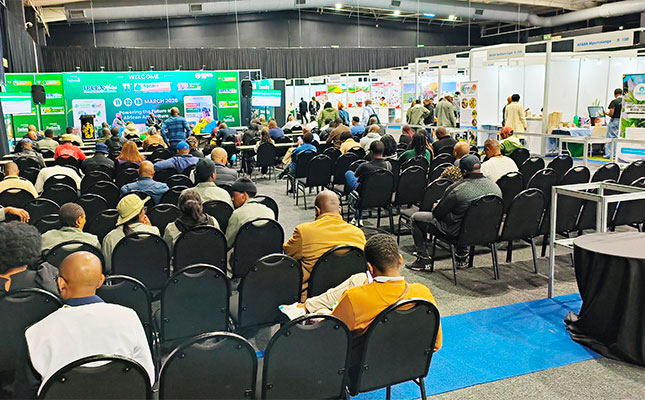

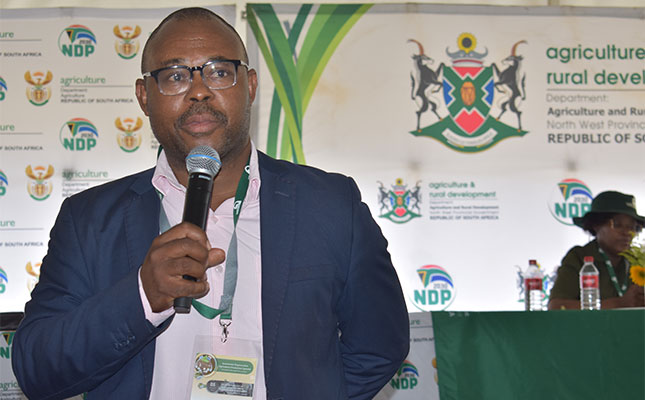
Addressing about 100 guests, Ramakgwale Mampholo, North West regional manager at the national Department of Agriculture (the department), said South Africans pride themselves on being self-reliant.
“Farmers have a responsibility to increase production year after year so our nation can grow. Members of the department joined us today to network with you. Our goal is to listen — you are our eyes and ears — and guide us in developing policies that benefit everyone.”
Healthy soil, healthy people
Mampholo urged his colleagues to ensure that state facilities, such as provincial labs responsible for soil testing, are functioning efficiently.
“As a department, we need to make sure farmers have the resources to test their soil. When farmers and government work together on regular testing, we can allocate resources more effectively.
“If subsistence farmers receive fertiliser without proper soil testing, we risk wasting taxpayers’ money. Fertilisers must be distributed according to each farm’s soil profile.
“Mastering soil health is an investment in our own well-being. Apply fertilisers and minerals correctly, and the grass and livestock will flourish, ultimately producing more healthy food for everyone.”
Invest in resources
Mampholo said he wants the department to go the extra mile.
“Functioning state labs are not enough. We need to invest in mobile labs to reach farmers so they can test soil regularly, saving millions of rands.”
He added that North West is especially vulnerable, as heatwaves and floods damage soil health, which means farmers need the right tools to overcome these challenges.
“We need to minimise soil moisture loss; our soil must always be covered so we don’t lose our investment. If farmers fail to manage their soil efficiently and production drops, the country will eventually suffer.”
Managing moisture
Farmland in sub-Saharan Africa is associated with low fertility. Kenny Nthangeni, a soil scientist at the North West Department of Agriculture and Rural Development, said 75% to 80% of farmlands in Africa are nutrient deficient. He gave a compelling presentation on managing soil health.
“Erratic rainfall causes environmental degradation and leads to soil erosion. Our country’s soil has low organic matter, ranging from 0,3% to 0,5%, compared with the global average of 1% to 2%. Moisture evaporation is a major factor, which is why crop cover is so important, as it helps retain moisture and minimise erosion,” he explained.
He added that soil testing aims to determine the soil profile so it can be corrected if necessary. “It reveals nutrient deficiencies, imbalances, toxicity levels, and pH. Your soil’s pH can range from very acidic, at 4,5, to very alkaline, at 7,5. The optimal range is 5,5 to 6,5, where most crops flourish and micro-organisms thrive.”
“Soil testing determines the nutrient content [nitrogen, phosphorous, potassium], pH, and overall soil fertility. The lab results provide recommendations to guide fertiliser use, crop management, and soil health improvements.
“At the lab, collected soil samples are analysed after being dried and screened,” he added. “Your job is to collect the samples correctly.”
According to Nthangeni, farmers should begin by mapping their land with GPS and creating zones, making sure to gather soil samples from each area.
“Collect small cores, about 15 cm deep, in a zigzag pattern across your fields using a clean plastic bucket and spade or auger. Mix the samples thoroughly, remove debris, and fill a clean, labelled
“Hand in your samples to an accredited institution, and make sure to test your soil regularly so you can track progress on soil health and apply fertilisers as needed,” he added.
Soil analysis is an important part of farming, as it identifies the inputs needed for efficient, cost-effective production.
“A proper soil test enables you to add just enough of the fertilisers and minerals your crops need, while at the same time taking advantage of the nutrients already present in the soil,” Nthangeni explained.
Using what nature provides
Also speaking at the event, Dr Theunis Morgenthal, a production scientist at the Natural Resource Inventories and Assessment Unit, said that in the process of planting commercial crops, organic material is broken down and nutrients are lost.
“That is why farmers must move away from tilling and embrace regenerative and conservative agricultural practices. In the process, both you and nature benefit,” he added.
He believes producers should adopt a more holistic approach, paying closer attention to water cycles, soil health, and crop rotation.
“By doing this, we can reduce the impact of soil erosion. Using nature’s resources efficiently means we waste less and contribute more,” he explained.
According to Morgenthal, farmers don’t farm livestock; they farm grass, and managing soil is central to producing nutritious grass.
“Regularly monitoring and evaluating soil health helps you build stronger crops and improve production,” he explains.
He recommended strategies such as planting sufficient cover crops, diversifying crops to make rotation part of the plan, and using organic fertilisers whenever possible.
“Look for natural remedies and use grazing management to facilitate better grass growth. The veld needs time to rest, so avoiding overgrazing and selective grazing is essential for promoting healthy root regrowth,” he added.
“At first glance, soil may seem dead, but it is a living organism with an intricate microbiological system that depends on organic material. If the soil doesn’t have enough organic material, it can’t bind properly, and crops will fail.”
In conclusion, he urged farmers to strive for improved soil fertility.
“It isn’t always easy, but if we work towards a goal, each step gets easier with time. We don’t have to do it all at once, but taking the first step and educating ourselves is essential. With time, we can restore our land and use resources more efficiently.”
For more information email Dr Theunis Morgenthal at [email protected].