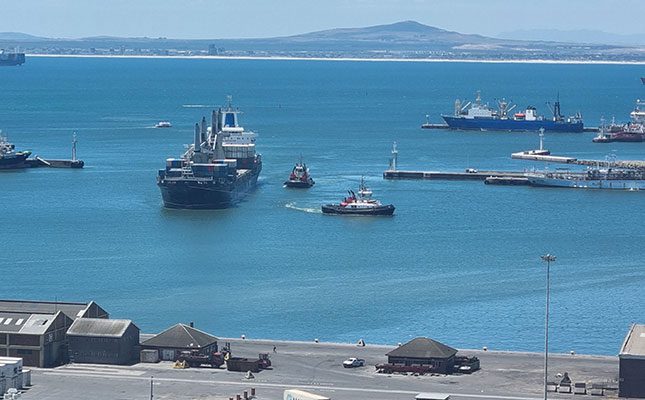
Hortgro said in a statement issued on 30 January that losses to the deciduous fruit export value chain in the 2025/26 season have already exceeded R350 million due to problems at the Port of Cape Town, “with further exposure continuing to accumulate daily as delayed vessels arrive at destination ports”.
Subsequently, the organisation shared shipping data with Farmer’s Weekly, indicating that the Port Elizabeth and Ngqura harbours shipped 785% more deciduous fruit between Week 40 (in early October 2025) and Week 4 (early January 2026) of the current season than during the same period last season. By comparison, Cape Town shipped 11% less.
Over the same period, the industry shipped 18% more fruit by air than last year, which contributed to “astronomical additional costs”, Pieter-Steyn de Wet, Hortgro agricultural economist and information manager, said in an email.
Overall, the industry exported 20 759 cartons of fruit between Week 40 and Week 4 this season, which is 8% more than the same period last year.
De Wet pointed out that this year’s export season started a week earlier than last year, meaning the current year-to-date volumes may include an extra week of shipments, inflating the data.
Nonetheless, the difference is stark: Durban shipped 1 174 cartons, up 520 from last year’s 654; Port Elizabeth and Ngqura shipped almost 4 000 cartons more; and Cape Town shipped almost 3 000 cartons fewer.
By 30 January, 1 200 40-foot containers of deciduous fruit had also been shipped via Walvis Bay.
Persistent sub-par performance
Over the past few years, the agricultural export industry has refrained from publicly criticising Transnet, choosing instead to work collaboratively to address costly shipping delays caused by machinery breakdowns, ageing infrastructure, and labour issues.
However, Hortgro’s latest statement marks a striking departure from the industry’s earlier restraint in publicly addressing Transnet’s performance.
“While the industry recognises the commitment and effort of operational teams working under extremely difficult circumstances, the persistence and scale of performance failures at the CTCT [Cape Town Container Terminal] point to deep-seated structural weaknesses that extend beyond isolated incidents or external disruptions, such as adverse weather,” Hortgro said in its statement.
“Over many years, the fruit industry has engaged constructively and in good faith with Transnet and port management, including a deliberate and disciplined commitment not to pursue media engagement while solutions were addressed internally.
“Despite these efforts, productivity has not recovered to globally competitive or operationally reliable levels, despite substantial new equipment investment following more than a decade of capital underspend and readiness assurances provided ahead of the season.
“Global productivity standards range from 25 to 30 GCH [gross crane movements per hour], while the CTCT remains below 20.
“The commercial consequences of this sustained underperformance are now severe, and options to recoup lost income and cover additional costs are being explored.”
Disastrous bottlenecks
Hortgro explained that, by the second week of the 2025/26 export season, exports were down by 9% compared with last year, while inspection volumes increased by 37%.
This resulted in “an abnormal build-up of approximately 1 688 containers in cold storage”, which “equates to an estimated R1 billion in fruit inventory currently at risk, excluding additional volumes already plugged in at back-of-port facilities”.
By 30 January, additional transport costs to ship containers to alternative harbours had already exceeded R133 million.
Additional costs from truck standing time penalties, cold storage, agent fees, and rising quality claims have not yet been calculated.
“These compounding losses are eroding exporters’ margins, destabilising rural economies, and placing South Africa’s hard-won reputation as a reliable supplier of high-quality fruit under increasing strain,” Hortgro said.
Failures abound
Hortgro said the South African deciduous fruit industry has “escalated its operational engagement with Transnet and is considering formal legal remedies due to ongoing operational failures at the Port of Cape Town”.
It ascribed the problems at the CTCT to five interconnected structural failures, rather than temporary operational shocks:
- Shortcomings in human resources and labour management
- Gaps in health and safety governance
- Equipment and systemic infrastructure issues
- Weaknesses in operational processes, execution, and control
- Failures in communication and accountability
It added that it had documented and shared these failures with Transnet as part of efforts to push for a solution, noting that there had been some positive outcomes. However, the improvements were too late to be of use to stone fruit exporters.
“Hortgro is firmly of the view that the challenges at the CTCT can no longer be addressed by incremental fixes or reactive crisis management. What is required is a coordinated, transparent, and expert-led transformation programme, supported by measurable commitments, strong executive ownership, strict accountability, and private-sector operational involvement,” it said.
*This article was updated with additional information from Hortgro – 5/02/2026.