
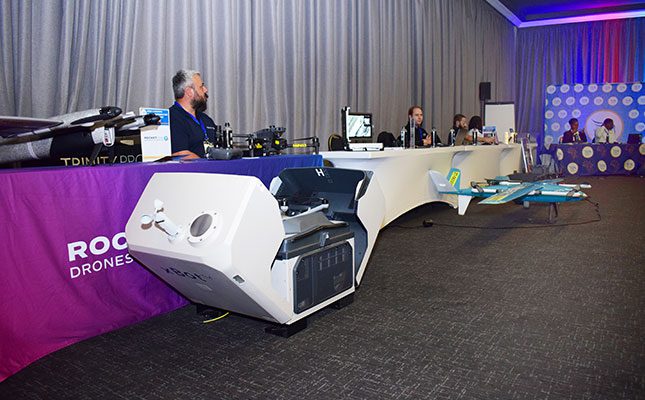
“South Africa’s most meaningful innovation isn’t happening where most people expect it – in glass-towered cities or buzzing start-up hubs. It’s unfolding far from the city skyline, where the horizon stretches wide and the soil carries our future – on farms,” said Brandon Alberts, managing director of ALTUS Aviation, a company specialising in advanced learning and training for unmanned and traditional aviation.
Alberts set the scene at the 2025 Second Edition of the Drone & Unmanned Aviation Conference, Africa’s flagship event dedicated to commercial drone technology, held on 27 and 28 November in Johannesburg.

The conference brought together stakeholders from industry, academia, government and international organisations to exchange research, share best practices and discuss lessons learned across the rapidly evolving unmanned aircraft systems sector.
Over two days, delegates engaged in panel discussions, technology, entertainment and design-style talks, fireside chats and technical sessions covering every major topic in this dynamic field.
The case for drones in agriculture
Despite rapid advancements, many farmers still underestimate what drones can do, Alberts told Farmer’s Weekly.
“Drones don’t merely spray crops. They can scan fields and, by analysing how light reflects off leaves, identify water stress, nitrogen deficiency or early signs of disease. This is the side of drone technology farmers should be far more involved in.”
However, he warned that precision services are not always provided by drone sprayers.
“Some operators prefer blanket spraying because they can charge for whole-field applications, even when only a few hectares need attention. This defeats one of the major benefits of drone spraying.”
Drones are not here to replace farmers, Alberts emphasised. Instead, they give producers sharper tools to complement their experience. Today’s farmers are growers, risk managers, meteorologists and economists all at once and drones provide the real-time insight needed to make sound decisions.
According to Alberts, drones allow farmers to view land the way engineers view a structure or doctors read an X-ray with precision:
- Drones map soil variation across fields, highlighting strong and weak zones;
- They monitor irrigation performance, pinpointing areas losing water to run-off;
- They assess crop emergence early, identifying poor germination or replanting needs;
- They provide rapid storm-damage assessments, saving hours of scouting;
- They record historical data to guide long-term decisions based on evidence, not guesswork.
‘Innovation doesn’t have to overpower nature – it can support it’
As artificial intelligence advances, drones will shift from observing the present to forecasting the future – predicting yield variations, irrigation needs and long-term soil patterns. “The goal isn’t to push nature harder,” Alberts said. “It’s to work with it more wisely, helping build a farming sector that is sustainable, regenerative and secure. That’s not just agri-tech, but agri-purpose.”
Navigating the regulatory landscape
Regulations were a major focus at the conference, with an in-depth panel featuring Sonet Kock (AviComply), Sandile Chipunza (IATA) and Shaun Ledlie (Drone Council of SA). Many questions from the floor reflected widespread concern about compliance and the industry’s voice in policymaking.
Ledlie urged operators to participate actively in the regulatory process. “The Air Services Licensing Act of 1990 is outdated; drones didn’t exist then. We need the industry to engage in public participation rather than complain after regulations are finalised.”
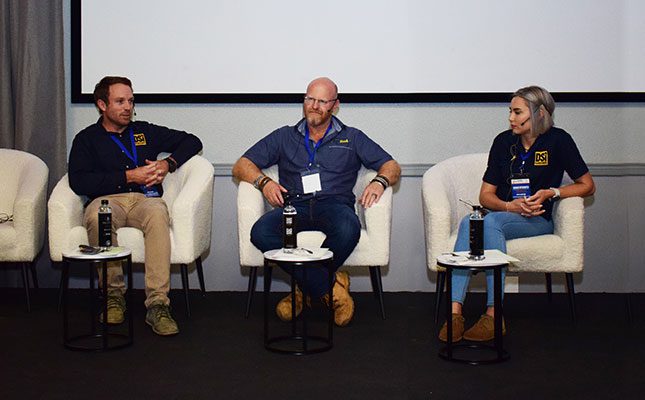
Kock agreed, warning of the risks posed by non-compliant operators. “All it takes is one serious accident for government to intervene and tighten regulations without consulting the industry. The regulations that will shape every operator’s business are being written now. Be proactive, not reactive.”
Agriculture: where drone growth is fast
The agricultural sessions drew particular interest. In 2020, South Africa saw the introduction of the first drone capable of carrying a 30ℓ tank – an important milestone, as most local chemicals are registered for aerial application of 30ℓ/ha. Today, 40ℓ, 50ℓ and even 100ℓ drones are operating locally.
Kas van der Merwe, COO of Agrihawk, shared remarkable growth figures. “About 1,6 million hectares have already been sprayed by drones this season. By year-end, it will likely reach two million hectares. In 2021, there were only 60 activated spray drones in the country. Today there are around 2 000.”
Monique Heydenrych, agricultural specialist and head of sales at Drone Solutions International (DSi), highlighted the power of crop-health analytics. The latest systems use Normalised Difference Red Edge Index (NDRE) and thermal sensing, complementary technologies that measure chlorophyll content and water stress, zone by zone, across a field.
Justin Hawley, co-founder and director of DSi, emphasised the broad applicability of these tools.
“Drone technology benefits crops from citrus and nuts to avocados, grapes and more. It’s not just about fancy sensors. It’s about contour mapping, irrigation planning, surveying, dam-site selection, drainage design and even farm security.”
Challenges when adopting drone spraying
The agricultural panel also outlined challenges for farmers considering drone spraying:
- Deciding whether to buy or hire
Farmers must choose between investing in their own system or contracting a service provider. - Adjusting to a new operational rhythm
Drone spraying is fast-paced and hands-on, involving constant battery changes, tank refills and flight management, very different from running a conventional ground sprayer. - Finding the right operator
A skilled pilot must understand flying conditions, wind, flight altitude and application techniques. The learning curve is long. - Keeping up with rapid tech upgrades
“Drones are like cell phones,” Hawley said. “Technology changes constantly. The jump from a 30ℓ to a 100ℓ tank, at the same price point, delivers a 260% efficiency increase. This makes smaller drones obsolete, forcing farmers to upgrade sooner than expected.” - Handling complex data
Modern drone systems generate large, technical datasets. For many farmers, processing and interpreting this information remains a significant barrier.
Docking stations ‘drone-in-a-box’ technology are set to transform operations further. They allow drones to operate autonomously from remote locations, handling security surveillance at night and crop monitoring or spraying during the day.
Broader applications: from beneficial insects to boreholes
Aerial mapping enables highly targeted chemical applications, reducing waste and lowering costs.
The panel also discussed using drones for releasing beneficial insects. While some species can be dropped effectively, Heydenrych cautioned against releasing insects that still need to hatch.
“They fall straight through the foliage onto the soil, essentially feeding ants,” she said.
Hawley highlighted emerging innovations such as using drones to identify promising drilling sites for water.
“We conduct magnetic surveys with geo-hydrologists to assess the geology. Tests have shown this method to be very effective.”
Livestock counting via drone has already been trialled in South Africa and is proving highly accurate, especially in feedlots, where it is faster and more precise than manual counts.
The future in the sky
“Drones will change the crop-spraying industry forever. We foresee a time when every farmer in South Africa will use a drone,” Van der Merwe said. Spraying by drone is cheaper, safer and more sustainable than many traditional methods.
Drones also eliminate soil compaction and reduce crop damage, especially in sensitive crops such as potatoes, where wheels in the rows can cause substantial losses. They minimise the risk of spreading disease as fewer vehicles move through fields.
“Eventually,” Hawley concluded, “the only machinery driving through a field will be a tractor at planting and a harvester at the end of the season.”