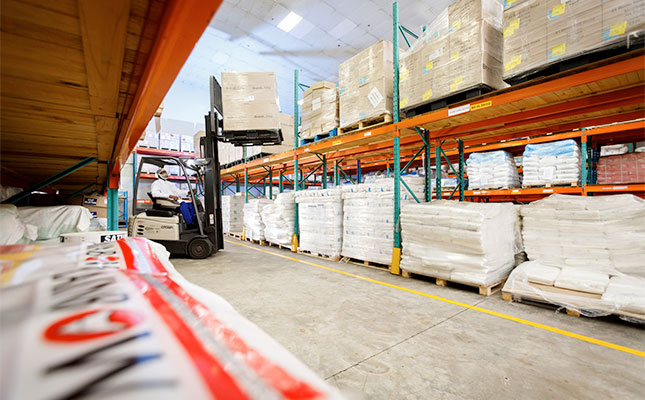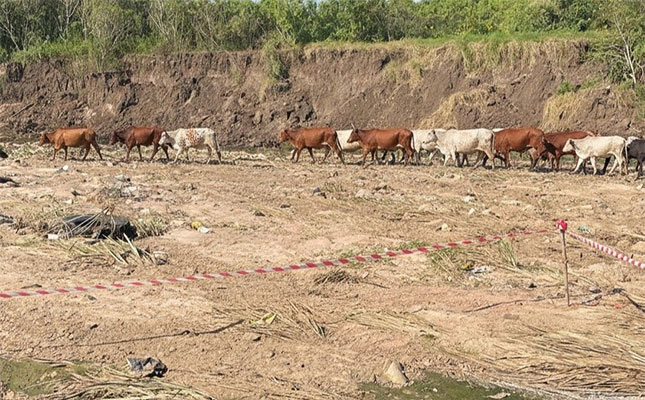
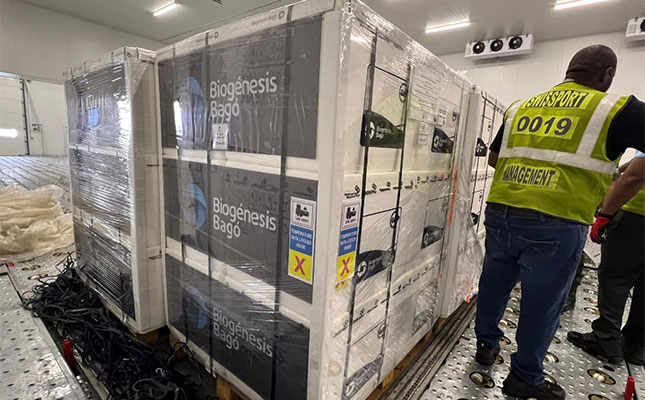
The shipment, imported from Argentine manufacturer Biogénesis Bagó, is the largest single consignment of animal vaccine ever received in South Africa and forms part of what government has described as a sustained international supply pipeline.
For a livestock industry battered by months of movement restrictions, disrupted markets, and mounting financial losses, the arrival of the vaccines signals a shift from containment to coordinated recovery, with government now openly linking vaccination at scale to the reopening of global red meat markets.
‘A pathway to becoming FMD-free’
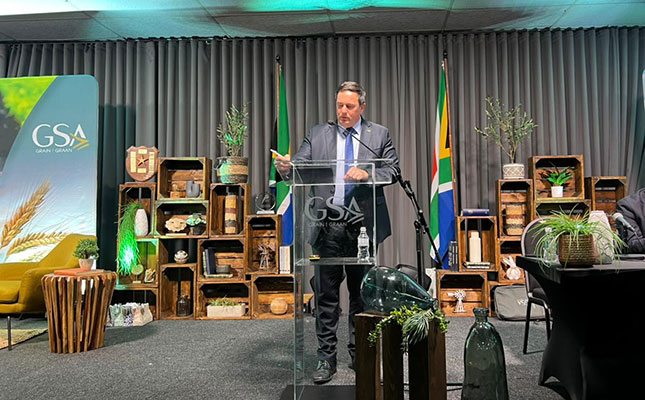
Minister of Agriculture John Steenhuisen, who oversaw the arrival of the consignment, said the objective goes far beyond ending the current FMD outbreak.
“We are going to vaccinate at scale in South Africa to not only break the back of the current FMD outbreak but to put South Africa onto the pathway of becoming an FMD-free country again,” he told the media present at the airport.
He stressed that South Africa’s red meat exports have been severely constrained for nearly 15 years because of its FMD status.
“For almost a decade and a half, many of our important markets have been closed to South Africa’s products,” he said, adding that reopening them would be “a catalytic step forward for the red meat industry in South Africa” in terms of “profitability, sustainability, and growth”.
Drawing a comparison with horticulture, Steenhuisen noted the transformative impact of fruit exports: “We’ve seen the knock-on effect that the export of fruit to other countries has had on the fruit industry,” adding that he believes red meat could follow a similar trajectory if the country’s disease-free status is restored.
“If we work together – the private sector, farmers on the ground, state vets, and private vets – in a whole-of-society approach and we stick doggedly to rolling out this plan, I believe fundamentally this will, firstly, be the last major outbreak of FMD that we have in the country.”
‘A real operational achievement’
Industry leaders have welcomed the milestone while acknowledging that major challenges remain.
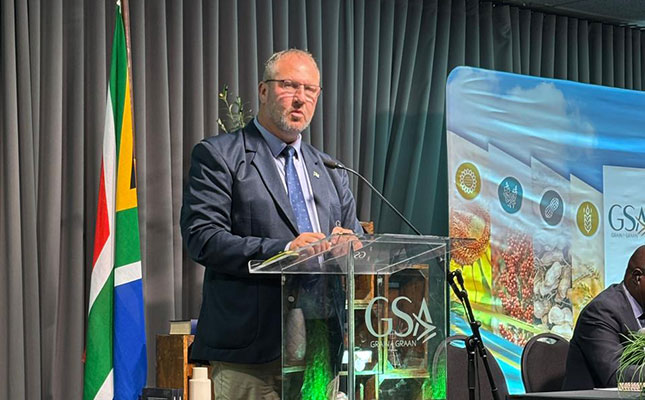
Dr Tobias Doyer, CEO of Grain SA, described the development as a moment worth pausing for.
“Today is a good day for South African agriculture. For the first time in nearly three decades, one million doses of foot-and-mouth-disease vaccine are on South African soil. That is not a small milestone. It is a real operational achievement,” he wrote on social media.
Doyer, who keeps a small herd of Nguni cattle, said importing vaccines is far from straightforward: “Correct strains, approvals, cold chains, borders… none of this is easy. The team that delivered this deserves recognition.”
After travelling through the Free State, North West, and the Northern Cape, he added that farmers are realistic about the road ahead.
“Yes, there is frustration and real pain, but also realism and commitment to solutions,” he wrote.
Risk-based rollout across provinces
Although outbreaks have been reported across all provinces, the Department of Agriculture (DoA) has adopted a hotspot-based distribution strategy.
From the first one million doses:
- KwaZulu-Natal will receive 200 000 doses
- Free State will receive 200 000
- Eastern Cape will receive 150 000
- Mpumalanga, North West, and Limpopo will each receive 100 000
- Gauteng will receive 70 000 doses
- Northern Cape will receive 50 000 doses
- Western Cape will receive 30 000 doses
Steenhuisen said vaccination had already begun in affected areas but that limited supply had slowed progress.
“With this arrival, we can now accelerate protection across priority provinces and stabilise the livestock industry,” he said.
The broader strategy aims to vaccinate the entire national herd, with a short-term target of reaching 80% coverage by December.
“For the first time in 30 years, we now have a plan to make South Africa into an FMD-free country, and we now have the tools to make that achievable,” he said.
“Help is on the way; it’s coming in the form of vaccines.”
The DoA’s longer-term goal is to reduce outbreaks by at least 70% and progressively restore internationally recognised disease-free status.
More doses in the pipeline
The current shipment is only the first in a larger supply programme. Further consignments are expected from Biogénesis Bagó, as well as the Botswana Vaccine Institute and Dollvet in Türkiye.
The Agricultural Research Council has also committed to producing 20 000 doses per week locally, with plans to scale up to 200 000 doses per week by 2027.
As FMD is a state-controlled disease, farmers will not be required to pay for vaccines distributed by government.
Vaccination ‘not a silver bullet’
Despite the positive momentum, Steenhuisen cautioned that vaccination alone will not solve the crisis.
“There is no silver bullet. Good biosecurity on farms, strict adherence to movement controls, and [compliance with] the laws and regulations relating to the movement of animals are what will have to change in South Africa,” he said.
He warned that non-compliance with animal movement regulations had contributed to the spread of disease in the past and would no longer be tolerated.
“Biosecurity has to become everybody’s responsibility,” he said.
He reiterated that vaccination does not grant automatic permission to move livestock. Movement permits, quarantine measures, and surveillance will remain in place, and “the full might of the law” will be applied where there is deliberate non-compliance.
Regulatory amendments are also being prepared to align with the new vaccination policy, and some previous measures — such as branding cattle with an ‘F’ — may become redundant if the entire national herd is vaccinated.
Private veterinarians are being registered to assist with the rollout, alongside 100 animal health technicians and veterinary students completing their community service.
Focus on dairy and recovery at farm level
The dairy industry, one of the worst affected by the outbreak, is receiving particular attention. Steenhuisen confirmed that he will visit Mooi River in KwaZulu-Natal on 27 February to vaccinate dairy cattle alongside veterinarians and farmers.
“The dairy industry has been among the hardest hit, with significant production losses, disrupted markets, and immense strain on farming families,” he said.
“Each vaccinated herd means stability returning to a business, wages returning to workers, and milk returning to shelves.”
He described the moment as a transition point: “We are moving step by step from crisis management to control. Vaccines are arriving, the system is scaling up, and compliance will be enforced.”
A cautious turning point
To support farmers, the DoA has established a dedicated FMD Control Centre and a toll-free helpline (0860 246 640), offering guidance on symptoms, movement permits, vaccine availability, and biosecurity.
After months of uncertainty and mounting frustration, the physical arrival of vaccine doses in South Africa signals that the country’s response has shifted decisively from planning to execution and from reactive containment to an ambitious bid to reclaim disease-free status and global market access.
As Doyer noted, the crisis is not over. However, for the first time in years, the industry can point to tangible progress and a clearly articulated strategy aimed at restoring confidence and competitiveness in the red meat industry.