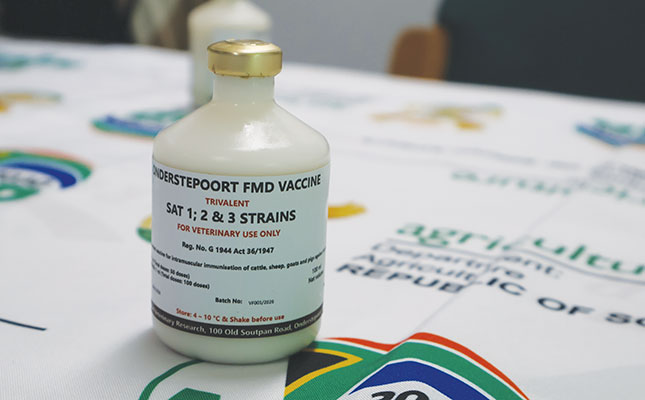
In an interview with Farmer’s Weekly, Dr Danie Odendaal, a ruminant veterinarian consultant and director of the Veterinary Network, described the release as ‘a national disgrace’, arguing that the vaccine is neither new nor a breakthrough.
According to him, the vaccine was researched from around 2010, fully registered in 2022, and publicly hailed as a success in 2023, yet it was never produced at scale while outbreaks worsened.
“This vaccine was developed with significant taxpayer funding and input from experts, including international specialists. The fact is that they had this registered formulation and never contracted it out to be manufactured while the disease was still at an early stage and could have been stopped with ample effective vaccines.” Odendaal said.
While government reported that more than two million animals had been vaccinated by the end of January 2026, the industry says vaccine shortages remain a major challenge to containing foot-and-mouth disease (FMD).
Critics note that effective FMD control requires an estimated 14 million doses every six months, far exceeding the 12 900 doses released last week. Even the Agricultural Research Council’s (ARC) planned scale-up to about 20 000 doses per week is seen as inadequate given the outbreak’s size and speed.
Vaccine delays questioned
In written correspondence, Farmer’s Weekly asked ARC spokesperson Joy Peter why, after the 2022 registration, the vaccine was not produced abroad under contract to ensure large-scale availability while local capacity was rebuilt. As yet, no explanation has been provided.
Several industry organisations argue that contract manufacturing is standard international practice and could have prevented the severe shortages that left farmers “watching animals suffer and die”, as one producer organisation put it.
They contend that reliance on slow institutional recovery rather than urgent interim solutions contributed directly to the crisis the livestock industry now faces.
Organisations including the Southern African Agri Initiative, Sakeliga, and Free State Agriculture have warned that continued delays threaten not only farm viability but also jobs, rural economies, and South Africa’s reputation as an exporter, with FMD already hitting red meat and wool exports.
Joylene van Wyk, spokesperson for Minister of Agriculture John Steenhuisen, defended the ARC’s actions, telling Farmer’s Weekly that rebuilding vaccine production requires stabilising governance, infrastructure, and technical expertise after years of neglect, and that diversifying imports from countries such as Botswana and Türkiye is part of a broader national strategy.
Government has also repeatedly said South Africa’s FMD strategy is modelled on South American successes, particularly Brazil and Argentina, with Steenhuisen citing these countries as proof that vaccination-led eradication works.